0G, The Prometheus of AI

Table of Contents
1. 0G’s Pursuit of AI Democratization
2. 0G’s Technical Evolution
3. Expanding the 0G Ecosystem
4. $0G Tokenomics
5. Conclusion: Building 0G into AI’s Prometheus
1. 0G’s Pursuit of AI Democratization
Artificial intelligence has ignited a new flame for human civilization, yet that flame is increasingly concentrated in the hands of a few large corporations. While such centralization can accelerate technological progress, it also raises the risk that a small group monopolizes the technology. At a conference, Elon Musk warned that “AI is far more dangerous than nuclear weapons,” cautioning that, depending on how it is developed and used, AI could become a major risk factor for humanity. Michael Heinrich, co-founder of 0G Labs, likewise noted that “AI is being controlled by a handful of companies, and while we hope they will operate it in line with human values, if they fail, the risk is enormous.”
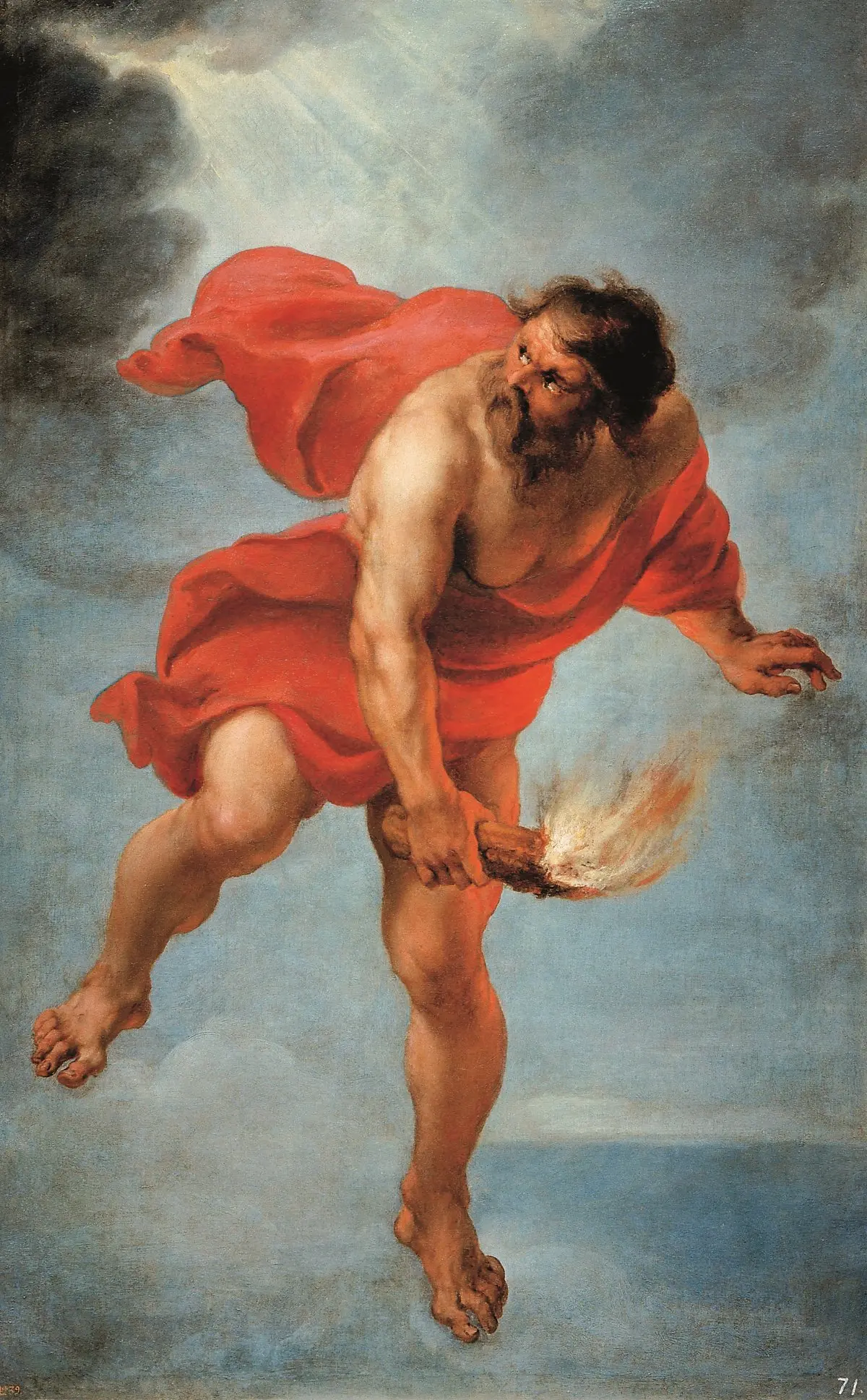
This dynamic recalls the myth of Prometheus: fire was once the gods’ exclusive property until Prometheus stole it and shared it with humankind, enabling civilizational progress. In the 21st century, AI is that flame and a new source of power; it carries true meaning only if it is accessible to all rather than monopolized by a select few. 0G treats the task of reclaiming this flame and making it shareable by everyone as paramount, aiming to become a modern Prometheus that frees AI from corporate control via a decentralized, blockchain-based AI infrastructure.
0G Labs has completed three testnets and now stands on the cusp of its mainnet launch. In February of this year, Xangle examined 0G’s then-current vision and technical architecture in detail in the research note, “0G: Opening the Era of On-Chain AI Agents.” Accordingly, this report delves into the technical changes introduced across those testnets, the tokenomics announced ahead of mainnet, and the now-richer elements of its ecosystem.
2. 0G’s Technical Evolution
2-1. Overview of the 0G Infrastructure Stack
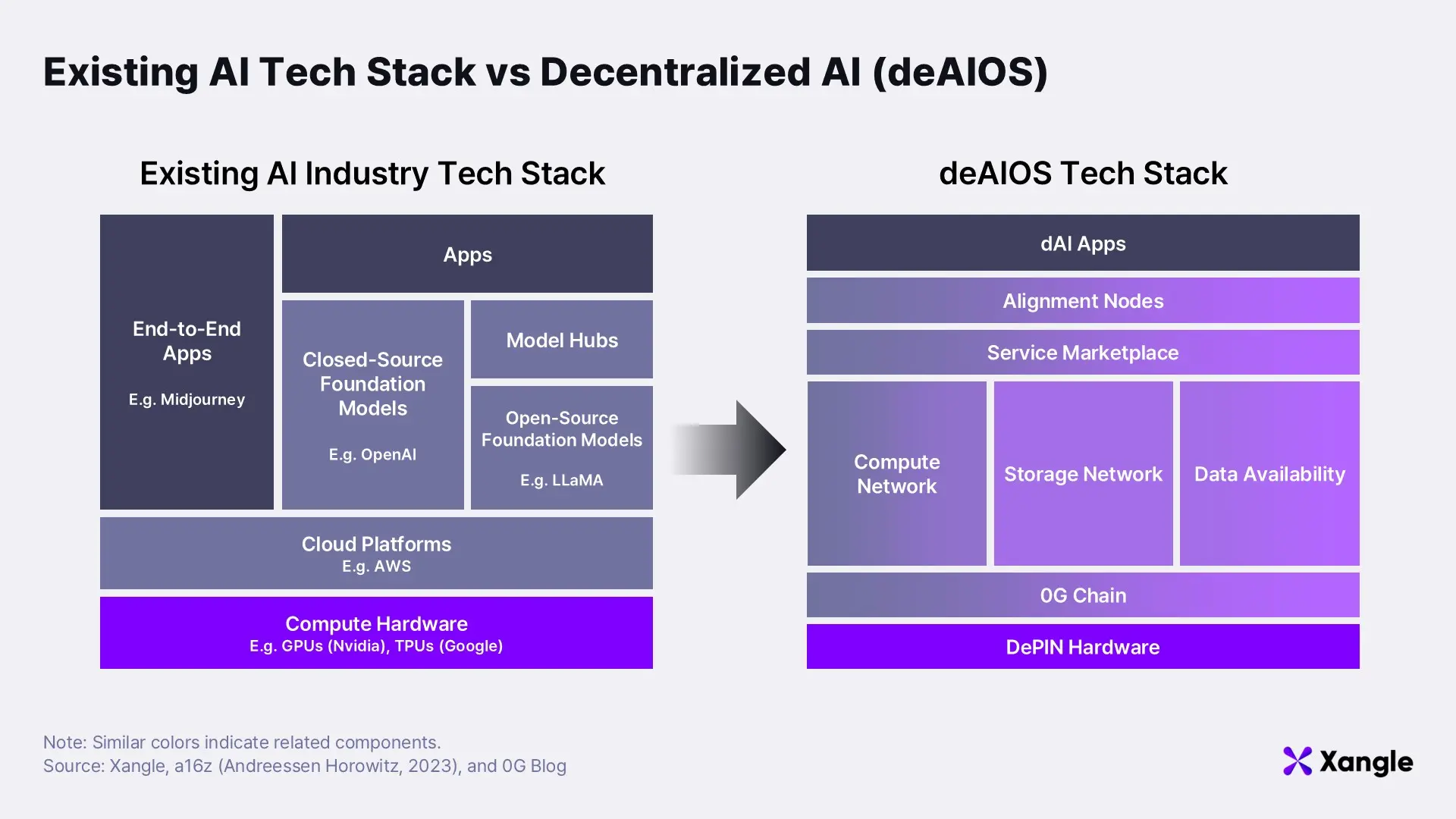
At its core, 0G is building an operating system for AI—a project that both decentralizes artificial intelligence and unifies fragmented AI infrastructures into a single, cohesive ecosystem. Blockchain technology provides the foundation for decentralization, while the vision of a decentralized AI Operating System (deAIOS) serves as the organizing framework to integrate these disparate layers.
deAIOS is composed of six core components:
1) 0G Chain 2) 0G Storage Network 3) 0G Data Availability Layer 4) 0G Compute Network 5) 0G Service Marketplace 6) 0G Alignment Nodes.
On top of these foundational infrastructures, a growing suite of decentralized AI applications (dAI Apps) is being developed and onboarded.
- 1) 0G Chain: An optimized blockchain designed to support high-performance AI and on-chain gaming through a modular scaling structure.
- 2) 0G Compute Network: A distributed computing framework that matches and manages resources needed for AI model computation in a decentralized manner.
- 3) 0G Storage: A decentralized storage network for storing and distributing the large-scale datasets required for AI model training and inference.
- 4) 0G Data Availability (DA) Layer: A DA layer engineered for virtually unlimited scalability.
- 5) 0G Service Marketplace: A comprehensive platform for the registration, hosting, and consumption of AI services, designed to accelerate the decentralized AI economy.
- 6) 0G Alignment Nodes: Community-driven validation nodes that monitor participants such as storage, DA, and compute providers, ensuring the integrity of AI through verification and oversight.
→ For a deeper dive into these infrastructure elements, see Xangle’s earlier research note: “0G: Opening the Era of On-Chain AI Agents.”
These infrastructure layers have been iteratively upgraded and refined across three testnets. With those milestones completed, 0G is now preparing for its mainnet launch. The following sections trace how the project has advanced through each stage and what the upcoming mainnet is set to deliver.
2-2. Newton → Galileo → Aristotle: Tracing 0G’s Testnet Journey
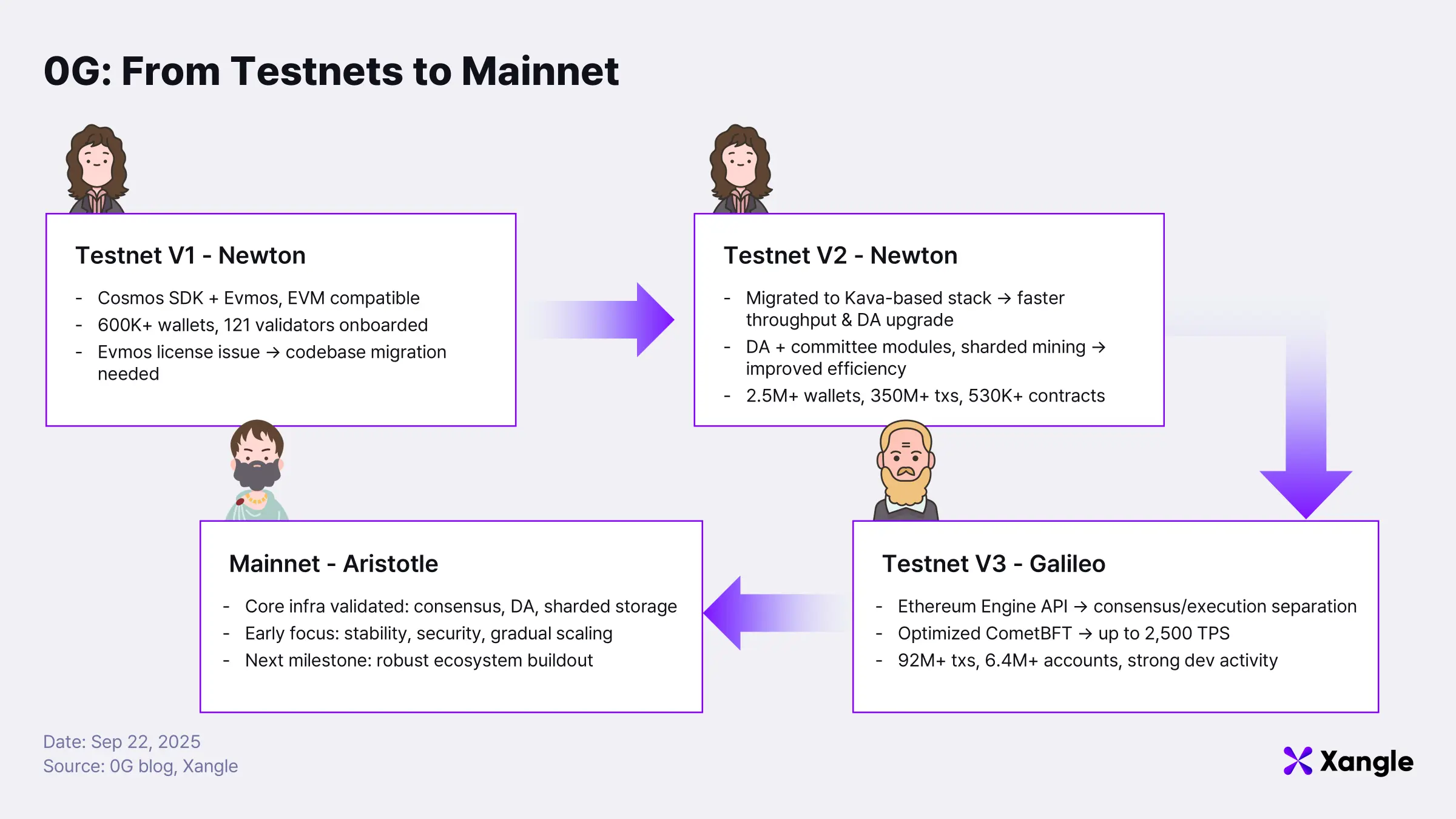
Testnet V1 - Newton
In April 2024, 0G Labs launched its first testnet, V1 – Newton. The 0G Chain was built on the Cosmos SDK and Evmos (formerly Ethermint), enabling a blockchain architecture tailored for AI while retaining the benefits of EVM compatibility. The launch drew significant traction, with over 600,000 wallets registered. More than 2,500 validator applications were submitted, of which 121 validators were ultimately selected. The testnet also generated 117 collaboration requests and 52 inquiries related to investment or long-term partnerships, signaling strong early momentum. However, when Evmos shifted its license to non-commercial use, it became clear that 0G would need to migrate its codebase to ensure long-term productization and upgrades.
Testnet V2 - Newton
By June 2024, V2 was rolled out to resolve the Evmos licensing issue and handle surging network demand. The codebase was migrated from Evmos to a Kava-based framework free of licensing restrictions, improving throughput and strengthening data availability. Two critical modules were introduced: a Data Availability (DA) module and a committee module, ensuring persistent data accessibility while streamlining consensus and verification. This enhanced both reliability and performance.
Storage nodes also adopted sharded mining, requiring each node to store and prove a specific data shard. This design improved resource efficiency. As a result, V2 recorded explosive growth: over 2.5 million wallets, 350 million transactions, and 530,000 smart contracts deployed—reaffirming the demand for an AI-specialized blockchain.
Yet structural limitations of the Cosmos SDK + Evmos stack surfaced. The default CometBFT (formerly Tendermint) mempool failed to prioritize transactions effectively by gas fees, leaving the network vulnerable to DDoS-like spam during congestion. Since consensus and execution were tightly coupled, bottlenecks in either process could cap overall node performance. In addition, ecosystem teams faced recurring friction costs as they struggled to adapt to frequent RPC/API changes.
Testnet V3 - Galileo
April 2025 marked a major architectural leap. The testnet was renamed Galileo, and 0G introduced the Ethereum Engine API, decoupling consensus (CometBFT) from execution (EVM execution client). This separation enhanced flexibility in upgrades while reinforcing EVM compatibility. An optimized CometBFT consensus further boosted performance, supporting up to 2,500 TPS—over 70% faster than previous iterations. The redesign alleviated the structural bottlenecks observed in V2, such as mempool congestion, node performance ceilings, and compatibility burdens.
Performance metrics underscored Galileo’s momentum. Within a month, the network processed 92 million+ transactionsand created 6.4 million+ accounts. Daily transactions ranged between 2–3 million, with peaks at ~4 million per day. Sustained throughput averaged 26.65 TPS, peaking above 50 TPS, while block times held steady at ~1.3 seconds. Block gas usage remained low at around 10%, leaving ample headroom toward the 2,500 TPS ceiling. Developer activity was also strong, with 31,000+ daily faucet requests.
Maine - Aristotle
The Newton and Galileo testnets allowed 0G to design and validate key components required for mainnet operations: consensus/execution separation, DA modules, and sharded storage mining. These features demonstrated resilience and scalability under heavy traffic. Metrics such as wallet creation, transaction throughput, contract deployments, fast block times, and low gas utilization all indicated readiness for production. 0G is therefore preparing to launch its mainnet, Aristotle.
The naming progression—Newton → Galileo → Aristotle—captures 0G’s development arc. Newton, who laid the foundations of modern science, reflects the project’s base architecture. Galileo, a paradigm shifter, symbolizes the structural overhaul at V3. Aristotle, who systematically integrated knowledge across science, philosophy, and politics, represents the mainnet’s ambition to unify multiple infrastructures into a cohesive deAIOS.
That said, a mainnet differs fundamentally from a testnet. Real costs and responsibilities are now involved. Heavy workloads, including AI model computations, must run seamlessly, while gas fees and other operational expenses introduce new constraints. The early mainnet phase will require gradual scaling with a focus on stability, security, and upgrade management. As workloads increase, maintaining consistent performance and predictable user experience will remain an ongoing challenge.
Ultimately, the success of the mainnet depends not only on robust technical infrastructure but also on how effectively a thriving ecosystem is built on top of it. The next section explores 0G’s ecosystem, its dApps and partners by category, that are expected to attract users and drive growth at mainnet launch.
3. Expanding the 0G Ecosystem
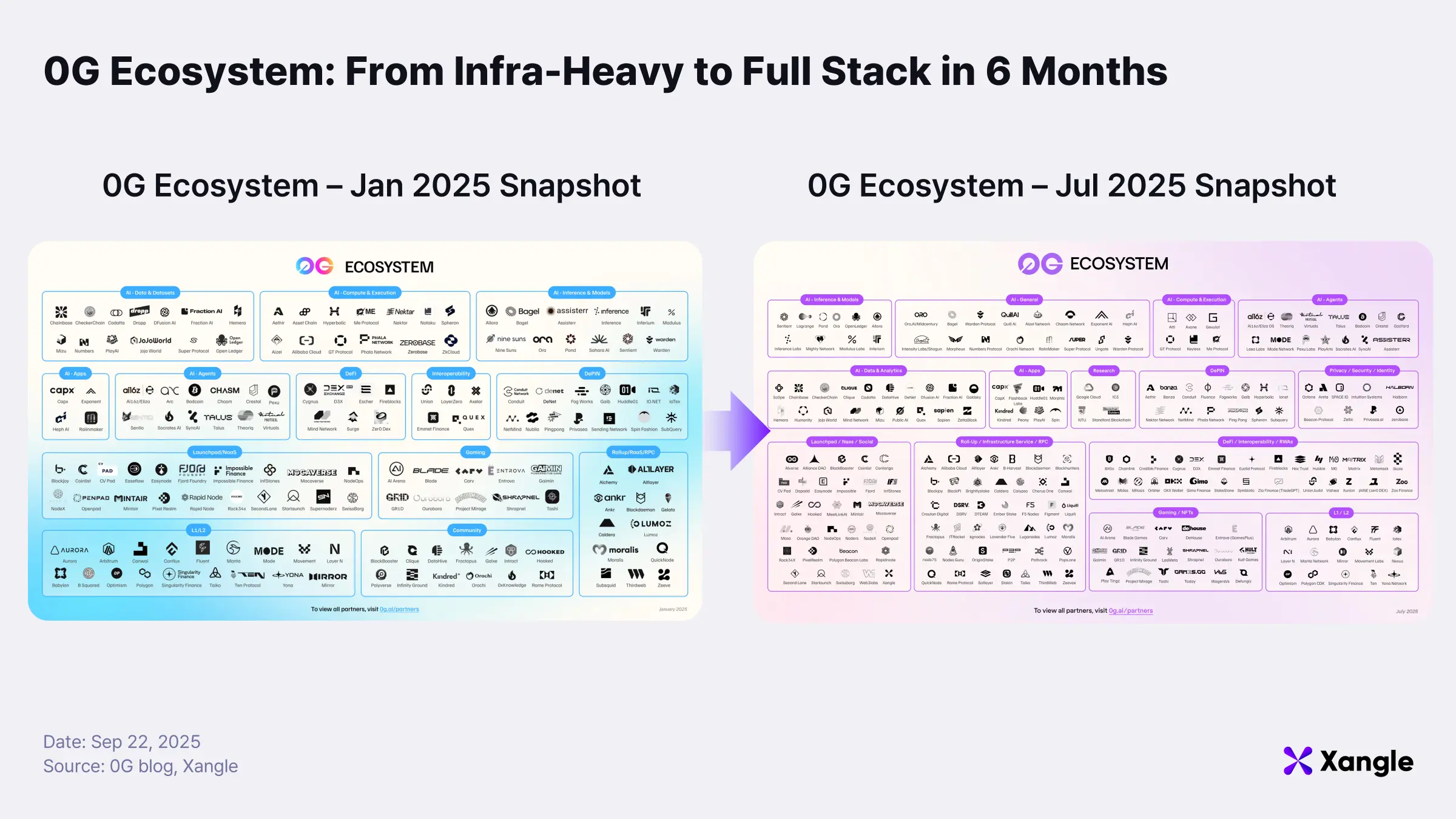
In our previous research, we noted that one of 0G’s practical challenges was the lack of “on-chain elements to enjoy.” The ecosystem was still tilted heavily toward infrastructure and technical stacks, with relatively fewer assets, applications, and DeFi protocols to meet user demand. Seven months later, the landscape looks markedly different: the ecosystem has expanded significantly, with a broader variety of dApps now onboarded. A side-by-side comparison with the earlier ecosystem map makes the change clear. Of particular interest is the influx of end-user dApps; applications that users can actually interact with and derive value from.
Over the past seven months, projects have launched across DeFi, gaming, AI apps/agents, and marketplaces. Their common thread is the modular use of 0G’s infrastructure, such as chain, storage, data availability, and compute, assembled in different combinations to enable either new product features or faster, more cost-efficient services. The sections below highlight representative examples, focusing on actual usage flows.
3-1. DeFi
In DeFi, the standout trend is the integration of AI into trading, liquidity, and staking protocols, aimed at improving user convenience and creating higher-quality yield opportunities.
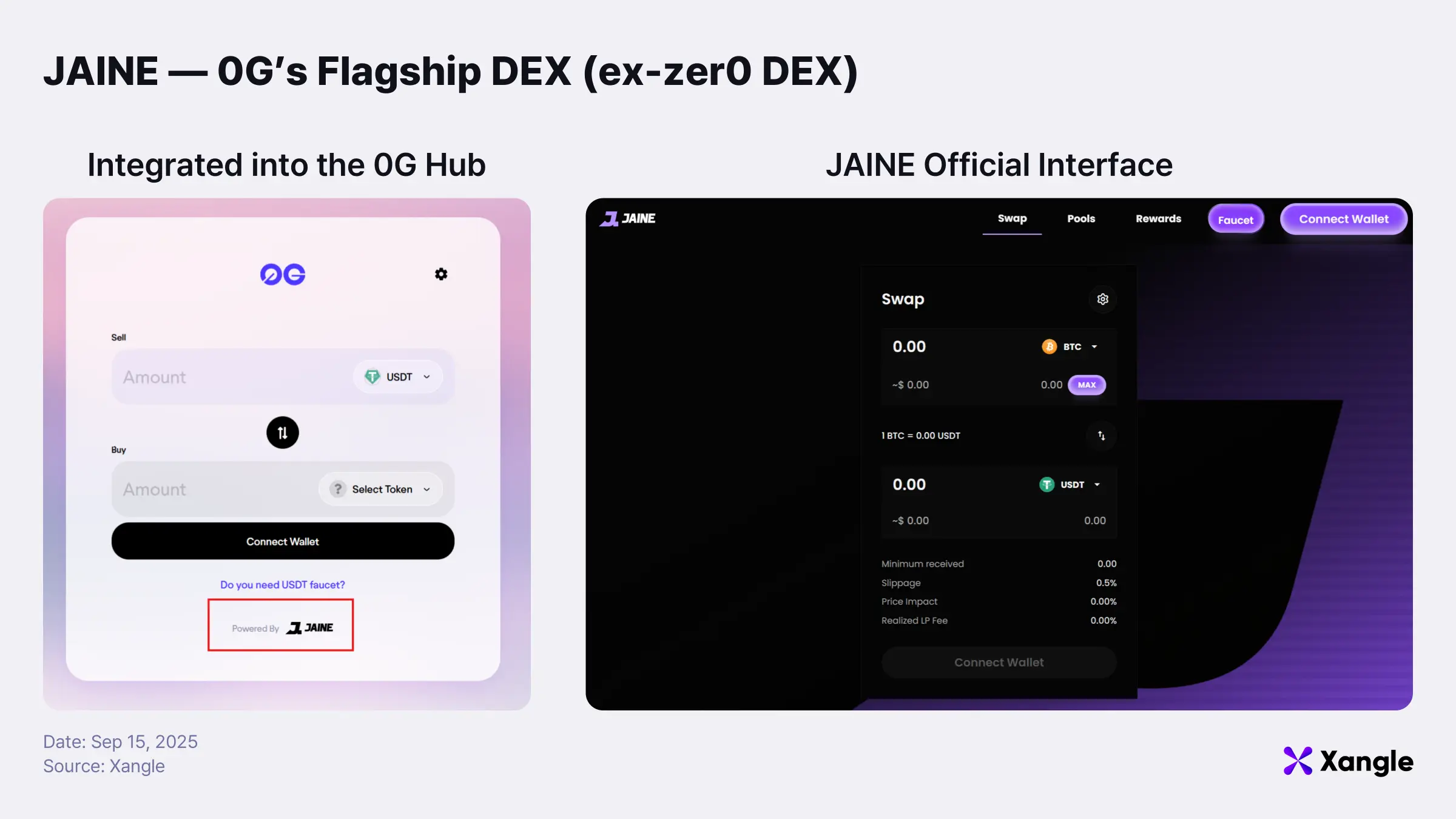
JAINE (formerly zer0 DEX) is an AI-powered DeFi protocol offering AI Automated Liquidity Management (AIALM) and enabling users to interact with DeFi through natural-language AI agents. These agents are hosted directly on the 0G chain, ensuring transparency of strategy execution and operational efficiency. JAINE is live on testnet and has been integrated into the official 0G Hub as the network’s flagship DEX project. While it is scheduled to launch on the first day of mainnet, only a limited feature set, roughly 5%, including basic swaps and liquidity provision, will be available initially, with gradual rollouts planned for additional functionality.
Gimo Finance is the first liquid staking protocol built on 0G. By staking the native token $0G, users receive $st0G, a liquid staking derivative that accrues rewards while remaining composable across other DeFi protocols. Beyond basic staking, Gimo plans to leverage 0G’s AI-optimized infrastructure to deliver automated strategies, rebalancing, and governance automation. Currently invite-only, Gimo is expected to launch publicly with the 0G mainnet.
TradeGPT, developed by Zia Finance, is exactly what the name suggests: a GPT-based trading interface for DEXs. It allows users to execute trades in a conversational, natural-language format—akin to chatting with a broker. Zia Finance also plans to launch its native token, $ZIA. Like JAINE, TradeGPT is slated to go live on day one of the mainnet.
3-2. Gaming & Entertainment
Gaming has long faced major hurdles in moving fully on-chain. Scalability limits, high transaction costs, and the complexity of real-time distributed data management have made it difficult to achieve even Web2-level performance—let alone integrate AI-driven features that demand heavy computation and robust data availability. 0G’s storage, DA, and compute infrastructure are designed to break through these barriers.
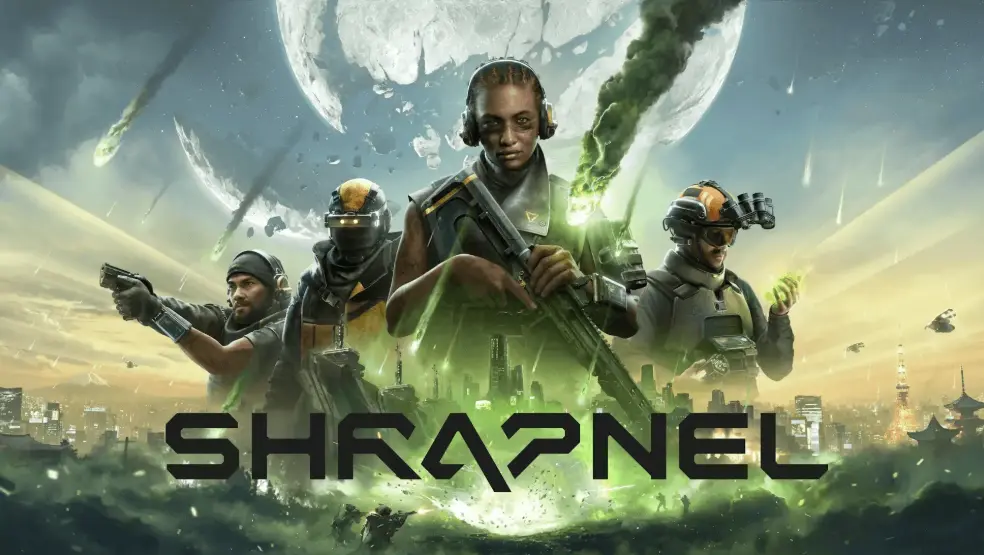
Neon Machine is a Web3 game studio founded by developers from blockbuster franchises such as Call of Duty, Halo, and Star Wars. Its flagship title, the first-person shooter Shrapnel, integrates 0G storage to safeguard the integrity of in-game assets.
Blade Games is a studio committed to fully on-chain gaming. Core logic and key assets are recorded directly on-chain, while match histories, rankings, replays, and ZK proofs are stored on 0G storage. This design creates a structure that is universally verifiable, maximizing fairness and transparency.
CARV positions itself as a modular data layer for gaming and AI. It records player activity and item ownership histories on 0G storage and leverages the 0G DA layer to provide verifiable data when required.
HAiO is an AI-powered Web3 music platform where anyone can launch and monetize their own music channel. Multi-agent systems based on 0G’s iNFT (Intelligent NFT) standard automate composition, curation, and real-time streaming. AI-generated music is stored on 0G storage, while creators benefit from transparent on-chain usage logs and automated revenue distribution via smart contracts.
3-3. AI Apps & Agents
AI projects have long struggled with storing and retrieving large datasets on-chain in a way that is both efficient and interoperable. Even when on-chain databases were used, they often failed to integrate directly with AI systems, creating latency and compatibility issues. 0G addresses these pain points with an all-in-one AI infrastructure: applications and agents can securely store data on-chain via 0G storage and DA, retrieve it instantly when needed, and tap into GPU compute resources at any time through the 0G compute network.
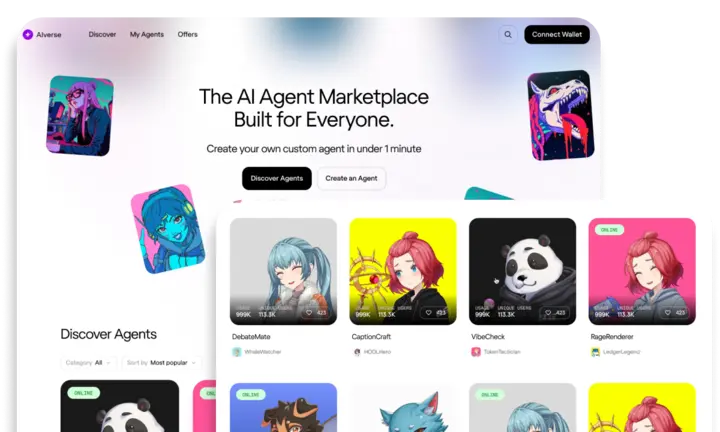
AIverse is a marketplace dedicated to iNFTs, where minting, trading, and collecting can all occur within the platform. It launched on the 0G Galileo testnet on September 4, with early access granted to holders of 0G’s One Gravity NFT collection, and is expected to expand to mainnet services at launch.
- iNFT (Intelligent NFT): A digital asset that tokenizes an AI agent as an NFT, tradable on-chain. It is built on ERC-7857, a custom NFT standard purpose-built for AI agents.
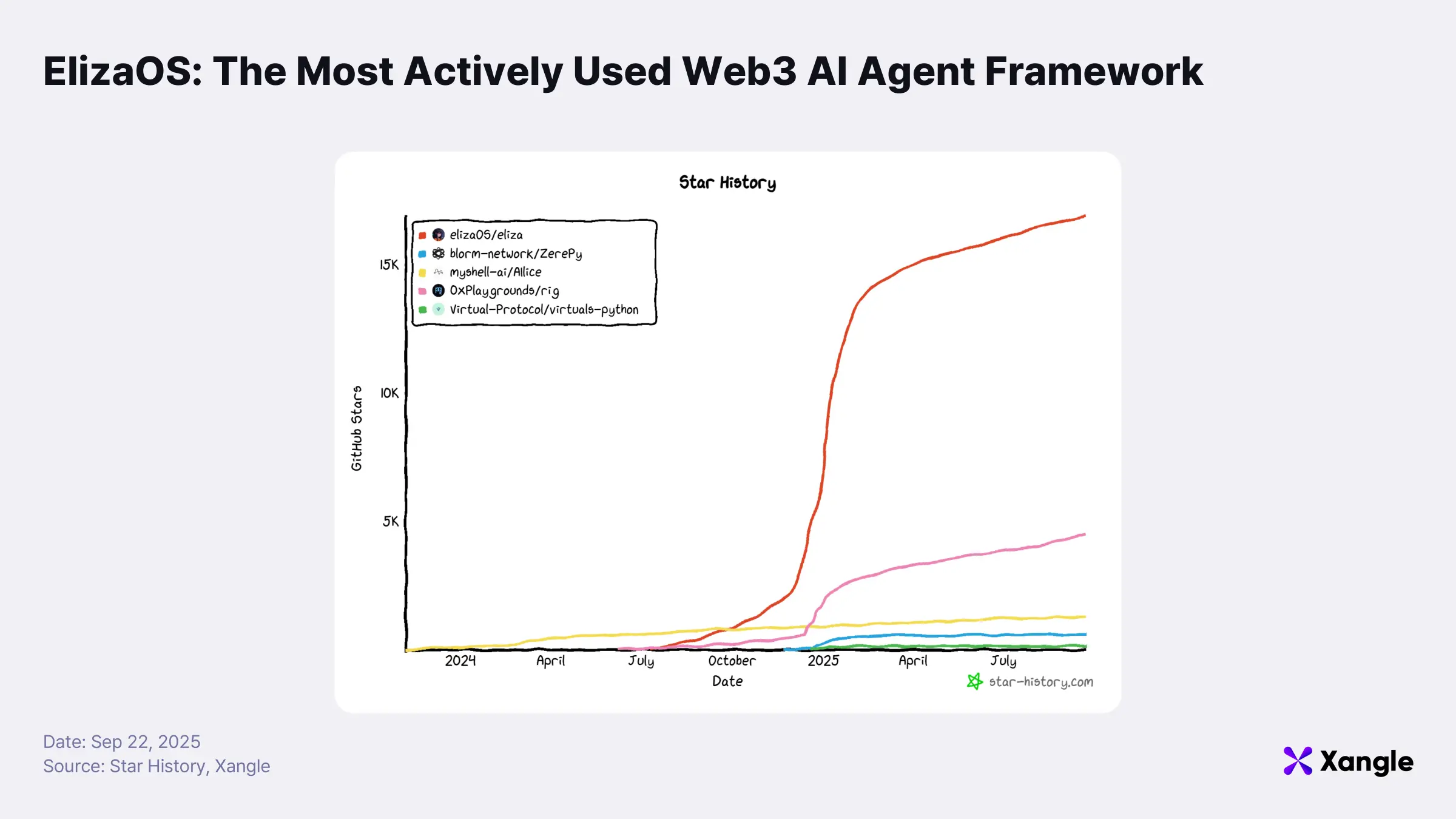
Eliza OS is one of the most closely watched frameworks in the Crypto AI agent space, offering an open-source ecosystem where developers can easily create, run, and manage agents. Its modular plugin architecture allows seamless integration with external infrastructures. Among its most critical features is the 0G storage plugin, which enables agents to record files, logs, and outputs directly on-chain—without the need for dedicated servers or backend systems. Dialogue histories, inference results, and decision logs can all be stored on 0G storage, accessible for retrieval by users or verification by third parties. The DA layer further ensures that verified data remains universally accessible across the network.
Talus is a Move-based Layer 1 designed to enable decentralized, on-chain AI agents via its Talus Agent service. It provides infrastructure that guarantees the identity, workflow, and autonomy of agents, enabling them to own assets, trade, and generate income on-chain rather than functioning as simple chatbots. In collaboration with 0G, Talus stores AI models and state data on 0G storage and leverages the DA layer for public verification when required. This establishes the foundation for a self-sustaining, revenue-generating agent ecosystem. Most recently, Talus launched IDOL.fun, an AI agent launchpad where agents compete and users can place bets on outcomes.
4. $0G Tokenomics
4-1. Token Distribution
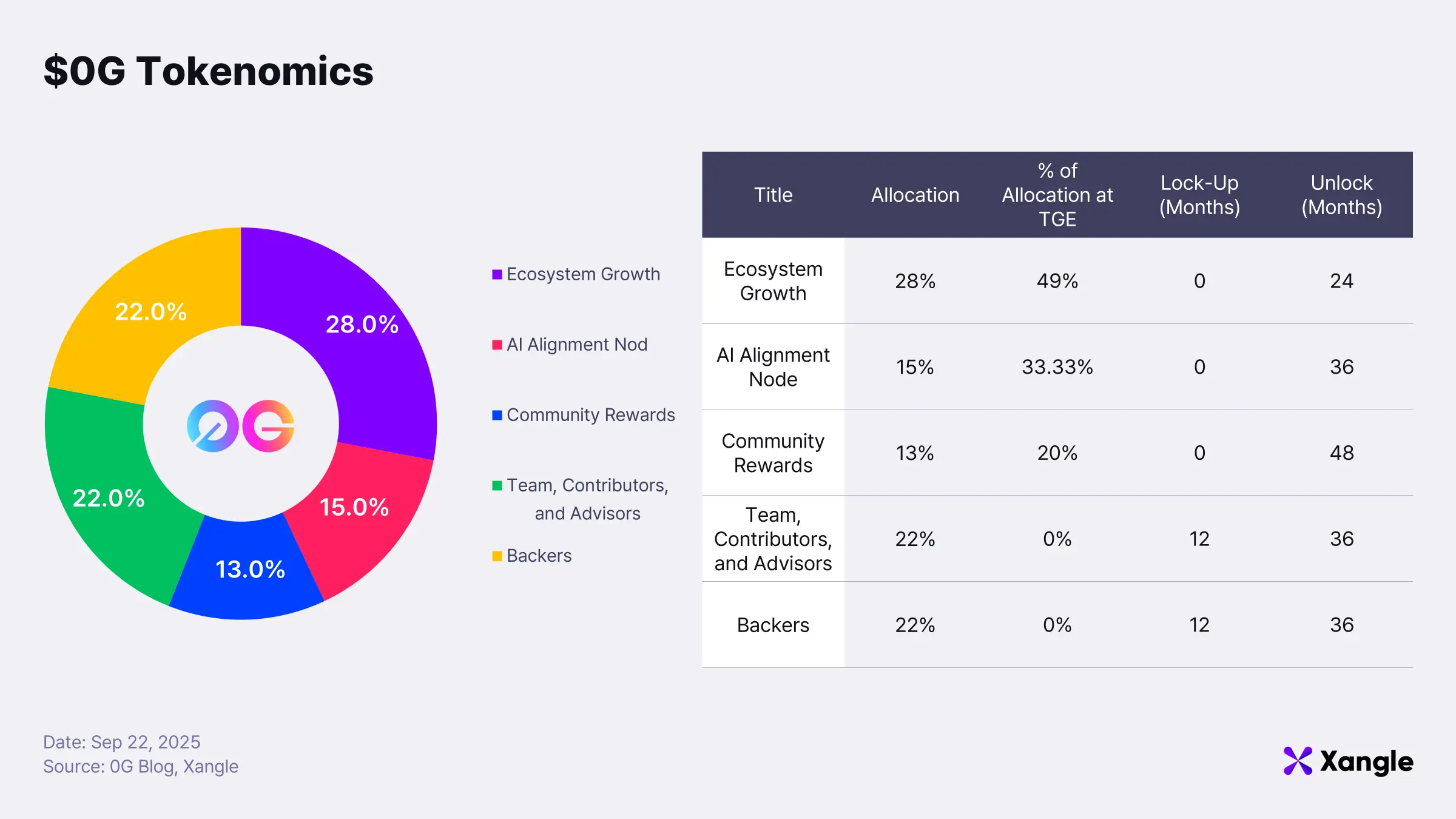
- Token Ticker: $0G
- Total Supply: 1,000,000,000 (1B)
- Distribution:
- Community & Ecosystem Growth: 56% (560M)
- Ecosystem: 28% (280M)
- AI Alignment Nodes: 15% (150M)
- Community Rewards: 13% (130M)
- Core Team & Early Investors: 44% (440M)
- 0G Team, Contributors & Advisors: 22% (220M)
- Investors: 22% (220M)
- Community & Ecosystem Growth: 56% (560M)
Allocations for the team and investors will not unlock at the Token Generation Event (TGE). Instead, they are subject to a 12-month cliff, followed by a 36-month linear vesting schedule. By contrast, tokens allocated to community and ecosystem growth will partially unlock at TGE, with the remainder distributed over 24–36 months. This structure is designed to cap the initial circulating supply at 21.32%, mitigating the risk of early dumping.
Community rewards alone account for 13% of the total supply, which may appear modest in isolation. However, the 15% allocated to AI Alignment Nodes is also distributed primarily to individual users operating small-scale nodes. In practice, this extends the community reward pool, meaning that roughly 28% of the entire supply flows directly back to the community.
Crucially, rewards for AI Alignment Nodes are not distributed as simple airdrops. Instead, they are tied to verifiable contributions that uphold the security and integrity of the 0G network. This model shifts incentives away from short-term speculation and toward a sustainable, contribution-based framework designed to endure over the long term.
4-2. Core Utilities of the $0G Token in the Ecosystem
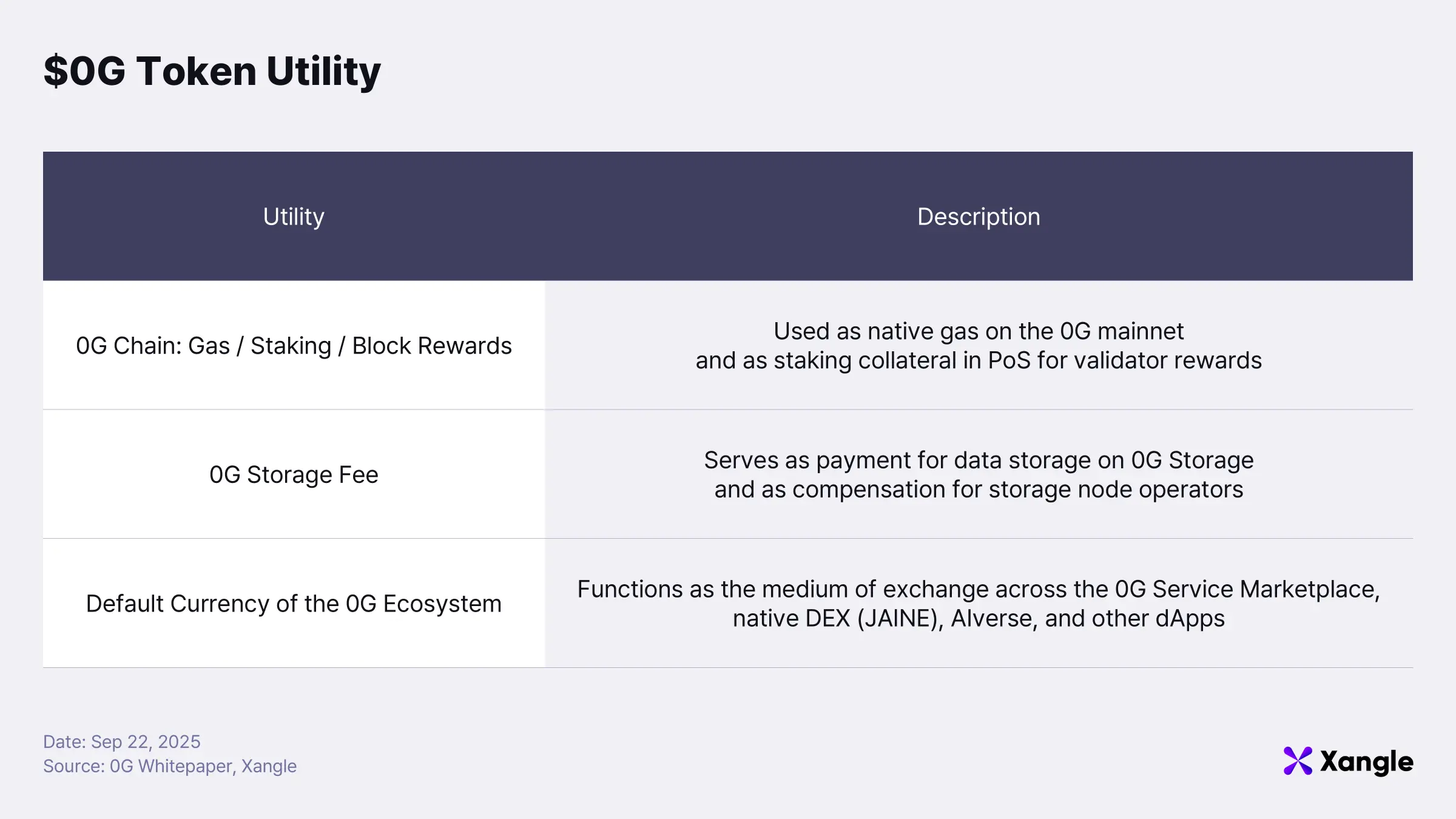
The $0G token is designed around three core utilities:
1. Native token of the 0G mainnet
$0G is used to pay transaction fees (gas) across the network. Under the PoS consensus mechanism, validators must stake $0G to participate in block validation and network security. The token is issued as an ERC-20 standard, enabling interoperability with restaking frameworks such as EigenLayer and Babylon. Validators are rewarded with $0G block rewards for their contributions. Notably, major global IT firms—including Amazon Web Services (AWS), Google Cloud, Alibaba Cloud, and NTT Docomo—have already joined as validators.
2. Payment for storage and node incentives
$0G is also the medium for paying storage costs and compensating the nodes that provide those services. When storing data, users pay a one-time fee (default: three years). This payment is divided between an on-chain storage request fee and a storage endowment. The endowment is distributed linearly to storage nodes over the designated period, incentivizing long-term retention. Users may “top up” to extend storage duration. In effect, storage costs are prepaid, while service quality is preserved via ongoing incentive distribution.
3. Medium of exchange across the 0G ecosystem
Within the Service Marketplace, users prepay in $0G for AI inference, data queries, training, and other services, while providers receive settlement rewards. On the native DEX JAINE, $0G acts as the base asset for trading pairs and liquidity provision. In AIverse, $0G is the currency for minting, trading, and collecting iNFTs. Across services and dApps, the token functions as the de facto currency of the ecosystem.
In summary, the $0G token circulates across three core pillars: it serves as fees and staking collateral for 0G chain operations, payments for storage and retention in the 0G storage layer, and a medium of settlement for services and transactions across the ecosystem.
This structure positions $0G as more than just a gas token. It becomes a core value medium linking security, storage, and service consumption, while establishing a circular flow that provides sustainable incentives for participants. The result is a flywheel effect that both reinforces intrinsic token demand and anchors the long-term growth of the 0G ecosystem.
5. Conclusion: Building 0G into AI’s Prometheus
The ambition of 0G is vast, yet its objective is straightforward: to ensure that AI, as a critical resource, is not monopolized by a few corporations but made accessible to all. To achieve this, 0G seeks to build a decentralized AI Operating System (deAIOS) that organically interconnects storage, data availability, compute networks, service marketplaces, and alignment nodes on top of blockchain.
Over successive testnets, 0G has validated and deployed the core technologies required for mainnet operations including consensus–execution separation, data availability modules, and storage sharding. Its token has been designed not merely as a gas fee mechanism but as the centerpiece of a circular economy linking staking, storage costs, service payments, and ecosystem incentives. The steady onboarding of DeFi, gaming, and AI applications has further expanded its scope of utility.
The upcoming mainnet launch will put 0G to the test against real-world benchmarks: stability, cost structure, user experience, and performance. Meeting these challenges step by step will determine whether 0G can establish AI infrastructure that is open and accessible to all.
The story recalls the myth of Prometheus, who stole fire from the gods and shared it with humanity, enduring eternal punishment in return. His sacrifice transformed fire into a shared asset, igniting the dawn of civilization. Today, AI is that flame of innovation, but decentralization remains obstructed by corporate monopolies and regulatory barriers around blockchain. 0G aspires to overcome these obstacles, positioning AI not as the privilege of the few but as infrastructure for the many. Only when AI runs on open networks will the vision of a decentralized AI Operating System (deAIOS) be realized.
Disclaimer
I confirm that I have read and understood the following: The information contained in this article is strictly the opinions of the author(s). This article was authored free from any form of coercion or undue influence. The content represents the author's own views and does not represent the official position or opinions of CrossAngle. This article is intended for informational purposes only and should not be construed as investment advice or solicitation. Unless otherwise specified, all users are solely responsible and liable for their own decisions about investments, investment strategies, or the use of products or services. Investment decisions should be made based on the user’s personal investment objectives, circumstances, and financial situation. Please consult a professional financial advisor for more information and guidance. Past returns or projections do not guarantee future results. This article was written at the request of 0G Labs. All content in this article was written independently by the author(s), and neither CrossAngle nor 0G Labs had any editorial control or influence over the content. The author(s) may hold the cryptocurrencies mentioned in this article at the time of writing.
Xangle or its affiliated partners own all copyrights of the written or otherwise produced materials and content provided on the platform. Any illegal reproduction of such content, including, but not limited to, unauthorized editing, copying, reprinting, or redistribution will result in immediate legal actions without prior notice.
![[CIS Partner Summit Highlights] Ault's Financial Super App Strategy: OnlyBulls](https://resource.xangle.io/files/content/C1A19E1DB41B7FB86076143803C40D8E_1790125531662.webp)
![[Xangle RWA Series] Solana RWA: A Look at the Key Players](https://resource.xangle.io/files/content/F779A005246C0299246537AACB3A39F2_1782287059970.webp)