
Comparing Saffron Lido Vaults against Lido Staking Pools

TL;DR:
One way to balance the overall risk of a portfolio is to seek low risk vehicles that have some return. In the ETH ecosystem these low risk vehicles are usually liquid staking pools like Lido. Saffron Lido Vaults sit on top of Lido Liquid Staking Pools and provide a fixed rate of return upfront. At an apparent break-even performance between naked Lido and the Saffron Lido Vault — where the average rate of Lido returns matches the fixed rate of the vault — there is a huge upside to deploy against the Vault because of the Time Value of Money and opportunity costs.
By receiving the return in a lump sum at the beginning of the contract, the Saffron Lido Vaults outperform the naked Lido deployment because of these two concepts.
Introduction
The upcoming Saffron Lido Vaults are a highly versatile product from Saffron Finance that mimic interest rate swaps in traditional financial markets. This type of contract is one of the most popular in TradFi because it allows two parties to swap the risks that happen with fluctuating interest rates from a variable yield-generating asset. We have covered examples of this type of financial instrument in the past and found that the previous real world examples helped our users understand the product better. As such, we will further expand on the real world applications of Saffron Lido Vaults today. In this article, we will focus on a practical application of the fixed side using a hypothetical scenario.
Meet Alice

Alice is a seasoned crypto user with a diverse portfolio who wants to allocate 100 ETH to deploy into a financial instrument. She wants this ETH to be put into a conservative, low-risk instrument with the highest yield possible. Alice is bullish on ETH and wants to avoid exposing this capital to the risk of ETH’s price rising against other currencies — which would cause her to miss the upward gain.
She is looking for a financial instrument that encompasses three things:
A Viable Solution
With what is available on the market now, a low-risk solution for her situation is to stake this ETH. Staking ETH is easy and there are many liquid staking pools out there — including options on traditional centralized exchanges like Coinbase and decentralized protocols like Lido. Lido itself has a well regarded reputation in the industry and provides liquid staking pools that boast over $26 billion of staked ETH — providing an annualized return of approximately 3% (this is an average and actual returns can vary). Although this liquid staking pool is stable, the returns themselves are variable. Lido operators use the ETH deposited into their pool to secure the Ethereum network and receive rewards for doing so. These rewards are then shared with the community proportionally to their participation in the pool (pro-rata) and provide the approximate 3% return as mentioned above. As veterans in the industry know, the exact value fluctuates based on the network activity, the total amount of ETH staked, the performance of validators, and other factors.
Alice’s Returns
Let’s suppose Alice decides to go with Lido and deploys her 100 ETH into their staking pool — and for the sake of simplicity — Lido performs at 3% per year. Lido is auto-compounded daily so at the end of the year Alice would receive 103.05 ETH, which is a 3.05 ETH gain.
However, Alice must also wait for the yield to accumulate every day. Her 100 ETH on Lido will gain around 0.0082 ETH daily. Although she could withdraw her gains at any time, she would only receive the entirety of the 0.05 ETH from compounding if she never withdrew during the year.
Ultimately, the Lido solution has two negatives that could stand to be improved upon:
With Saffron Lido Vaults
From Alice’s perspective Saffron Lido Vaults work similarly to Lido Liquid Staking Pool as a financial instrument but it has some key differences. First, her return rate is fixed and set in when creating the vault (the Fixed side). So if Saffron Lido Vault says it has a fixed return of 3% the users of the fixed side — including Alice — will receive 3% no matter what. Second — and this is the huge difference — the users of the fixed side will receive their return in a single lump sum at the beginning of the contract. They do not need to wait for the daily returns of Lido Liquid Staking Pool. However, this means that Alice’s principal will be locked for the duration of the contract. The good news is that Saffron Lido Vaults allow Alice to pull her principal before the contract expiration date for a fee. This feature decreases the opportunity cost of having their capital locked, because at the end of the day this is still a market where macro elements can change on a dime so having the flexibility to adapt is important. The table below summarizes these differences and their significant consequences on the performance of these two financial instruments:
Table 1: Comparison between Lido Staking Pool and Saffron Lido Vault from the user’s perspective of the fixed side of the contract.
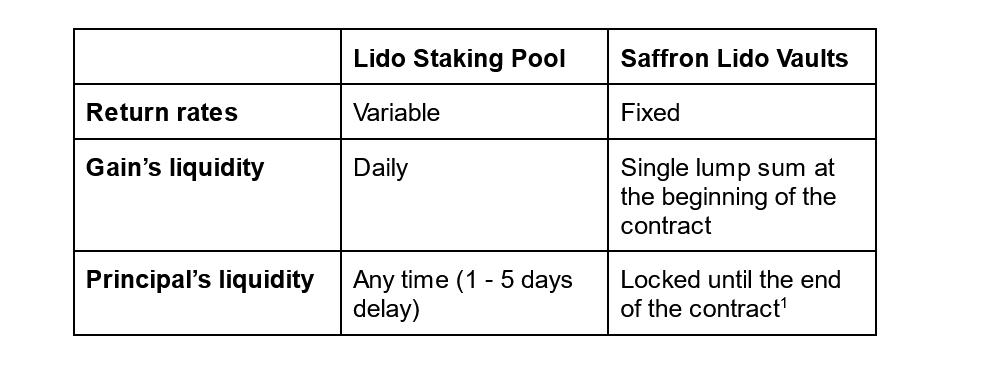
A preliminary analysis would indicate that the capital on the fixed side of a Saffron Lido Vault would outperform the Lido Liquid Staking Vault if — on average — the variable rate is lower than the fixed rate.
But there is more to it. Let’s take a look:
Time Value of Money
Let’s compare Alice’s gains in two scenarios:
1) Alice puts 100 ETH on the Lido Liquid Staking Pool
2) Alice puts 100 ETH on the fixed side of a Saffron Lido Vault contract with a 3% fixed rate
As we saw with the example of the Lido Liquid Staking Pool, if Alice wants to receive all of the 3.05 ETH returns, she must wait until the end of the year. In contrast, she has access to 3 ETH from the Saffron Lido Vault as soon as the contract starts.
In this hypothetical example, Lido performs 3% over that period. And let’s suppose that Alice took that 3 ETH from the Saffron Lido Vault and deposited it on the Lido Liquid Staking pool. In this case, Alice would end up with 3.09 ETH instead of 3.05 ETH if she didn’t use the Saffron Lido Vault. This 0.04 ETH is attributed to the time value of money, a critical financial concept stating that a given amount is worth more now than later. To simplify it; 1 ETH now is worth more than a promise of 1 ETH a year from now. Those who are familiar with the ebb and flow of digital assets understand that this is infinitely more relevant to our industry than in any other financial market.
The idea behind the time value of money is that it’s not just inflation of goods and services or fluctuations in exchange rate that one has to take into consideration. One apple now is always worth more than one apple in the future. The concept is more based on the fact that having available capital now can lead to more capital in the future, and it is intimately linked to opportunity costs — and we’ll talk more about opportunity cost later.
It is important to be clearly stated that this hypothetical scenario is almost impossible to predict at the beginning of the contract. However, from this analysis it is clear that Saffron Lido Vaults will have a slightly lower nominal rate of return than the average performance of Lido Liquid Staking Pool simply because of the time value of money: money now is worth more than money in the future.
To bring this thought exercise home; how much would a Saffron Lido Vault fixed rate need to be in order to match the gain in one year of Lido Liquid Staking Vault that performs at 3% on average if no other instrument were available? The answer is 2.96% and not 3%, and as you might guess the result comes directly from the concept of the time value of money.
Opportunity Cost

This advantage is hard to completely quantify because so much off it depends on market sentiment overall. Having said that, we expect that the fixed rate agreed on successfully launched vaults will be a major indicator of market sentiment regarding this aspect of the crypto market.
On the other hand, if the opportunity cost of the gains are so important (and they certainly are), also consider the opportunity cost of locking the capital’s principal for a significant amount of time. This cost alone would entirely overcome the performance of reasonable fixed rates and render the Saffron Lido Vaults useless if the principal was locked.
If there are unexpected developments in the market and Alice sees an opportunity to take her 100 ETH out of the Saffron Lido Vault, she can. However, she must pay back a penalty calculated based on the amount she received at the beginning of the contract and a fee. We will discuss the fee and how it is determined more in the next article.
Conclusion
The fixed side of Saffron Lido Vaults is a highly enticing alternative to deploying capital directly to the Lido Liquid Staking Pool, mainly because of opportunity costs and the time value of money. We deploy several features to take mitigate the first and take advantage of the latter. In the next article we’ll go into more detail about how users from the fixed side can take advantage of unlocking their capital if there is an unexpected opportunity in the market.
Web3 app: https://saffron.finance
Governance: https://gov.saffron.finance
Telegram: https://t.me/saffronfinance
Discord: https://discord.gg/pDXpXKY
Twitter: https://twitter.com/saffronfinance_
Github: https://github.com/saffron-finance/saffron
Saffron Lido Vaults vs. Lido Staking Pools was originally published in saffron.finance on Medium, where people are continuing the conversation by highlighting and responding to this story.