[Xangle Comment] FSC Unveils Comprehensive Digital Asset Bill
1. FSC Unveils Comprehensive Digital Asset Bill
Key Developments
- Function-based licensing and registration: Digital asset businesses would be divided into dealing, brokerage, custody, and investment management. Dealing, brokerage, and custody would require licenses, while investment management would require registration. Businesses holding all three dealing, brokerage, and custody licenses and meeting additional requirements would be designated as exchanges (digital asset platform operators).
- Issuance of won-denominated stablecoins: Issuers would need authorization from the Financial Services Commission (FSC), at least KRW 5 billion in equity capital, and reserves of no less than 100% of outstanding issuance. Initially, issuance would be limited to consortia in which banks collectively hold a majority stake, although fintech and technology companies could participate as the largest individual shareholder. Interest payments to holders would be prohibited.
- Domestic ICOs subject to disclosure: Issuers and other responsible parties would be able to sell digital assets in Korea after filing and publishing a whitepaper with the FSC and completing a deliberation period. Exchanges would also need to publish a listing disclosure report before listing a token.
- Exchange ownership limits: A shareholder's stake in an exchange would generally be capped at 20%, although financial institutions and certain other entities could hold up to 34% with FSC approval. The requirements would be deferred for three years after designation, with small and midsize exchanges receiving up to three additional years.
- Stronger liability for hacks and system failures: Operators would generally bear no-fault liability for losses arising from hacks or system failures. An incident caused by a breach of IT security obligations could result in an administrative fine of up to 10% of revenue.
Xangle Comment | Joey Kim, Hyeongseok Lim
Korea's virtual asset regulation has focused on anti-money laundering, protection of customer assets, and the prohibition of unfair trading. The new bill brings together provisions on market entry, stablecoins, ICOs, exchange governance, and liability for operational incidents. Its purpose is to establish rules that allow a broader range of businesses to enter a market shaped primarily by exchanges and retail investors.
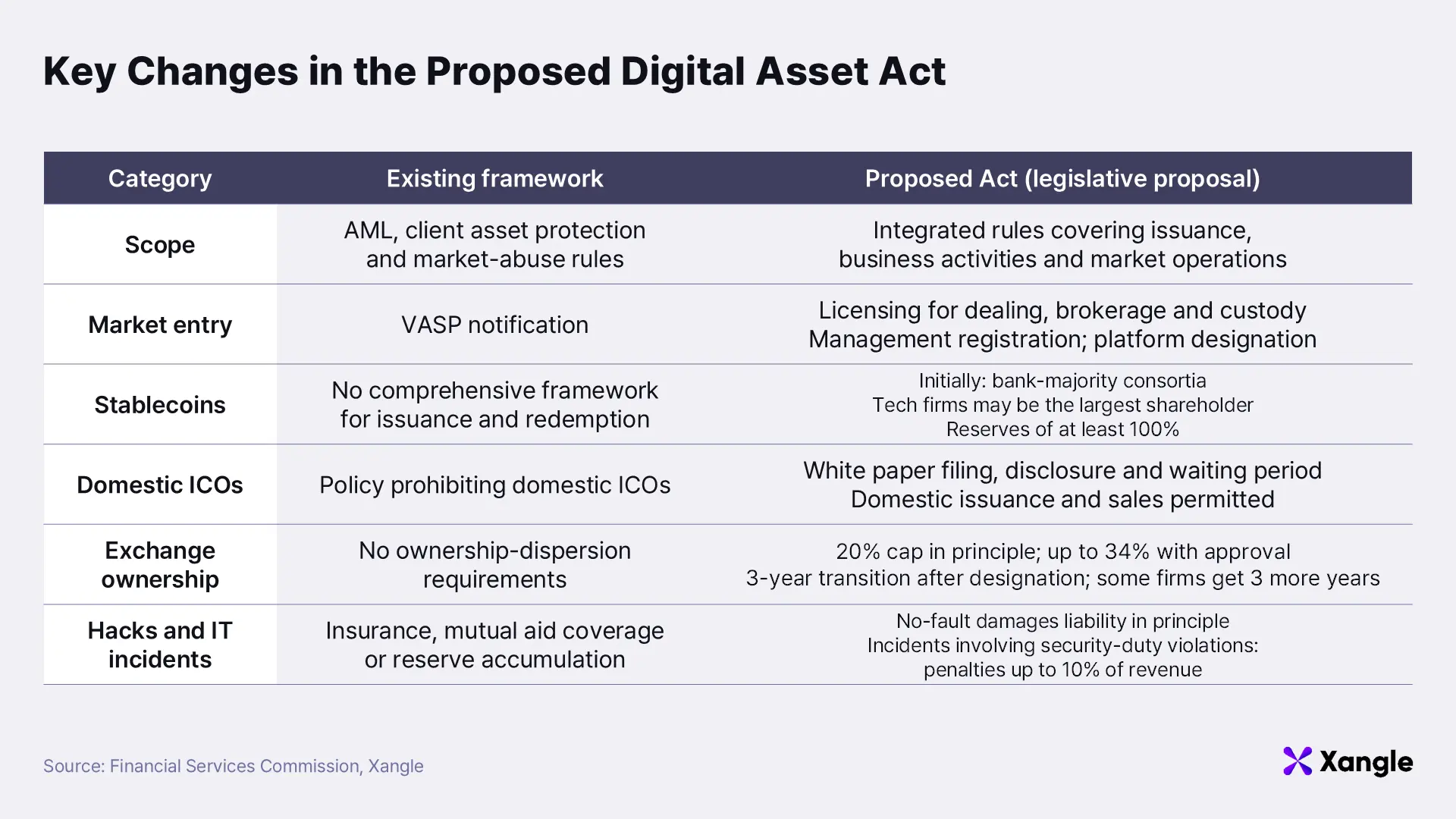
This Comment examines the changes and points of interest under each category in the table.
1) Expanded Regulation of Issuance, Business Activities, and Market Operations
Korea's existing virtual asset rules were designed to protect users and prevent unlawful conduct. The Act on Reporting and Using Specified Financial Transaction Information focuses on money laundering, while the Virtual Asset User Protection Act addresses the loss of customer assets and unfair trading. Both laws primarily impose prohibitions and obligations on operators, with few provisions specifying which activities they may undertake and under what conditions.
The bill specifies permitted activities, entry requirements, and operating rules for each business category. Services whose legal basis has been unclear, including staking, liquidity provision, discretionary management, and investment advice, could operate as formally recognized businesses once the relevant requirements are met. The significance is that the bill establishes a legal basis for these businesses, extending a framework previously focused on restricting operators' conduct.
2) Function-Based Licensing and Registration for Market Entry
Previously, businesses filed as a single category of virtual asset service provider, whether they engaged in dealing, custody, or brokerage. The bill divides digital asset services into four business categories plus platform operators, as shown below. Dealing, brokerage, and custody firms would require FSC licenses. They would need to be joint-stock companies under the Commercial Act and meet requirements for equity capital (at least KRW 1 billion when handling only stablecoins, or KRW 2 billion otherwise), major shareholders and executives, conflict-of-interest controls, and IT infrastructure. Investment managers that do not directly hold customer assets would instead register, with KRW 500 million in equity capital and qualified personnel. The FSC would designate platform operators from among firms licensed for dealing, brokerage, and custody.
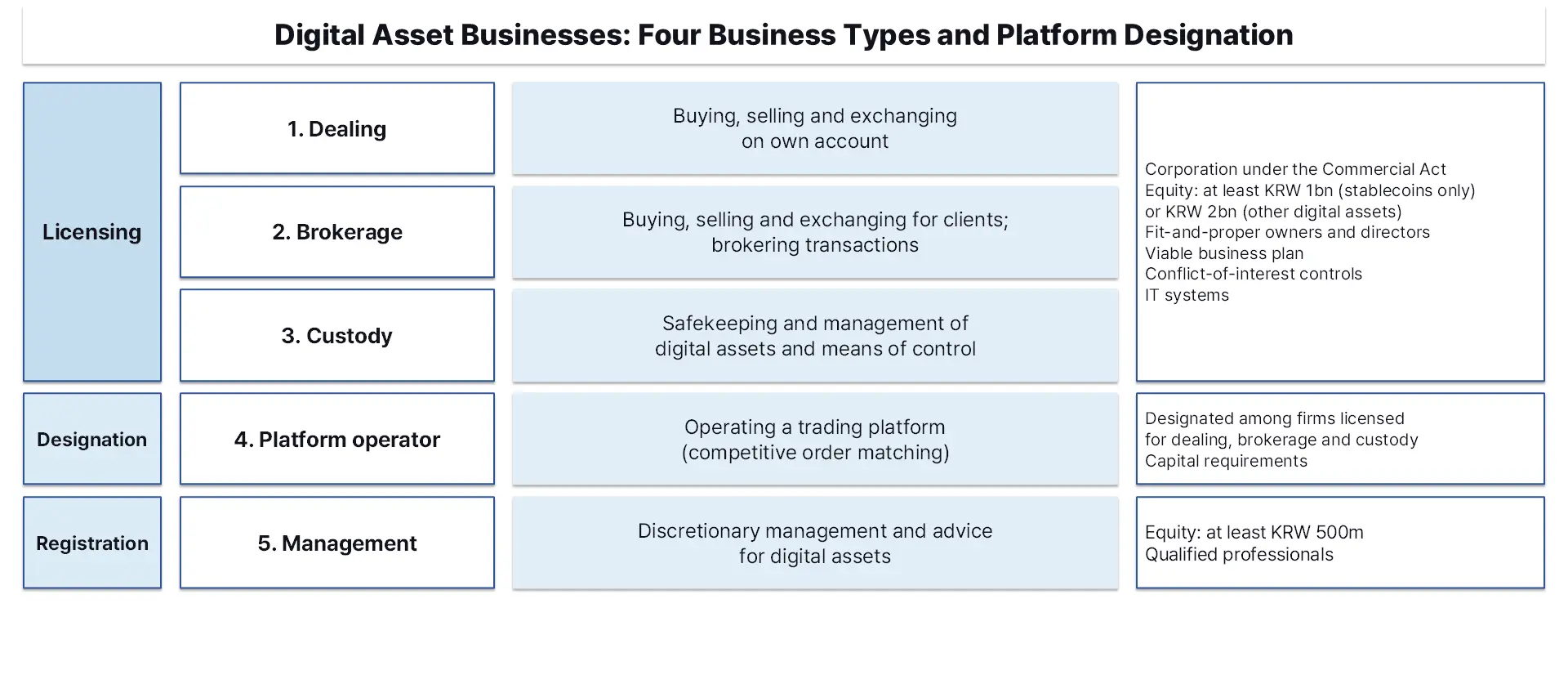
This classification closely follows the financial investment business framework under the Financial Investment Services and Capital Markets Act. The comparable roles in traditional finance are as follows.
- Dealing: Buying and selling digital assets with the firm's own capital. Under a contract with an issuer or exchange, a dealer could quote prices as a liquidity provider (LP). This resembles a securities firm's proprietary trading and market-making activities.
- Brokerage: Receiving customer orders and intermediating trades, with an obligation to obtain the most favorable terms among multiple counterparties. This is comparable to a securities firm's brokerage business.
- Custody: Safekeeping and managing customers' digital assets and private keys, including staking. The role is comparable to custodial institutions such as custodian banks or the Korea Securities Depository.
- Investment management: Managing customer assets on a discretionary basis or providing investment advice, similar to discretionary investment managers and investment advisers. Managers could not directly hold customer assets, so custody would need to be entrusted to a custodian, much as an asset manager places fund assets with a custodian bank.
- Platform operators: Operating a market that brings together multiple buy and sell orders for competitive execution. Only platform operators could run order-book trading venues, comparable to the Korea Exchange or Nextrade.
Firms holding multiple licenses could combine dealing, custody, and advice for institutional clients, much as large securities firms provide prime brokerage services to hedge funds. The framework would clarify the scope of business for institutional brokers, custodians, and investment managers. Establishing a new exchange, however, would become more demanding because it would require all three licenses as well as designation.
3) Stablecoin Issuance Through Bank-Led Consortia
Korea has had no law directly governing stablecoin issuance and redemption. The bill's main provisions are as follows.
- Issuers: Initially, issuance would be limited to consortia in which banks collectively hold a majority stake, while fintech and technology companies could participate as the largest individual shareholder. Issuers would need to deposit or place in trust with banks or other eligible institutions reserves equal to at least 100% of outstanding issuance.
- Foreign issuers: Foreign issuers could issue and redeem stablecoins in Korea after establishing a local branch and registering with the FSC. Coins already issued overseas could circulate in Korea following a filing with the FSC.
- Restrictions on unfiled coins: Stablecoins that have not undergone approval or filing would be prohibited from listing on Korean exchanges or being traded or held in custody by operators. Dollar stablecoins currently traded on Korean exchanges would also be subject to filing.
- Oversight of won-denominated coins: The FSC could designate coins with at least KRW 1 trillion in outstanding issuance as significant stablecoins, and the Bank of Korea could request joint inspections of their issuers. Aggregate issuance would be discussed by the FSC, the Ministry of Finance and Economy, and the Bank of Korea.
- Oversight of dollar-denominated coins: Foreign issuers would be required to hold part of their reserves with Korean banks. The government intends to bring dollar coins already used for trading and remittances in Korea within the regulatory framework.
- Prohibition on interest: Issuers would not be allowed to pay interest to holders. Like the U.S. GENIUS Act, this provision confines stablecoins to a payment function to prevent them from replacing deposits.
Won-denominated stablecoins are likely to begin with banks responsible for financial stability and technology companies responsible for customer services. Banks would manage reserves and anti-money laundering controls, while fintech and technology companies participating as the largest individual shareholders would operate wallets and payment services. Because issuers could not pay interest to holders, competition would depend on the breadth of payment acceptance and practical use cases. For dollar stablecoins, continued listing on Korean exchanges would depend on foreign issuers completing the required filings. How major issuers such as Tether and Circle meet Korea's requirements will therefore be an important development.
4) Domestic ICOs Subject to Whitepaper Disclosure
Domestic projects have been unable to issue tokens directly in Korea since the government imposed a blanket ICO ban in 2017. They have instead established overseas foundations in jurisdictions such as Singapore and Switzerland, issued tokens there, and subsequently listed them on Korean exchanges. The bill would create a formal domestic issuance route in place of this offshore structure. Issuers could sell tokens to Korean investors after filing and publishing a whitepaper with the FSC and completing a deliberation period.
The issuance procedure itself is relatively straightforward. The FSC could review a whitepaper for missing material information and demand corrections, but would not decide whether to approve it by assessing the commercial merits of the business. Liability, however, would be substantial. False statements or omissions in a whitepaper could expose issuers and executives to damages claims, administrative fines, or criminal penalties. Issuance and listing would also remain separate. Trading a token on a Korean exchange would require the token to pass the exchange's review and a separate listing disclosure report to be published.
In practice, the difficulty of issuance will depend more on the ability to pass listing reviews and bear disclosure liability than on the filing process itself. Tokens issued overseas would face the same level of disclosure when seeking a Korean listing, reducing the incentive to issue abroad. Which tokens would be classified as securities, and whether private placements to a small number of institutions would also require filing, remain unsettled. Those questions will depend on the implementing decree and guidelines.
5) Ownership Limits and Exchange Governance
Ownership limits have been one of the most contentious issues in preparing the bill. Exchange shareholdings have not previously been capped. Financial regulators argued that won-based exchanges function much like public infrastructure, yet a small group of major shareholders exercises considerable influence over their operations. They therefore sought ownership dispersion comparable to that required of alternative trading systems (ATSs). Industry participants and legal professionals objected that requiring reductions in lawfully acquired stakes could infringe property rights and amount to retroactive legislation. They also argued that there was no overseas precedent for limiting exchange ownership. Some proposed conduct rules or major-shareholder suitability reviews as alternatives.
The government proposal introduces ownership limits while allowing time to reduce their impact. A shareholder would generally be limited to 20%, with financial institutions and certain other entities permitted to hold up to 34% with FSC approval. Voting rights attached to holdings above the limit would be restricted. A transition period of three years after designation would apply, extending to as long as six years for small and midsize exchanges. Exchanges would also need a majority of outside directors and an audit committee. Listing reviews and surveillance of unusual trading, currently governed by self-regulation, would become statutory operating requirements. The government is applying public oversight to exchanges as market infrastructure.
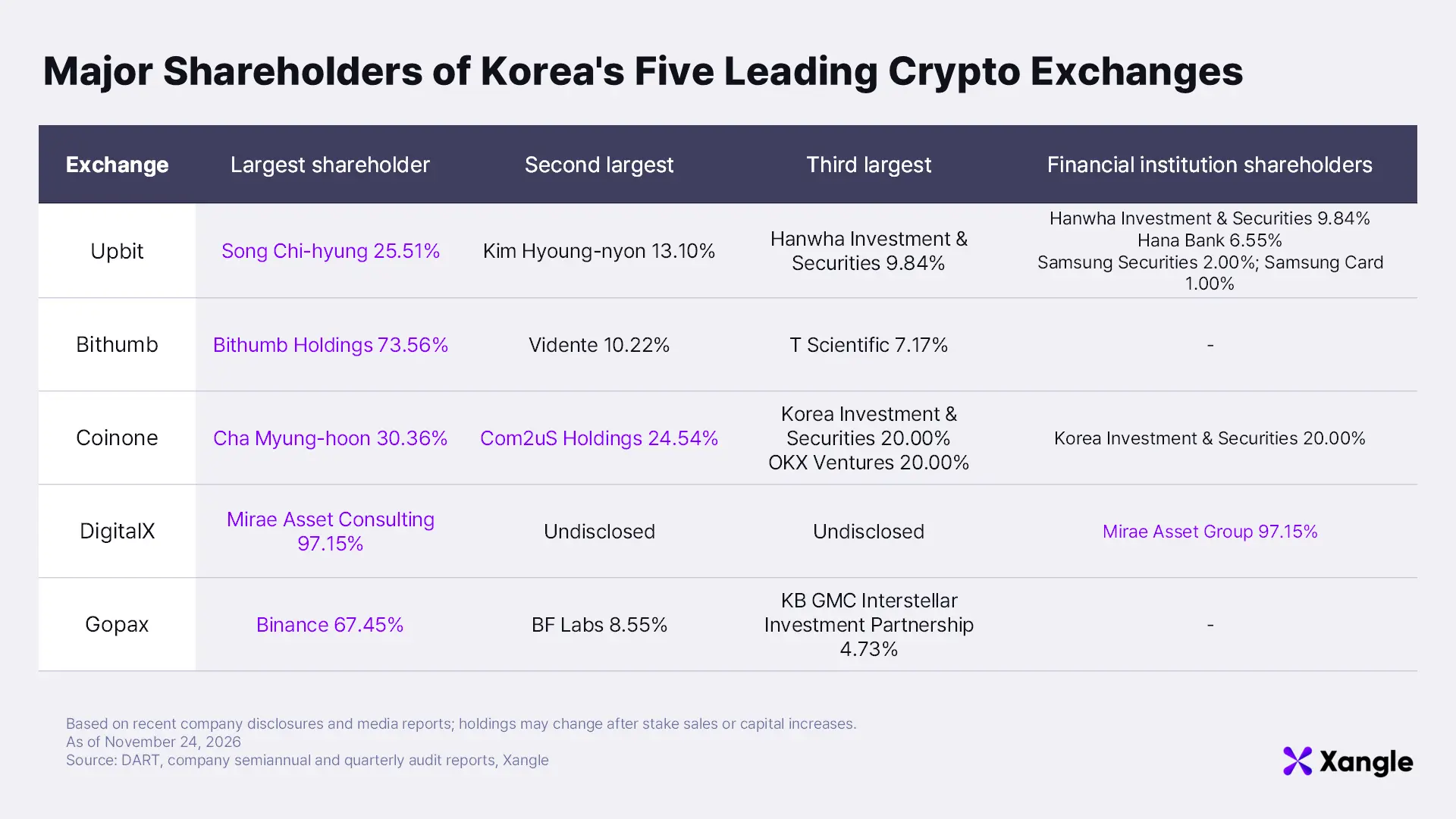
The limitation of the 34% exception to "financial institutions and certain other entities" is significant. The largest shareholder of each of Korea's five major exchanges currently holds more than 20%. Dunamu Chairman Song Chi-hyung (25.51%) and Coinone CEO Cha Myung-hun (30.36%) are their respective firms' largest shareholders. Bithumb Holdings owns 73.56% of Bithumb, Mirae Asset Consulting holds 97.15% of DigitalX (formerly Korbit), and Binance owns 67.45% of GOPAX. Individual controlling shareholders would need to reduce their stakes to 20%, while the largest shareholders of Bithumb, DigitalX, and GOPAX would face substantial reductions. Naver Financial's planned acquisition of Dunamu as a wholly owned subsidiary, scheduled for March 2027, would also conflict with the cap.
Financial institutions, by contrast, would have room to acquire exchange stakes. More institutions could become shareholders by buying minority holdings, as Hana Bank has done with its 6.55% stake in Dunamu and Korea Investment & Securities with its 20% stake in Coinone. They could then collaborate with exchanges on stablecoins, tokenized securities, and other businesses. Constitutional objections remain unresolved, however, and the National Assembly could revise the limits and the scope of exemptions during its deliberations.
6) No-Fault Liability for Hacks and System Failures
The existing Virtual Asset User Protection Act requires operators to obtain insurance or mutual-aid coverage, or set aside reserves, but does not separately specify who must bear losses after an incident. The bill would generally require digital asset businesses to compensate users for losses caused by hacks or system failures even when the operator is not at fault. If an incident results from a breach of security obligations, the FSC could impose an administrative fine of up to 10% of revenue.
This liability framework mirrors Article 9 of the Electronic Financial Transactions Act, which applies to banks and electronic financial service providers. Users would share responsibility only when they act intentionally or with gross negligence and the terms and conditions provide for that allocation. Because digital asset operators directly hold customer assets, liability is likely to extend to hacks of exchange wallets. Another issue will be the extent to which compensation covers losses caused by an inability to place orders during system outages in volatile markets. The 10% fine ceiling matches the cap for serious data breaches under the Personal Information Protection Act as amended in 2026. Higher security and insurance costs would place a greater burden on small operators, while demand for custody and security infrastructure providers is likely to increase.
The Government Proposal Ahead of Parliamentary Deliberations
The government has published a draft bill, not an enacted law. Twelve member-sponsored digital asset bills are already before the National Assembly, comprising nine comprehensive bills and three stablecoin bills. The government proposal is likely to be considered alongside them. Provisions facing strong industry resistance, such as exchange ownership limits, could change during that process. Even if legislation passes, many key requirements, including the shareholder composition of bank consortia, eligibility for the 34% exception, and minimum capital by business category, would be delegated to the implementing decree. The practical impact will become clearer once that decree and supervisory rules are available, making both parliamentary deliberations and subsequent rulemaking relevant to businesses.
References
- Financial Services Commission: Press release on the proposed Act on Innovation and User Protection in the Digital Asset Industry (PDF)
- Financial Services Commission: Key provisions of the bill (PDF)
- Financial Services Commission: Opening remarks by the FSC Chairman (PDF)
- U.S. Code: GENIUS Act: Requirements for payment stablecoin issuance and the prohibition on interest (12 U.S.C. §5903)
- National Law Information Center: Electronic Financial Transactions Act, Article 9: Liability of financial companies and electronic financial service providers
- Financial Services Commission: Financial-sector roundtable on security innovation in the AI era
- EU: Markets in Crypto-Assets Regulation, MiCA, Regulation (EU) 2023/1114
- National Law Information Center: Personal Information Protection Act, administrative fines (2026 amendment)
Disclaimer
I confirm that I have read and understood the following: The information contained in this article is strictly the opinions of the author(s). This article was authored free from any form of coercion or undue influence. The content represents the author's own views and does not represent the official position or opinions of CrossAngle. This article is intended for informational purposes only and should not be construed as investment advice or solicitation. Unless otherwise specified, all users are solely responsible and liable for their own decisions about investments, investment strategies, or the use of products or services. Investment decisions should be made based on the user’s personal investment objectives, circumstances, and financial situation. Please consult a professional financial advisor for more information and guidance. Past returns or projections do not guarantee future results.
Xangle or its affiliated partners own all copyrights of the written or otherwise produced materials and content provided on the platform. Any illegal reproduction of such content, including, but not limited to, unauthorized editing, copying, reprinting, or redistribution will result in immediate legal actions without prior notice.