Lumera: 2026 Roadmap and Expansion Strategy

Table of Contents
1. Lumera Project Overview
2. 2025 Performance Metrics and Ecosystem Expansion
3. 2026 Roadmap: From Infrastructure Readiness to Adoption
4. Closing Remarks: 2026 as Lumera’s Market Test
1. Lumera Project Overview
Lumera is a decentralized, application-specialized blockchain positioned as a Web3 AI infrastructure layer. Unlike general-purpose Layer 1 networks that primarily focus on smart contract execution, Lumera is designed to allow AI workloads, including inference and agent execution, as well as permanent storage and content authenticity verification, to be directly invoked at the protocol level. This architectural choice constitutes Lumera’s core differentiation.
Support for this design comes from a Cosmos SDK–based Proof-of-Stake architecture optimized for fast finality and operational efficiency. Standardized cross-chain connectivity further enables seamless integration with external chains and services. At the infrastructure level, the system is built to meet the low-latency requirements, execution consistency, and integration simplicity demanded by AI-native services.
At the architectural layer, Lumera adopts a dual-node model that separates Validators, which are responsible for consensus, from SuperNodes, which execute AI and storage services. This separation of roles allows network security and service execution to be managed independently while maintaining overall system stability and scalability.
The native token, $LUME, functions as the core asset across the Lumera infrastructure. It is used for consensus security through staking, service execution via module calls, and participation in governance. Lumera also implements a usage-linked token flow in which LUME is converted into AI Credits during service consumption, with a portion subsequently burned. This structure ensures that growth in real-world usage translates into increased token demand and reinforced scarcity. For a more detailed technical background and architectural overview, refer to Xangle Research, “Lumera, Setting the Standard for Web3 AI Infrastructure.
The remainder of this report outlines how Lumera has translated its Web3 AI infrastructure thesis into concrete execution following its rebranding in May 2025. It also reviews emerging on-chain and operational performance indicators and presents the core roadmap elements guiding Lumera’s trajectory toward 2026.
2. 2025 Performance Metrics and Ecosystem Expansion
2-1. Initial On-Chain Traction and Operational Metrics
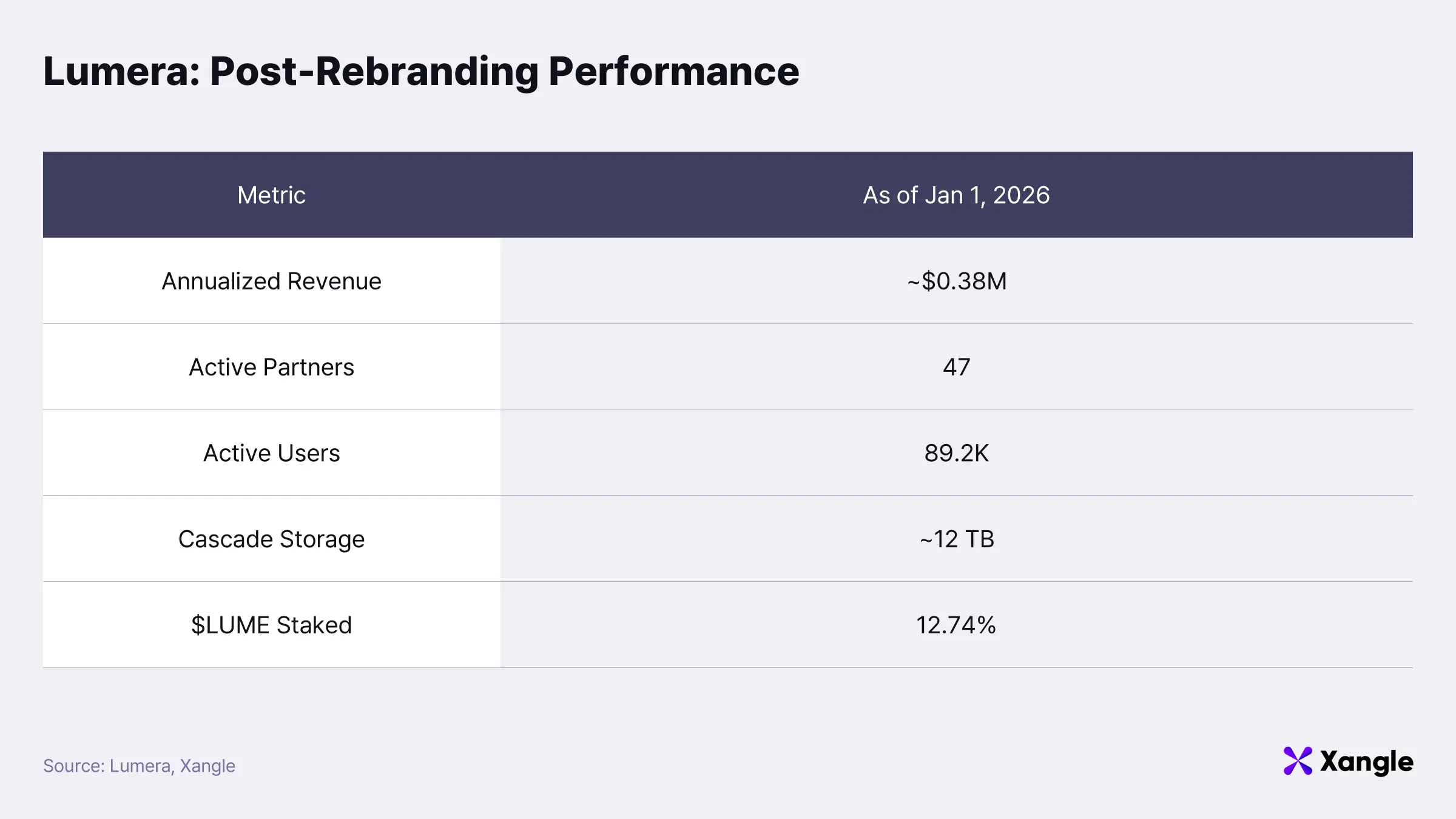
Lumera Hub has not yet been officially deployed on mainnet, and direct access for retail users remains limited. Even under these conditions, Lumera has already generated approximately $0.38M in annualized protocol revenue and recorded roughly 12TB of Cascade storage usage.
Network participation indicators further reinforce this early traction. The $LUME staking ratio has risen to 12.74%, which can be interpreted as evidence that validators and early participants have formed a measurable level of confidence in the network’s stability and long-term growth potential, despite the absence of listings on major centralized exchanges.
Post-TGE, the mainnet launch of Lumera Hub and the expansion of retail accessibility are expected to add user-driven traffic and service-call demand on top of the existing partner-led usage base. Under this scenario, Lumera retains meaningful upside potential for broad-based growth across revenue, storage utilization, and overall network activity metrics.
2-2. Partnership-Led Ecosystem Expansion
-
Validators
Lumera has onboarded and is currently operating with a cohort of 50 major validators, including Citadel, Cosmostation, and Nansen. This validator composition reflects a deliberate strategy to secure consensus stability and network security early, ahead of a transition to a fully public validator set. The participation of Nansen, a data and research firm, extends beyond baseline infrastructure provision and introduces potential synergies in on-chain data interpretation and network-level transparency.
-
Wallets
Lumera supports core wallets within the Cosmos ecosystem, including Cosmostation, Keplr, and Leap. This compatibility allows existing Cosmos users to access Lumera directly through familiar wallet interfaces, reducing onboarding friction and accelerating early user adoption. At the same time, Lumera is preparing staged collaborations with additional wallet providers in anticipation of future expansion into EVM and SVM ecosystems.
-
DeFi
On the DeFi front, Lumera is onboarding to Osmosis, the primary decentralized exchange within the Cosmos ecosystem. This integration enables key DeFi use cases for $LUME, including trading, liquidity provision, and yield farming. As a result, Lumera establishes a stable foundation for early asset circulation and price discovery.
-
Layer 1
Lumera has established partnerships with multiple Layer 1 networks, including Injective, DOMA, and LUKSO. These collaborations highlight Lumera’s orientation toward infrastructure that can be utilized across a multichain environment rather than reliance on a single base layer. Over time, this structure supports the reuse of Lumera’s modules, such as Cascade, Inference, and Sense, across heterogeneous chains.
-
dApps
At the application layer, Lumera has partnered with Metaplex, a Solana-based protocol that provides token and NFT standard infrastructure. By supplying its decentralized storage module, Cascade, Lumera addresses storage scalability and permanent data retention challenges within the Metaplex ecosystem. This partnership represents a concrete example of Lumera’s infrastructure being applied at the application level.
-
On/Off Ramps
Lumera integrates with Transak and Ramp, two core providers that connect fiat currencies with crypto assets. This integration indicates that Lumera is designed not only for crypto-native users but also for broader consumer and enterprise use cases. Over the long term, such on- and off-ramp infrastructure is essential for scaling real-world adoption.
-
Analytics
On the analytics and compliance side, Lumera has announced a partnership with Chainalysis, a leading on-chain data analytics provider. This collaboration strengthens Lumera’s capabilities in fund flow analysis and compliance readiness, and provides a foundation for delivering more mature services aligned with regulatory and institutional requirements.
2-3. Cascade and Lumera Hub as the Initial User Entry Points
Lumera Hub functions as the primary user interface for the Lumera ecosystem, designed to be accessible to both developers and general users. Serving as a gateway to Lumera’s full stack of services, the Hub has been released initially in a testnet environment.
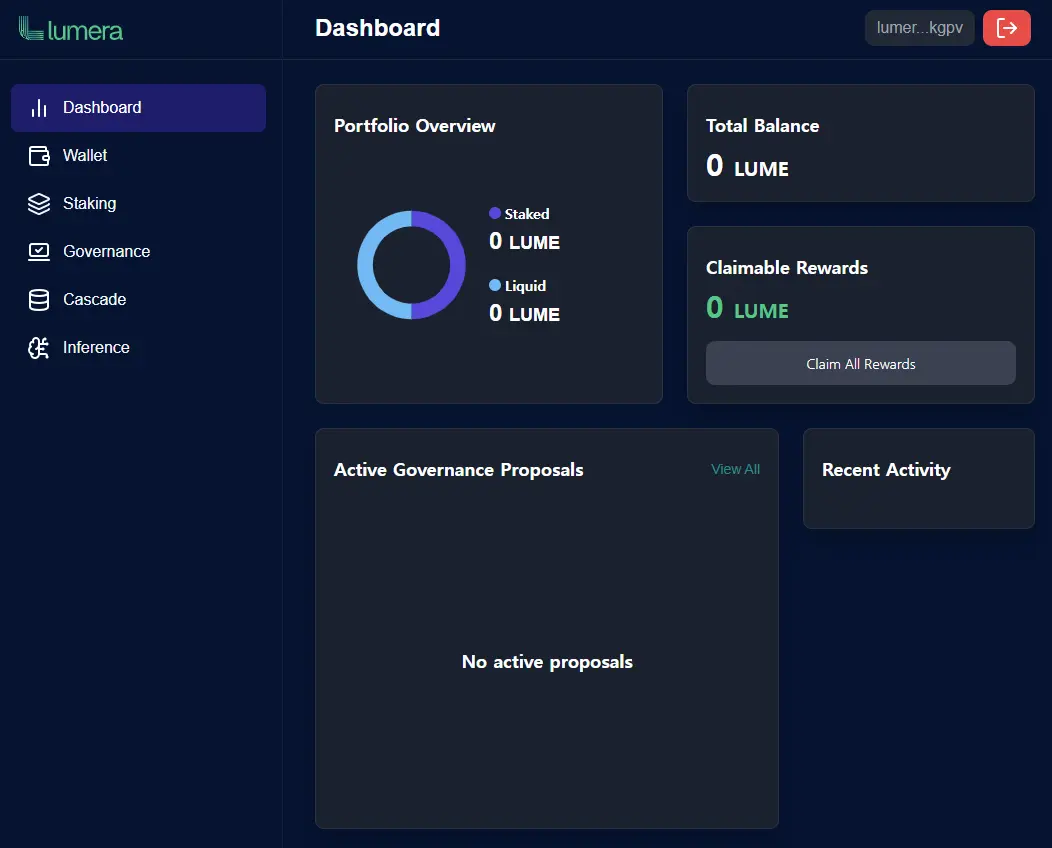
The Hub supports all major wallets within the Cosmos ecosystem—including Keplr, Leap, and Cosmostation—allowing users to connect existing wallets without additional setup. Once connected, users can view their assets in a portfolio format, participate in token staking and governance, and directly interact with Lumera’s core modules, such as Cascade and Inference, through a unified interface.
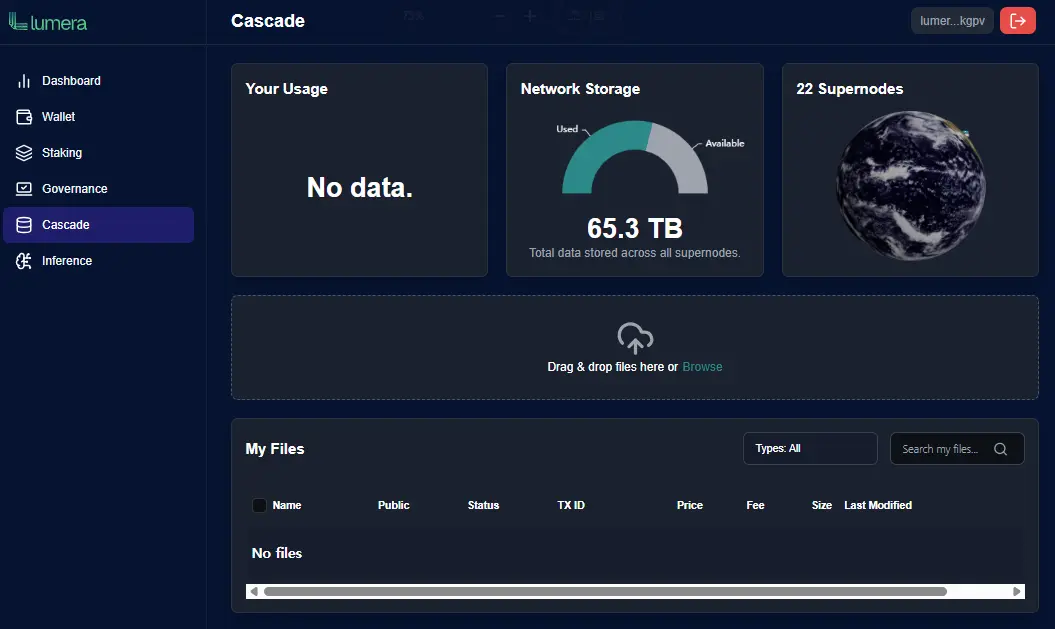
Among currently available features, Cascade represents the primary functionality accessible to general users. Files such as images and videos can be uploaded via a drag-and-drop interface; a one-time payment of LUME tokens, proportional to the data size, permanently stores the content on the Lumera network. By abstracting away complex configuration requirements, Cascade emphasizes a user-centric experience for decentralized permanent storage.
While Lumera Hub remains in the testnet phase, mainnet services have already been selectively deployed for partner institutions. As a result, the network has accumulated approximately 12TB of stored data and generated around $0.38M in annualized revenue to date. A mainnet transition for Lumera Hub is planned within the next one to two months; once paired with broader user onboarding, ecosystem activity is expected to accelerate meaningfully.
3. 2026 Roadmap: From Infrastructure Readiness to Adoption
3-1. Roadmap Overview and Strategic Priorities
Across its testnet and early mainnet phases, Lumera has validated its core modules—Cascade, Inference, and Sense—alongside the SuperNode architecture and an initial base of users and ecosystem partners. The year 2026 represents a transition from technical validation to scaled execution: expanding real-world usage, deepening integration with external ecosystems, and establishing sustainable patterns of network utilization.
In support of this objective, the Lumera Foundation has allocated a total of 12.5 million LUME throughout 2026 for ecosystem expansion and marketing initiatives. These tokens are designated to accelerate community growth, multichain integration, and the onboarding of developers, validators, and institutional partners.
Key priorities by quarter are outlined below.
- Q1 2026
- Listings on centralized exchanges (CEXs)
- Fiat and crypto on/off ramps go live
- Additional multichain wallet integrations
- Deeper partnerships with Cosmos-based chains and applications
- Continued SuperNode onboarding
- Broader LUME utility via integration with Cosmos DeFi protocols such as Osmosis and Helix
- Q2 2026
- Expansion beyond the Cosmos ecosystem
- Strategic partnerships with EVM- and SVM-based projects
- Lumera positioned as a neutral, modular infrastructure layer independent of any single chain
- Ongoing multichain wallet integrations and SuperNode onboarding
- Q3 2026
- Full mainnet activation of Lumera’s module suite, including Inference and Sense
- Ecosystem growth driven by offline events, hackathons, and developer programs
- Continued partnership development across Cosmos, EVM, and SVM ecosystems
- Additional CEX listings
- Q4 2026
- Introduction of the MCP layer to extend the modular architecture
- Continued partnership formation and SuperNode onboarding
3-2. SuperNode Onboarding and Upgrades (LEP-4)
Lumera’s SuperNodes differ fundamentally from conventional Validators: they do not participate in chain consensus or block production. While Validators are responsible for maintaining secure consensus, SuperNodes function as high-performance infrastructure nodes that execute Lumera’s modular services—Cascade (storage), Inference (AI computation), and Sense (verification). All substantive workloads within the Lumera network, including data storage, AI execution, and verification logic, are therefore processed through SuperNodes.
Given these structural characteristics, Lumera initially operated with a restricted SuperNode participation model. As the network progressed beyond experimentation and began preparing for real-world usage and scale, this approach shifted. On December 19, 2025, Lumera officially opened the SuperNode Program, allowing permissionless applications for participation. This transition marked a move away from a technology-validation phase toward an infrastructure expansion phase capable of supporting sustained service demand.
SuperNode scalability, however, cannot be achieved simply by increasing node count. If nodes with heterogeneous storage capacity, computational performance, network conditions, and software versions are allowed to participate without constraint, service latency or outages can directly translate into degraded user experience. To address this risk structurally, Lumera introduced LEP-4, an upgrade applied on January 5, 2026.
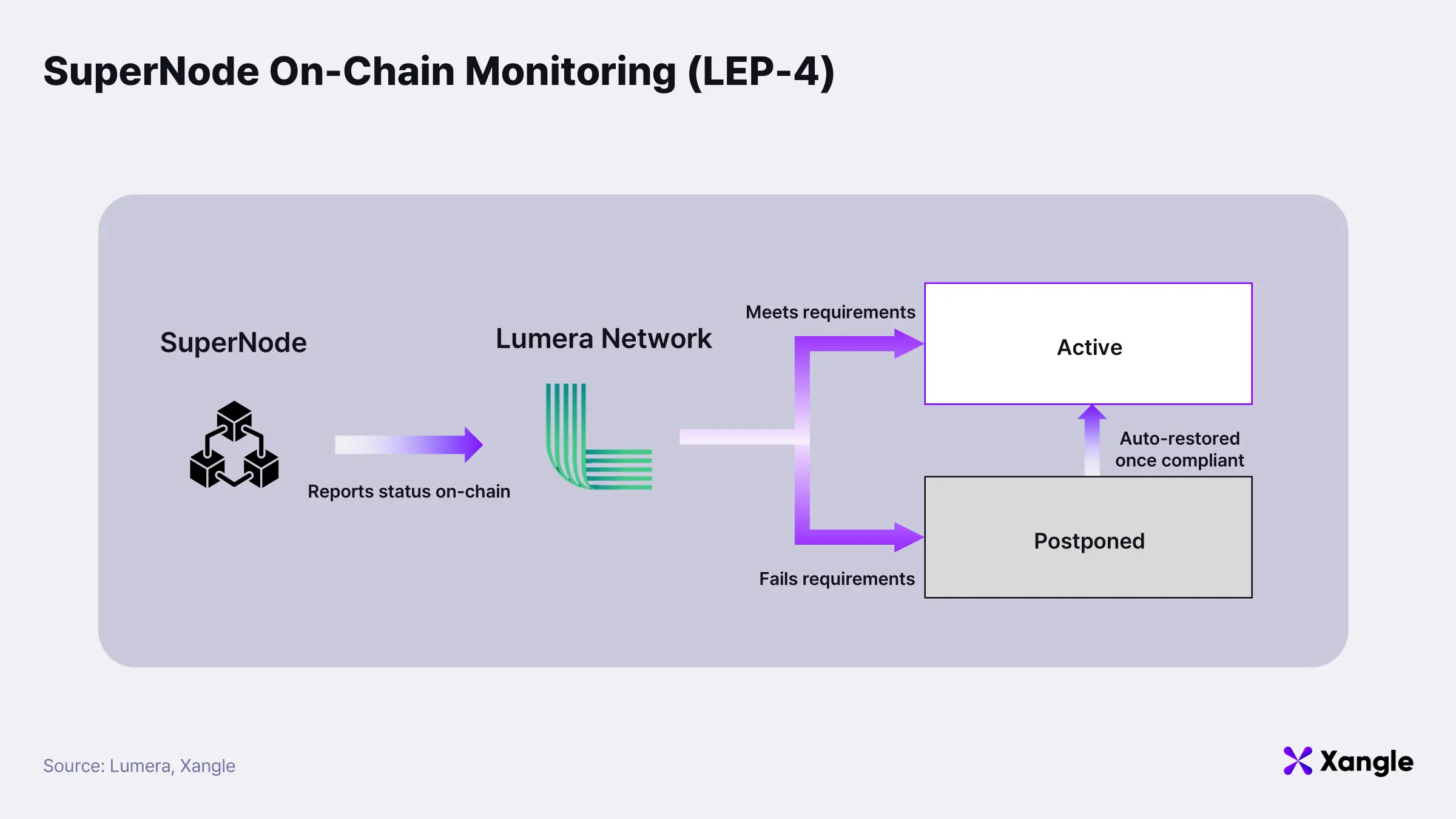
LEP-4 (Lumera Enhancement Proposal 4) introduces an on-chain monitoring system designed specifically for SuperNodes. Each SuperNode periodically reports its operational status on-chain, including service-critical metrics such as CPU, memory, storage, uptime, network port status, and software version. The network compares these metrics against predefined benchmarks to determine whether a given SuperNode is capable of reliably executing Lumera’s modular services.
When a SuperNode fails to meet the required standards, it is not immediately penalized through expulsion or asset slashing. Instead, the node is temporarily excluded from the pool of eligible service providers. This condition is referred to as the POSTPONED state. A key feature of this mechanism is that once the underlying issues are resolved and compliant metrics are resubmitted, the node is automatically restored to active status without manual intervention. In this respect, LEP-4 functions not as a punitive enforcement system, but as an automated safeguard designed to preserve overall network quality.
LEP-4 operates within Lumera’s Audit Module, where SuperNode status is evaluated using a combination of self-reported data, metrics collected during actual Action execution, and external observation signals. This design enables Lumera to open SuperNode participation while maintaining service quality at the protocol level. The resulting structure clearly illustrates Lumera’s positioning: not as a general-purpose Layer 1, but as a modular infrastructure chain explicitly designed around the execution of real-world services.
3-3. Multichain Expansion Anchored in Cosmos
Lumera’s cross-chain expansion strategy is not centered on token bridging between networks. Its core objective is to make Lumera’s modular services, including Cascade (storage), Inference (AI computation), and Sense (verification), directly usable by other chains and applications. The technical foundation enabling this approach is ICS-27 (Interchain Accounts).
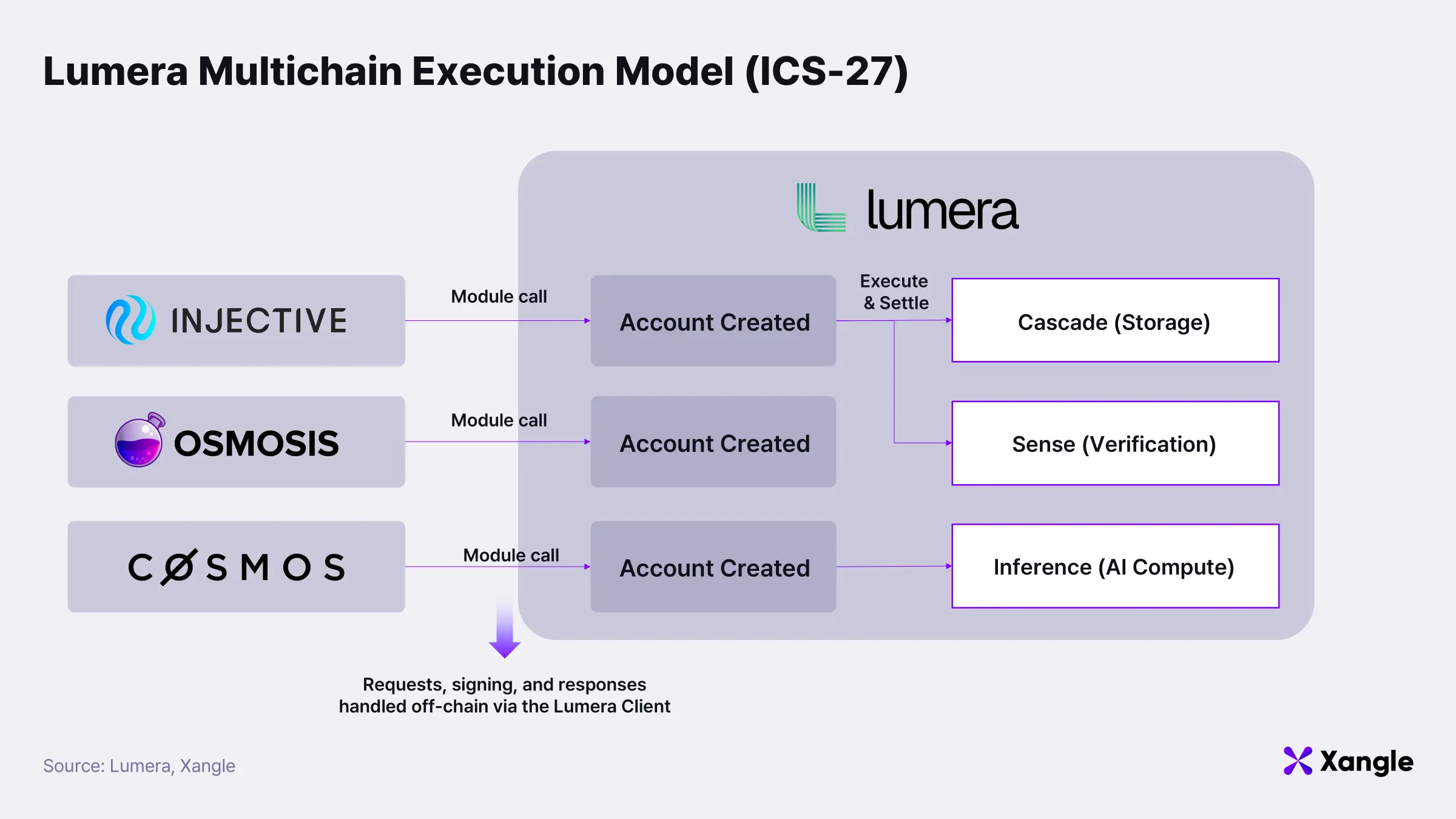
ICS-27 is a standard within the Cosmos IBC framework that allows one chain to create an account on another chain and execute transactions remotely through that account. Under this model, an external chain establishes a dedicated account on the Lumera chain and uses it as the execution endpoint for submitting transactions to the Lumera network.
Lumera leverages this structure so that other Cosmos chains can directly invoke Lumera Actions. The Interchain Account created on the Lumera chain functions as the execution entity for Actions such as Cascade, Sense, and Inference. Fee payment, escrow handling, and settlement of execution outcomes follow the existing logic embedded in Lumera’s Action modules, without introducing a separate cross-chain execution framework.
Operational complexity related to IBC and ICA flows is handled by the off-chain Lumera Client. This client abstracts transaction signing, submission, response handling, and file uploads, removing the need for developers or enterprises to interact directly with low-level cross-chain mechanics. From the perspective of external chains or applications, Lumera’s storage, computation, and verification capabilities can therefore be invoked in a manner comparable to consuming an external service.
A defining characteristic of this architecture is the preservation of Lumera’s existing security and settlement model. Action execution remains bound to the Interchain Account address, while escrow-based fee distribution and settlement logic, triggered by execution completion or expiration, remain unchanged. As a result, Lumera’s economic and security assumptions remain stable even in cross-chain environments.
In its initial phase, this expansion proceeds through Cosmos-centric integration using ICS-27. Lumera’s longer-term objective, however, extends beyond a single ecosystem. Beginning in the second quarter of 2026, the project plans to pursue partnerships with EVM- and SVM-based networks, positioning Lumera as a chain-agnostic and neutral modular infrastructure layer. Cosmos-based integrations will continue in parallel, while the scope of service invocation expands across a broader blockchain landscape.
In summary, ICS-27–based expansion reframes Lumera not as a standalone chain, but as a shared execution layer callable across multiple chains and applications. This approach is central to Lumera’s strategy of evolving beyond a storage-focused or AI-specialized chain and establishing itself as modular infrastructure with practical, recurring usage across diverse ecosystems.
4. Closing Remarks: 2026 as Lumera’s Market Test
Lumera is not positioned as a general-purpose smart contract platform. It is a Web3 AI–specialized infrastructure chain architected around clearly defined modules: AI computation, permanent storage, and content verification. The year 2025 marked Lumera’s transition from conceptual experimentation to live operation. Despite continued constraints on retail access, measurable revenue and storage utilization have already emerged. In addition, partner-led early demand translating into tangible on-chain activity serves as an initial signal of Lumera’s viability as an infrastructure layer. The transition to a public SuperNode participation model and the introduction of LEP-4 further underscore a long-term strategy focused on maintaining service quality at the protocol level as the network scales.
The direction of the 2026 roadmap is clear. Accessibility is set to expand through the mainnet launch of Lumera Hub and listings on centralized exchanges. At the same time, Lumera aims to establish itself as a neutral, modular infrastructure layer operating across a multichain environment, beginning with Cosmos and extending into EVM and SVM ecosystems. Within this framework, the ICS-27–based cross-chain architecture represents a critical inflection point. It shifts Lumera from a single-chain deployment to a shared execution layer that can be invoked across multiple networks.
Ultimately, Lumera’s success will not be determined by short-term traffic metrics. The decisive criterion lies in whether core modules such as Cascade, Inference, and Sense are repeatedly invoked across real applications and heterogeneous chain environments, and whether they become embedded as production-grade infrastructure. The year 2026 therefore represents a defining test. It is the period in which Lumera must demonstrate sustained, practical usage and validate whether its positioning as a Web3 AI infrastructure layer remains viable under market conditions.
Disclaimer
I confirm that I have read and understood the following: The information contained in this article is strictly the opinions of the author(s). This article was authored free from any form of coercion or undue influence. The content represents the author's own views and does not represent the official position or opinions of CrossAngle. This article is intended for informational purposes only and should not be construed as investment advice or solicitation. Unless otherwise specified, all users are solely responsible and liable for their own decisions about investments, investment strategies, or the use of products or services. Investment decisions should be made based on the user’s personal investment objectives, circumstances, and financial situation. Please consult a professional financial advisor for more information and guidance. Past returns or projections do not guarantee future results. This article was written at the request of Lumera. All content in this article was written independently by the author(s), and neither CrossAngle nor Lumera had any editorial control or influence over the content. The author(s) may hold the cryptocurrencies mentioned in this article at the time of writing.
Xangle or its affiliated partners own all copyrights of the written or otherwise produced materials and content provided on the platform. Any illegal reproduction of such content, including, but not limited to, unauthorized editing, copying, reprinting, or redistribution will result in immediate legal actions without prior notice.
![[CIS Partner Summit Highlights] Ault's Financial Super App Strategy: OnlyBulls](https://resource.xangle.io/files/content/C1A19E1DB41B7FB86076143803C40D8E_1790125531662.webp)
![[Xangle RWA Series] Solana RWA: A Look at the Key Players](https://resource.xangle.io/files/content/F779A005246C0299246537AACB3A39F2_1782287059970.webp)