PerpDEX’s Memecoin Strategy: The Economics of Hype and Community

1. The Economics of TGEs: Attention Is All You Need
2. The PerpDEX Race: Winner Takes All
3. PerpDEX Memecoins: Nothing but Everything
4. The Hype War: There Can Be Only One
5. How Far Can It Go? All or Nothing
1. The Economics of TGEs: Attention Is All You Need
There is a simple rule that governs the crypto market: the first coin to launch becomes the owner of the narrative. The logic is straightforward — the earliest mover captures attention before anyone else. The recent cases of Succinct and Boundless illustrate this dynamic clearly. Despite sharing near-identical characteristics and launching their TGEs around the same period, Succinct’s slightly earlier release had a disproportionately large influence on the valuation gap between the two.
In a market where narratives flip quickly and prices move just as violently, securing attention first becomes the decisive factor. This structural reality pushes most projects to accelerate their TGE ahead of competitors; when that isn’t possible, they resort to any method available to keep attention from fading.
Among today’s narratives, one in particular dominates the spotlight: PerpDEX, decentralized perpetual futures exchanges. The surge in interest does not stem from a narrative born solely within the crypto ecosystem. PerpDEX has instead emerged as the competitive arena where centralized exchanges (CEXs) are forced into a high-stakes chicken game for market leadership.
2. The PerpDEX Race: Winner Takes All
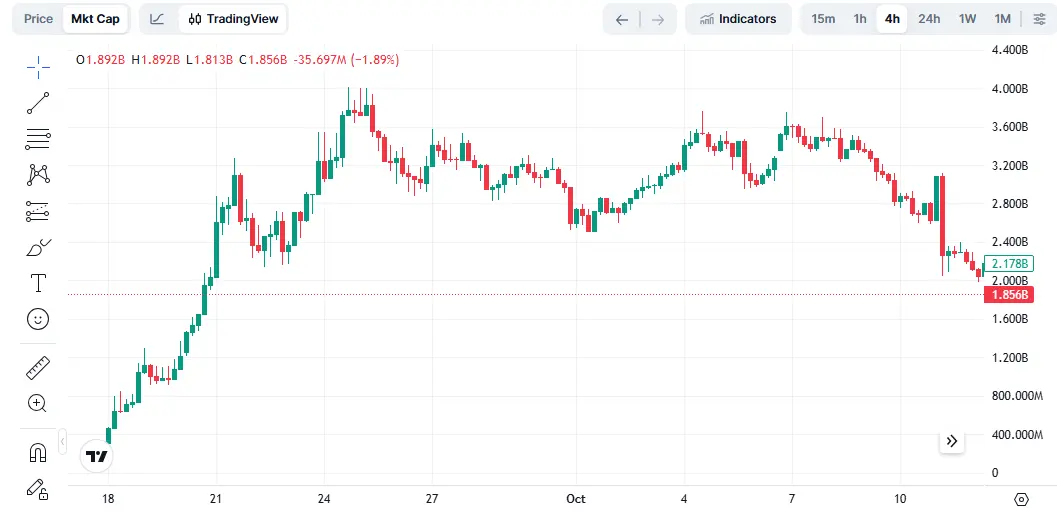
The primary reason PerpDEX has surged into investor focus is the explosive price performance of recently launched PerpDEX tokens. Hyperliquid is widely viewed as the flagship success case, yet several other PerpDEX projects that held their TGE in recent weeks have also seen valuations accelerate at extraordinary speed.
Source: Coinmarketcap
A clear example is the performance of $AVANT and $ASTER. Both Avantis and Aster were relatively overlooked PerpDEX contenders at the time, but once they secured backing from Coinbase and Binance, respectively, their growth trajectory shifted dramatically. Within a matter of days, each rallied close to 1,000%. This level of price aggression and valuation expansion reflects a broader belief forming in the market: PerpDEXs are no longer seen as another class of decentralized exchanges (DEXs) but as potential catalysts capable of rewriting the competitive dynamics of crypto trading itself.
Source: Dune
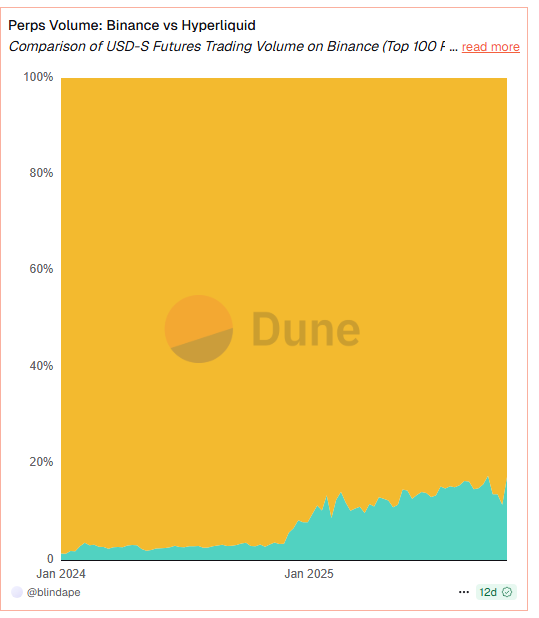
The gap between Hyperliquid and Binance remains substantial, yet Hyperliquid continues to close the distance. While CEXs continue to hold dominant market share, users are gradually shifting toward PerpDEXs for their transparency and value-distribution model, which contrasts sharply with the opaque structure of CEXs that do not share revenue with users. Just as DEXs increasingly encroach on CEX territory, CEXs are now pushing back. Binance, Coinbase, and Bybit are aggressively promoting their own chains, BNB, Base, and Mantle, to consolidate on-chain influence. As the boundary between CEX and DEX blurs, PerpDEXs are evolving into financial hubs that bridge on-chain ecosystems with real-world exchange infrastructure. In effect, the ongoing PerpDEX race is poised to become one of the most intense competitive battles in the industry.
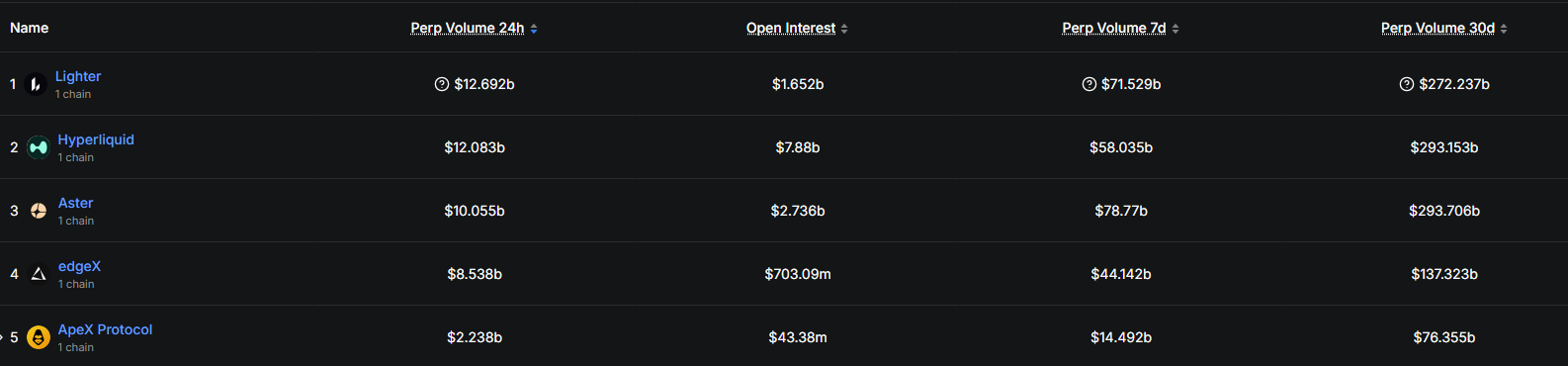
The strong performance of Avantis and Aster naturally redirected investor attention toward Lighter and EdgeX — two platforms that have not yet conducted their TGE but already command significant trading volume. Despite the absence of major exchange backing, both Lighter and EdgeX attracted users by delivering an experience comparable to Hyperliquid. Lighter, in particular, gained pre-TGE momentum with its “0% fee” policy, positioning itself as one of the most anticipated upcoming launches. Yet the success of Aster and Avantis created both opportunity and pressure. Lighter and EdgeX must now prove they can achieve similarly elevated valuations at TGE — and, perhaps more importantly, sustain them as Hyperliquid did.
For PerpDEXs, token price functions as more than a speculative indicator; it directly influences product performance. Exchanges benefit from strong network effects: rising user activity increases liquidity depth, which in turn enhances execution quality and attracts even more users. Sustained token strength increases perceived airdrop value, giving users additional motivation to continue trading. In this sense, price becomes a strategic tool — a mechanism for generating hype and reinforcing user lock-in.
Source: defillama
A successful launch hinges on two conditions: a continuous inflow of new users and a strong base of existing users willing to hold the token. Airdrops remain one of the most effective methods for driving new participation. Fully aware of this dynamic, both Lighter and EdgeX allocated substantial community distributions within their tokenomics.
Even so, this approach alone cannot fully solve the problem. Larger airdrop allocations inevitably translate into higher selling pressure once tokens unlock, prompting the need for a different strategy to mitigate it. At the same time, one exchange captured market attention with a surprisingly inventive approach — Based.
3. PerpDEX Memecoins: Nothing but Everything
Based is a mobile exchange built on Hyperliquid’s Builders codebase. Ahead of its TGE, the team operated a point system that rewarded user trading activity. Users who accumulated these points later received an airdrop of a memecoin called $PUP. At peak, PUP reached a market cap of $200 million, igniting substantial hype across the user base.4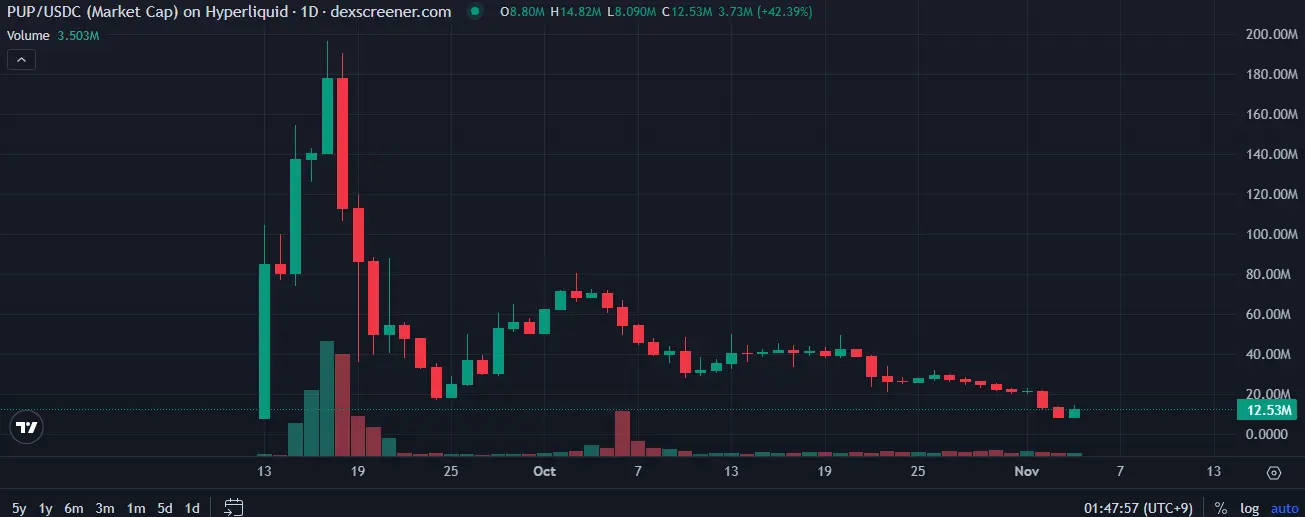
Source: Dexscreener
Because a memecoin does not touch a project’s core tokenomics, it avoids the immediate post-TGE selling pressure that native tokens typically face. The smaller market cap also enables far sharper price reactions to catalysts such as buybacks. In a Web3 environment where “being early” is synonymous with generating hype, Based managed to replicate the market effects of a TGE without actually holding one — while simultaneously elevating anticipation for the real TGE still to come. The approach gave existing community members a sense of belonging and conviction, while triggering FOMO among new entrants. In effect, the strategy delivered both heightened attention and deeper community loyalty at the same time.
Source: defillama (Date : 9/11)
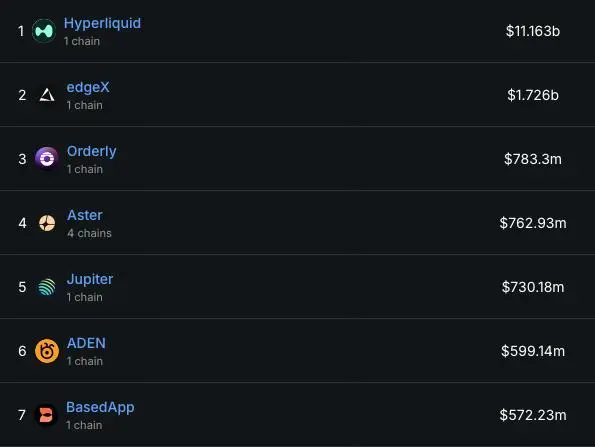
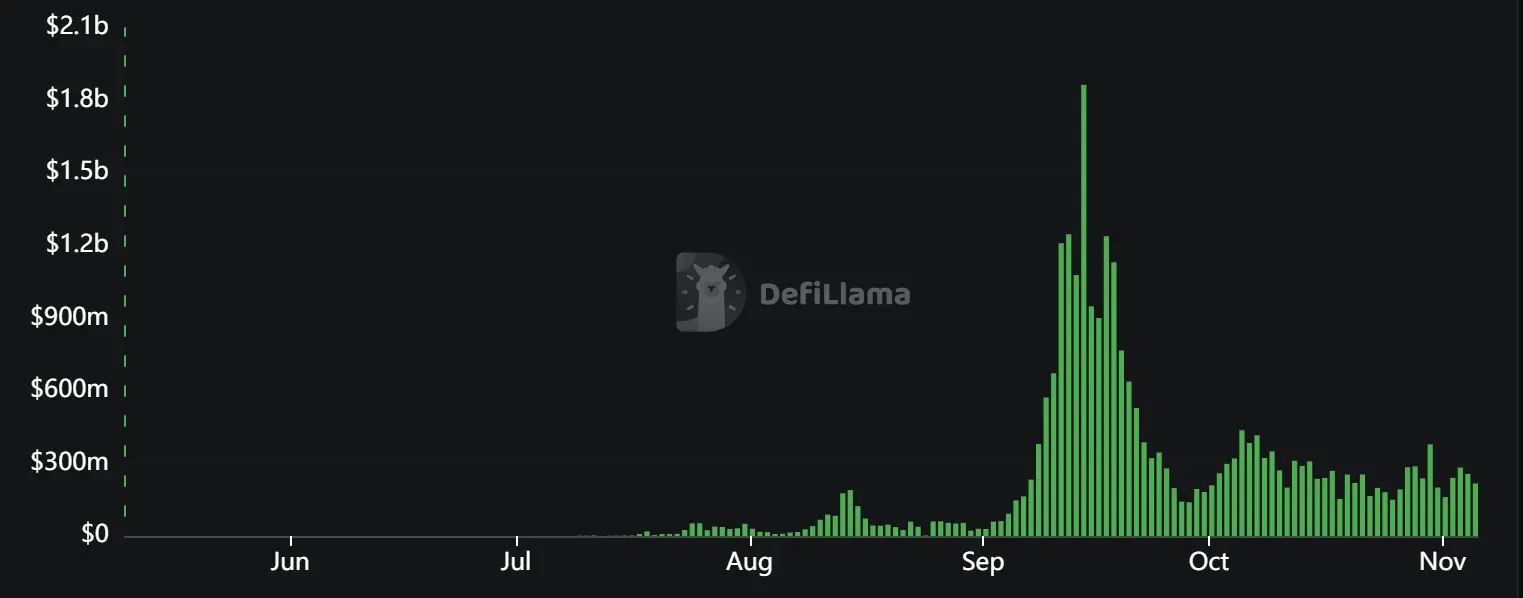
The results were significant. As PUP rallied, Based’s trading volume surged in tandem, and by September 11, Based had climbed to 7th place among all PerpDEXs by volume. The achievement is especially notable given that most of the other top-ranking PerpDEXs were already well-established names, whereas BasedApp was essentially a lightweight mobile interface built on Hyperliquid.
Source: defillama
Sustaining that momentum, however, proved difficult. Delays to the TGE gradually weakened PUP’s price, and user interest in Based began to fade. Trading volume declined accordingly. Although Based captured strong marketing impact and drove substantial user inflow through its memecoin launch, the project ultimately fell short of converting that attention into sustained anticipation for its TGE — resulting in a half-fulfilled success story.
The takeaway from Based’s trajectory was straightforward. Hype matters as much as — and sometimes more than — product quality and unique competitive advantages. Yet the episode also demonstrated that hype without continuity risks devolving into a short-lived promotional flash. That realization is what led Lighter and EdgeX to replicate Based’s playbook.
4. The Hype War: There Can Be Only One
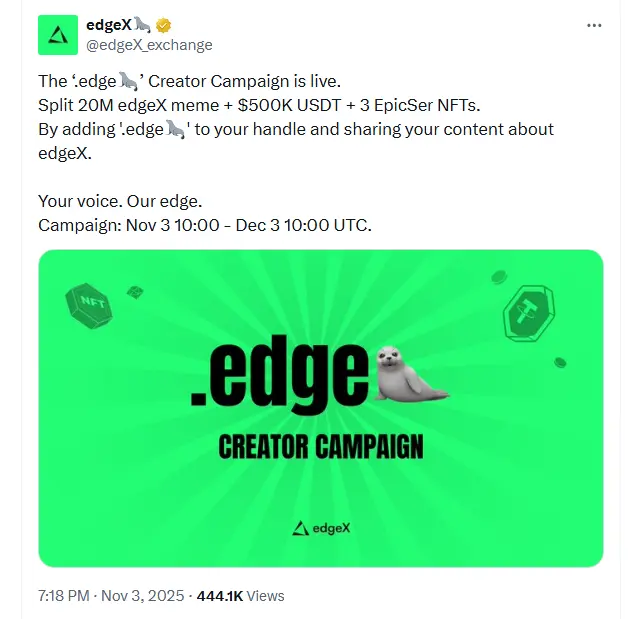
Lighter has followed Based’s playbook by committing to airdrop a memecoin called LIGER. EdgeX has taken a similar route with the launch of its own memecoin, $MARU. Lighter already holds an advantage due to the early momentum created by its 0% fee policy, leaving EdgeX noticeably behind in terms of hype. That gap has driven EdgeX to confront Lighter directly in the memecoin arena, signaling an aggressive push to catch up.
Source: EdgeX Official X
EdgeX has even gone as far as hosting a full-scale memecoin contest, making clear its intent to pull in as much hype as possible. The approach suggests a deliberate strategy: release the memecoin early, spark a strong price rally, draw in a large wave of users, and extend that momentum straight through to the TGE. The thinking behind this is straightforward — with Lighter currently dominating the hype narrative, winning the memecoin race appears to be the most accessible path for EdgeX to overtake Lighter before TGE.
A second layer reinforces this urgency. Even if EdgeX manages to capture brief attention around its TGE, the market is widely expecting hype to converge around Lighter once Lighter conducts its own TGE in December. That expectation seems to have pushed EdgeX into an all-in stance, choosing to fight for hype now rather than risk being overshadowed later. The memory of Based’s PUP rally also looms large: had Based executed its TGE at the peak of PUP’s momentum, it could have delivered an outsized success. That precedent likely shaped EdgeX’s current strategy.
5. How Far Can It Go? All or Nothing
The potential upside for Lighter and EdgeX’s memecoins can be estimated by looking at previous examples. Hyperliquid’s $Purr NFT reached a peak market capitalization of roughly $600 million, while Based’s memecoin PUPsurpassed $200 million at its high. Those numbers alone suggest the possibility of outsized success. Even so, an important distinction exists: Hyperliquid’s community at the time was exceptionally strong, whereas Lighter and EdgeX have yet to build communities with comparable depth or cohesion.
That gap, however, does not imply their memecoins are unlikely to appreciate. The upcoming launches function simultaneously as a “trial TGE” and as a stress test for each project’s community strength and hype durability. The higher these memecoins trade, the more they directly reinforce each PerpDEX’s perceived valuation and overall project momentum.
Given this setup, both Lighter and EdgeX are positioned to push aggressively to elevate their memecoin prices. The issuance is more than a user acquisition tool or a vehicle for sustaining hype; it is a pivotal moment for each project to establish and validate its valuation narrative ahead of TGE. Commitments to buybacks—or similar mechanisms that support price stability—are highly plausible as part of this strategy. For that reason, the memecoin rollout from both PerpDEXs deserves close attention in the lead-up to their TGEs.
Disclaimer
I confirm that I have read and understood the following: The information contained in this article is strictly the opinions of the author(s). This article was authored free from any form of coercion or undue influence. The content represents the author's own views and does not represent the official position or opinions of CrossAngle. This article is intended for informational purposes only and should not be construed as investment advice or solicitation. Unless otherwise specified, all users are solely responsible and liable for their own decisions about investments, investment strategies, or the use of products or services. Investment decisions should be made based on the user’s personal investment objectives, circumstances, and financial situation. Please consult a professional financial advisor for more information and guidance. Past returns or projections do not guarantee future results.
Xangle or its affiliated partners own all copyrights of the written or otherwise produced materials and content provided on the platform. Any illegal reproduction of such content, including, but not limited to, unauthorized editing, copying, reprinting, or redistribution will result in immediate legal actions without prior notice.