
How GAIB Makes Real-World AI Infra Investment Accessible to Everyone
1. In the Age of AI, What We’re Missing Is the Cash Flow of GPUs
2. GAIB, Opening Access for Retail Investors to GPU Cash Flow Opportunities
2-1. Why Traditional Capital Formation Fails: The GPU Valuation Challenge
2-2. GAIB’s Edge: On-Chain Metrics and Tokenized Investment Execution
2-3. The AID Token: Tokenizing the AI Data Center Investment Process
3. Benefits of Investing in AI Infra through GAIB
3-1. Beyond GPUs, GAIB Has Expanded to Embodied AI - Robotics
3-2. $GAIB Tokenomics as an Additional Investment Incentive
3-3. Enhancing Capital Efficiency and Diversifying Investment Strategies through DeFi
4. Conclusion: Can GAIB Set a Precedent for Capital Formation in Emerging Industries?
1. In the Age of AI, What We’re Missing Is the Cash Flow of GPUs
As the era of large-scale AI approaches, one sector demands particular attention—GPU infrastructure. Large language models (LLMs) such as ChatGPT require enormous computing power. Training a single LLM can involve tens of thousands of GPUs, with capital expenditures (CAPEX) reaching hundreds of millions to billions of dollars. Even after training, inference costs remain substantial—operating ChatGPT, for example, is estimated to cost around $700,000 per day. In short, GPU is the core infrastructure and the largest cost drivers behind AI development.
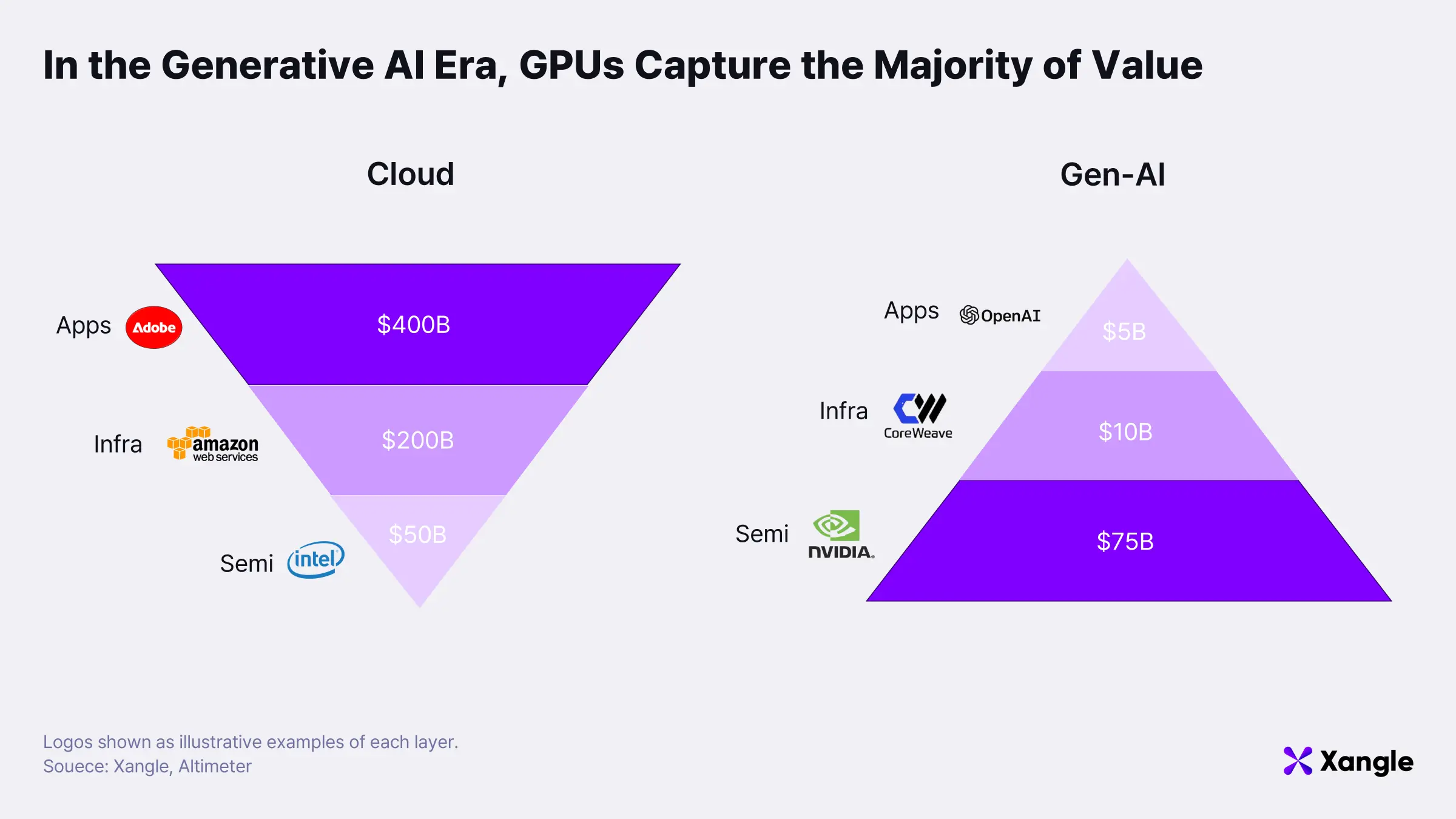
As a result, the generative AI infrastructure stack has formed a fundamentally different value structure from traditional IT infrastructure. In the conventional cloud market, most of the value accrued to application-layer companies that directly interacted with end users, rather than to infrastructure providers. According to analysis by Altimeter, the value distribution of the cloud industry is roughly $400 billion in the application layer, $200 billion in the infrastructure layer, and $50 billion in the semiconductor layer.
In contrast, within the generative AI industry, this structure has been completely reversed. The semiconductor layer, led by companies like NVIDIA, now captures around $75 billion in value, followed by the AI data center infrastructure layer represented by firms such as CoreWeave at $10 billion, and finally the application layer, including OpenAI, at approximately $1 billion.
Consequently, GPUs are no longer viewed as simple hardware components—they have evolved into “digital oil” and even “national strategic assets”.
However, despite the explosive growth in the economic value of GPUs, opportunities to directly invest in the cash flows generated by GPUs remain extremely limited. Although GPUs form the foundation of the AI infrastructure and generate substantial profits, these cash flows are largely confined within the closed domains of major technology corporations and private equity firms.
So, what investment opportunities are actually accessible to ordinary investors?
The most obvious candidate is NVIDIA. With more than 92% market share in AI data center GPUs, NVIDIA remains the purest play on AI infrastructure growth. However, its current valuation—trading at roughly 50x forward P/E—appears stretched. Above all, NVIDIA is merely a manufacturer that supplies GPUs — it has no direct access to the cash flows generated through the actual operation of those GPUs.
Big Tech players such as Amazon, Microsoft, and Google are themselves investing heavily in AI data centers. However, their diversified revenue streams across cloud, advertising, e-commerce, and enterprise software dilute investor exposure to the pure upside of data center buildout.
Data center REITs (e.g., Digital Realty Trust, Equinix) offer another angle but remain encumbered by real estate regulation, dividend obligations, and an operational focus on legacy infrastructure—far removed from the hypergrowth curve of AI-specialized capacity.
The more structural problem, however, lies in accessibility. AI data centers represent a rapidly scaling emerging industry, yet the universe of publicly listed operators remains thin. Retail investors face extremely limited entry points. Private equity giants such as Blackstone, which has deployed more than $40 billion into data centers since 2021, and Brookfield, with a $30 billion portfolio, dominate the space. These deals are overwhelmingly in private markets, with minimum commitments in the billions—well beyond the reach of retail investors.
To address these barriers, some firms have begun treating data centers as infrastructure projects using project financing (PF) structures that rely on the project’s cash flow for repayment. While PF offers relative stability, it still excludes retail investors and typically demands large upfront capital commitments.
2. GAIB, Opening Access for Retail Investors to GPU Cash Flow Opportunities
The reason this article begins by highlighting the importance of GPUs and the limited investment opportunities surrounding them is that the project we will examine — GAIB — aims to solve exactly this problem.
GAIB positions itself as a Web3-native solution designed to address both sides of the equation—lowering barriers to investor participation while easing capital formation for data centers. At its core lies a structured finance framework that channels onchain capital liquidity to offchain data center operators, while returning yields from a diversified portfolio of GPU-backed financing deals to onchain investors. Put simply, GAIB tokenizes the financial structure of data center investment.
Two features distinguish GAIB. First, it compresses the cost and latency of traditional financing. Banks shy away from GPUs due to limited understanding of their asset value, while VCs and private equity firms impose both high cost of capital and lengthy decision cycles. GAIB, by contrast, unlocks additional on-chain capital liquidity and underwrites financing deals more efficiently and flexibly, tailoring them to specific capital needs.
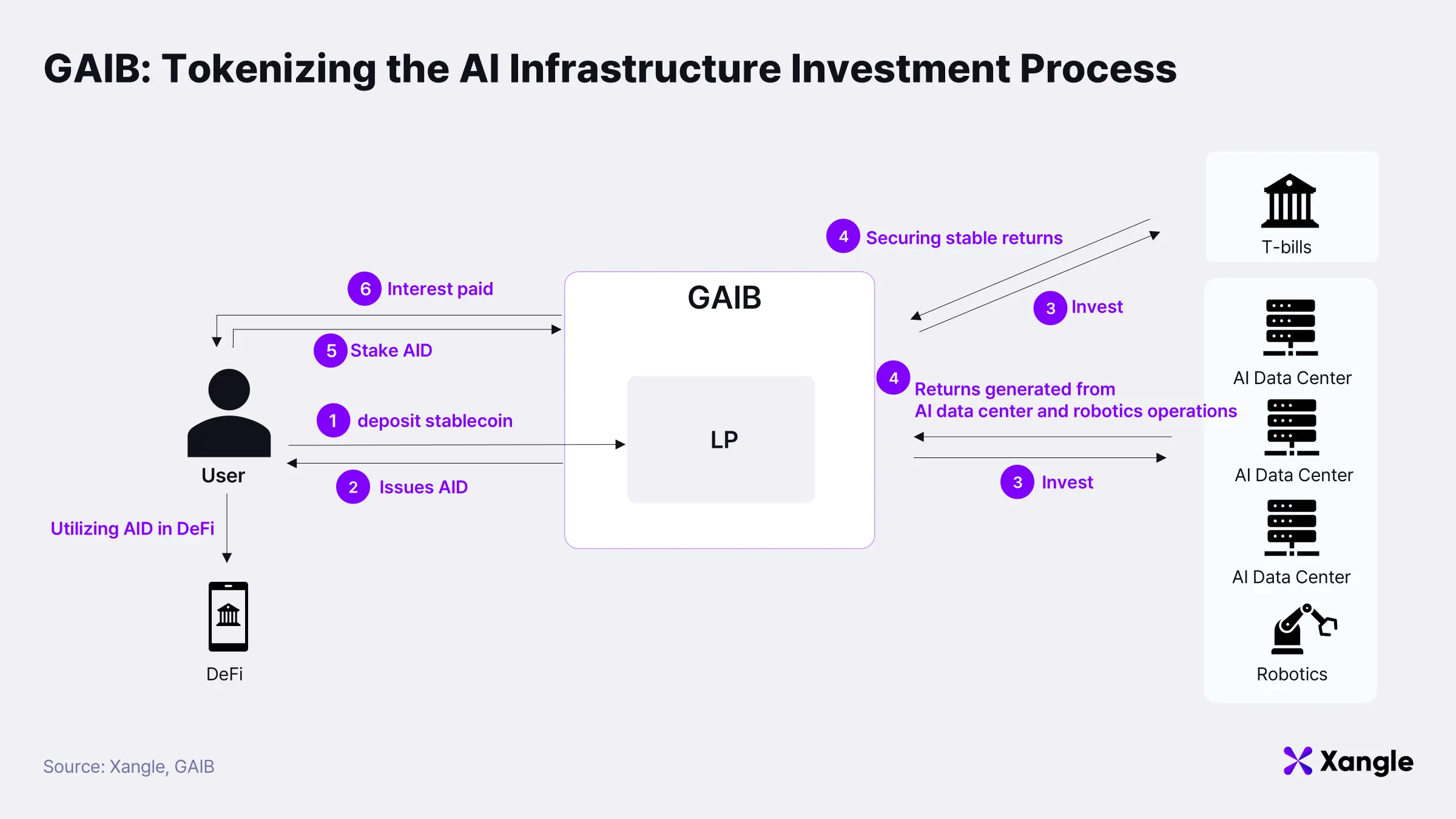
Second, it introduces investment democratization via AID (AI Dollar). Retail investors can exchange stablecoins (e.g., USDT, USDC) for AID at 1:1, and then stake AID to have sAID (staked AID) which is a yield-bearing fund token, gain direct exposure to revenue streams generated from real-world GPU operations. Unlike REITs or Big Tech equities, this model provides direct, unfiltered exposure to AI infrastructure yields.
While most Web3 AI projects aim to merge crypto with AI models or computing resources, GAIB represents a different paradigm: it expands retail investor accessibility to AI infrastructure while simultaneously creating a more efficient capital formation mechanism for AI data centers and Neoclouds.
2-1. Why Traditional Capital Formation Fails: The GPU Valuation Challenge
To understand why AI data centers struggle with capital formation, it is crucial to first examine GPUs as an asset class. NVIDIA’s H100 GPU, the best-selling model last year, costs roughly $30,000 per unit, making it a high-value piece of hardware. Yet the traditional financial system lacks clear benchmarks for assessing its expected returns or collateral value. Banks prefer collateral like real estate or automobiles—assets supported by decades of established valuation methodologies and highly liquid secondary markets. Even when prices fall, the extent of decline is predictable, and liquidation via auction remains straightforward.
GPUs, by contrast, represent an entirely different category of asset. The pace of innovation is such that within one to two years, a new generation can render existing models obsolete. The secondary market for GPUs is opaque, offering little visibility for lenders. For banks, they are simply too risky to accept as collateral. The problem is compounded by tighter lending standards after the 2008 financial crisis and the 2023 U.S. banking crisis, leaving Neoclouds without investment-grade credit ratings effectively locked out of bank financing altogether.
Venture capital and private equity might appear better suited, given their expertise in early-stage technology investment. CoreWeave, for example, raised capital at a $2.3 billion valuation in its 2023 Series B. Yet here lies the catch: VC/PE funding comes at a steep cost of capital, effectively 25–40% annually. While structured as equity rather than interest-bearing debt, the required return hurdles are exceptionally high. Companies face relentless pressure to deliver rapid growth and sustained outsized returns. This dynamic clashes with the very nature of data center operations, which are designed to be stable, infrastructure-like businesses rather than high-growth startups.
Structured finance represents the final option, but its advantages are limited. Established data centers with long-term client contracts can leverage these for credit ratings and favorable terms. Newer entrants, however, struggle to qualify. Add to this the multi-month delays caused by complex legal, auditing, and regulatory processes, and structured finance becomes an ill fit for an industry as fast-moving as AI.
In the end, the unique characteristics of GPUs expose the shortcomings of traditional finance. Banks deem them too risky, VC/PE capital is prohibitively expensive, and structured finance is cumbersome and slow. Against this backdrop, GAIB introduces a fundamentally new approach: AI data center investment structured and delivered via tokenization.
2-2. GAIB’s Edge: On-Chain Metrics and Tokenized Investment Execution
How does GAIB address the shortcomings of traditional financing? The key lies in its approach: rather than purchasing and operating GPUs directly, GAIB tokenizes the investment process itself.
GAIB does not hold GPUs on its balance sheet. Instead, it channels GPU purchase capital to multiple data centers, creating a diversified investment structure across dozens of projects. By distributing exposure across various operators, GAIB mitigates concentration risk and builds a more stable return profile. Moreover, as most financing deals are structured as GPU-backed loans, the assets can be liquidated through the secondary market if necessary, ensuring effective capital recovery.
The more fundamental innovation lies in asset evaluation. Traditional financial institutions avoid GPUs because they lack a framework for valuation. GAIB overcomes this with on-chain transparency. Blockchain records allow real-time tracking of GPU utilization, profitability, and contract status. For example, investors can see the physical location and operational information (e.g.,utilization rate, latency, bandwidth, memory, etc) of the collateralized GPU assets. This enables continuous, data-driven risk assessment that far surpasses the static financial statements banks typically rely on.
This positioning also differentiates GAIB from existing real-world asset (RWA) platforms. Centrifuge tokenizes real estate; Maple Finance tokenizes corporate loans. While useful, these are assets already well-integrated into traditional finance. Tokenization in such cases offers only incremental value.
GPUs, however, are inherently different. Because legacy finance cannot properly evaluate them, the value of tokenization and on-chain tracking is immediately evident. Whereas most RWA products yield 5–12% annually, GAIB leverages granular data center monitoring to generate higher returns across structured finance products. According to the GAIB team, bond-like offerings are expected to deliver annualized yields in the 10–20% range, while equity-linked products could return as much as 40–80%, catering to different investor risk appetites.
Ultimately, GAIB’s true differentiation is not in simply tokenizing GPUs, but in building a dedicated financial infrastructure for an entirely new asset class. By filling the gaps left by traditional finance, GAIB simultaneously lowers the cost of capital for data centers and opens direct participation in AI infrastructure growth to retail investors worldwide.
2-3. The AID Token: Tokenizing the AI Data Center Investment Process
1) The Nature and Revenue Structure of AID
At the core of GAIB lies AID — a token fundamentally different from traditional stablecoins. The GAIB team describes AID as a “synthetic dollar.” While USDT is backed by dollar deposits, AID is fully collateralized 1:1 by a reserve of high-quality and highly liquid assets, including U.S. Treasuries, cash equivalents, and major stablecoins.
From an investor’s standpoint, the mechanism is straightforward: deposit stablecoins to receive AID, and stake that AID to obtain sAID (staked AID). Over time, yields generated from GPU financing accumulate in sAID, increasing the amount of AID redeemable per token. For instance, if 1 sAID initially can be unstaked for 1 AID, after one year it may unstake for 1.15 AID — a 15% annualized yield. Later entrants receive fewer sAID for the same AID deposit, but as the redemption ratio rises, they eventually realize comparable returns.
These yields originate from the interest and revenue participation GAIB receives through three types of financing agreements with data centers:
-
Debt Model: Data centers borrow GPU purchase capital and pay fixed annualized interest in the 10–20% range. A live contract exists around 15%, offering attractive terms compared to traditional bank loans while remaining significantly cheaper than VC/PE financing (25–40%).
-
Equity Model: GAIB provides equity financing structures that participate in operating revenues from GPU utilization. This model entails higher risk but also higher potential returns — ideal for investors seeking aggressive upside exposure tied to GPU price appreciation and utilization.
-
Hybrid Model: A combination of fixed interest and revenue participation, designed for operators seeking a balance between stability and yield potential.
By maintaining a diversified portfolio across these three models, GAIB enables investors to tailor exposure according to their individual risk–return preferences.
2) Risk Management and Value Stabilization Mechanisms
For the AID ↔ sAID structure to function sustainably, robust systems for risk control and value stabilization are indispensable. GAIB implements a multi-layered framework focused on investor protection.
The most fundamental safeguard is overcollateralization. For example, if GPU collateral has a present value of $1 million, financing would typically be limited to $600–700k. This ensures that even if market prices fall by 30%, the principal remains fully recoverable
To mitigate the legal and operational risks associated with the data center operator, each financing deal transfers the collateralized GPU assets to a Special Purpose Vehicle (SPV) through a “true sale.” In the event of default, GAIB assumes ownership of the underlying GPUs.
AID’s price stability is sustained through an automated balancing mechanism. When new capital enters the GAIB protocol or yields accrue, AID is minted; when yields are distributed, AID is burned. This continuously aligns AID’s total supply and market capitalization with the value of its underlying reserves. Additionally, dual liquidity pools enable arbitrage-based price convergence — if AID trades below $1 in one pool, arbitrageurs can buy discounted tokens and redeem them elsewhere, naturally restoring the peg.
The core innovation of GAIB lies not in tokenizing a single asset, but in tokenizing an institutional-grade investment process purpose-built for the AI era. By making GPU asset performance transparent and auditable on-chain, GAIB provides AI data centers and Neoclouds with a more efficient access to capital and offers investors direct exposure to the growth of AI infrastructure — effectively bridging the gap that traditional finance has failed to close.
3. Benefits of Investing in AI Infra through GAIB
3-1. Beyond GPUs, GAIB Has Expanded to Embodied AI - Robotics
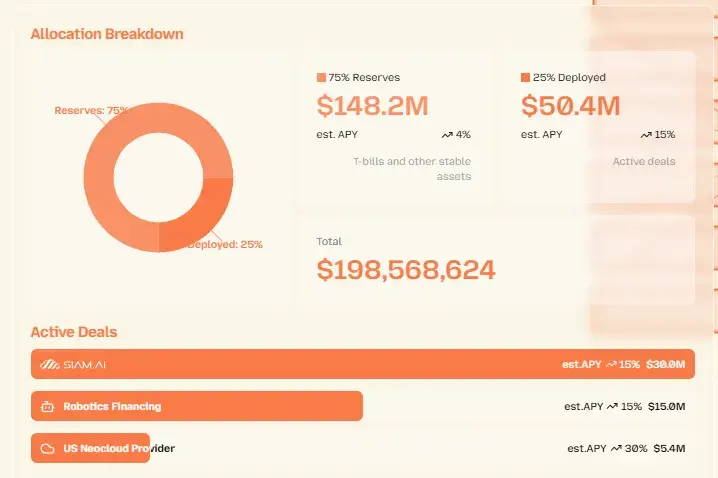
As of October 2025, GAIB manages approximately $200 million in AUM. Of this, roughly 75% is allocated to stable and liquid instruments such as U.S. Treasuries and short-term deposits, while the remaining 25% is directly deployed into AI infrastructure and robotics investments.
 Source: Gaib
Specifically, GAIB has invested around $30 million into Siam.AI, an AI data center operator based in Thailand, which is also the first Nvidia Cloud Partner (NCP) in Asia. Siam.AI provides GPU cloud services to enterprises and research institutions across Southeast Asia and plans to expand its GPU infrastructure to meet the region’s growing AI computing demand. GAIB expects this investment to yield approximately 15% annualized returns. In addition, GAIB has invested $5.4 million in a U.S.-based cloud infrastructure company with target yield of 30%.
GAIB has recently expanded its portfolio beyond GPU infrastructure into the robotics sector. Robotics serves as a core component of AI infrastructure and represents a field capable of generating tangible cash flows across industries such as manufacturing, logistics, and services.
GAIB does not directly provide R&D funding or participate in the development and operation of robots. Instead, it focuses on facilitating large-scale robotic deployment through a series of B2B debt-based financial instruments, supplying essential capital liquidity to the industry and redistributing the stable yields generated from these debt assets to participants within the GAIB ecosystem.
Currently, GAIB has deployed approximately $15 million into a “Robotics Financing” program targeting industrial robotic equipment, aiming for an annualized yield of around 15%. Through this initiative, GAIB seeks to accelerate the large-scale commercialization of the robotics industry and share predictable, asset-backed returns from real-world robotic operations with on-chain investors.
Looking ahead, it remains to be seen whether the robotics sector will evolve into a national strategic asset class comparable to GPUs, and whether GAIB can solidify its position as a core financial infrastructure provider in this emerging domain.
 Source: GAIB
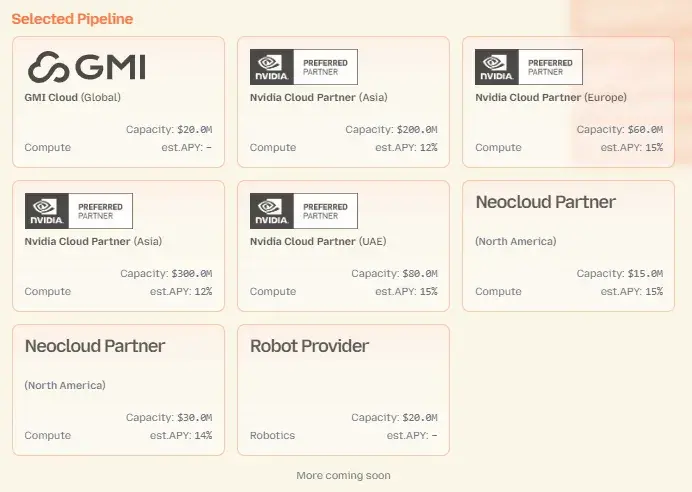
GAIB’s investment pipeline is expected to expand progressively. Current candidates under review include GMI Cloud (Global), NVIDIA Cloud Partners (Asia, Europe, and the UAE), Neocloud Partners (North America), and several Robot Providers, with a total potential investment estimated at approximately $725 million. As GAIB’s on-chain capital deployment continues to grow, these projects are expected to be sequentially incorporated into its investment portfolio.
3-2. $GAIB Tokenomics as an Additional Investment Incentive
Through GAIB, investors gain access to AI data center and GPU infrastructure investments that were previously inaccessible to retail investors. Beyond accessibility, GAIB offers additional token-based incentives that enhance total returns.
The $GAIB token has four core utilities:
-
Governance participation: Users can lock $GAIB into veGAIB to obtain voting power and participate in key decisions, including new real-world asset (RWA) approvals, chain deployments, and protocol fee adjustments.
-
Staking and network security: $GAIB is staked to secure and validate the GAIB network.
-
Investment priority access: Holders and stakers of $GAIB receive priority allocations and discounts for GPU tranches, robotics vaults, and AID/sAID investment products.
-
Ecosystem incentives: A portion of protocol fees is redistributed for validator incentives, treasury accumulation, and ecosystem growth.
In essence, $GAIB functions not merely as a governance token but as a core incentive asset driving investment participation and ecosystem capital circulation. Investors benefit from both direct AI infrastructure exposure and additional token incentives, along with exclusive investment access and discounts.
This structure creates a powerful motivation for investors to choose GAIB over traditional platforms, sustaining continuous capital inflows and long-term ecosystem growth.
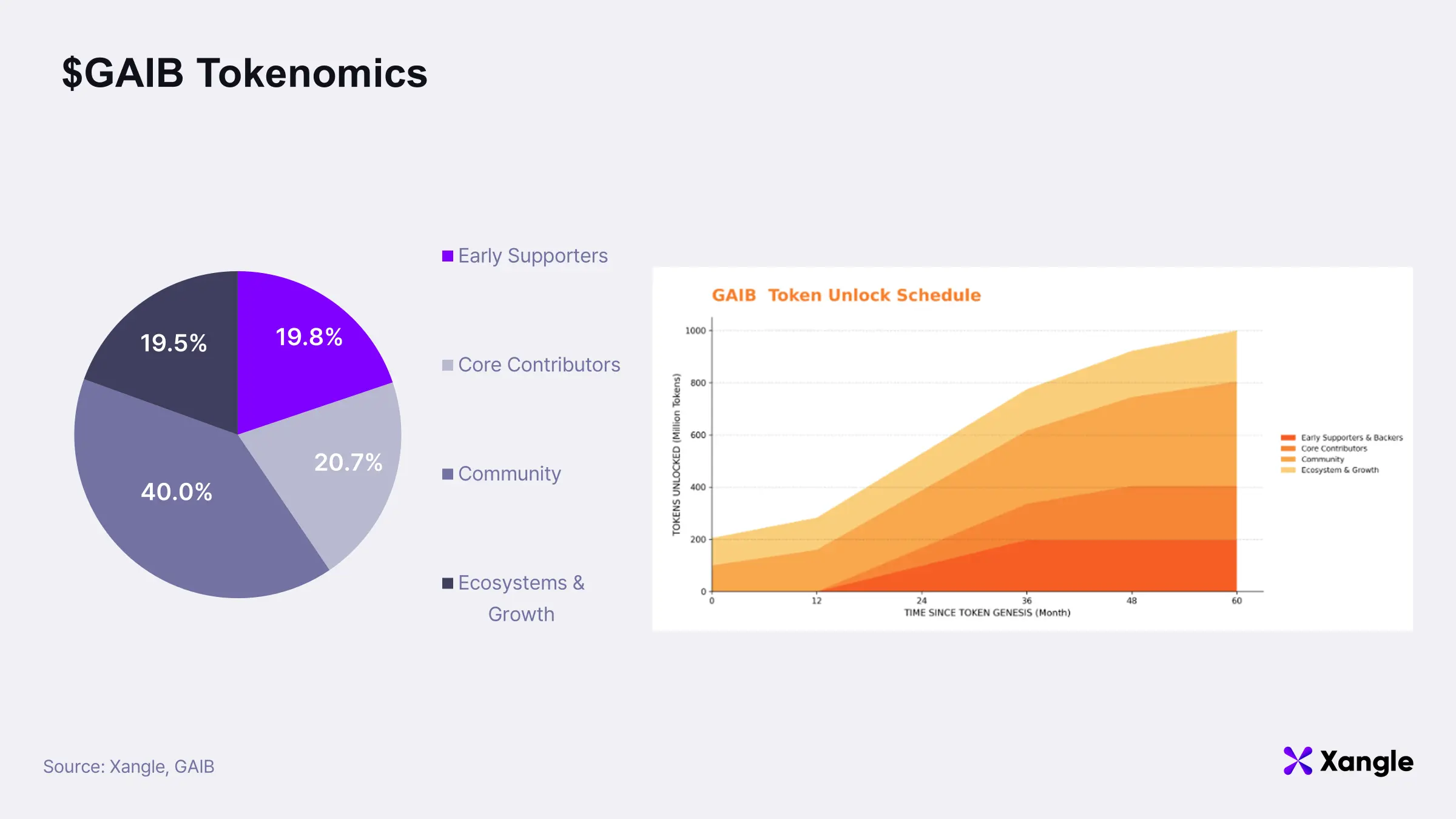
GAIB, which serves as the ecosystem’s primary incentive asset, follows the tokenomics structure outlined below. Out of the total supply of 1 billion tokens, approximately 60% is allocated to the Community (40%) and Ecosystem Growth (around 19.5%), reflecting a design that prioritizes broad participation and long-term expansion of the GAIB economic layer. The remaining tokens are distributed to Early Supporters & Investors (19.8%) and Core Contributors (20.7%), ensuring stable financial and human capital support for the protocol’s long-term development.
3-3. Enhancing Capital Efficiency and Diversifying Investment Strategies through DeFi
When investors deposit stablecoins into GAIB, they receive AID tokens representing their stake. Notably, AID is not a static deposit receipt—it is a fully composable DeFi asset that can be freely utilized across on-chain ecosystems, allowing investors to deploy their capital dynamically instead of locking it up.
For example, if investors need liquidity, they can instantly sell AID on decentralized exchanges (DEXs). Conversely, when aiming to maximize returns, they can supply AID to liquidity pools or integrate it with other DeFi protocols to earn additional yields. Thus, AID provides both liquidity and profitability, ensuring structural flexibility for investors.
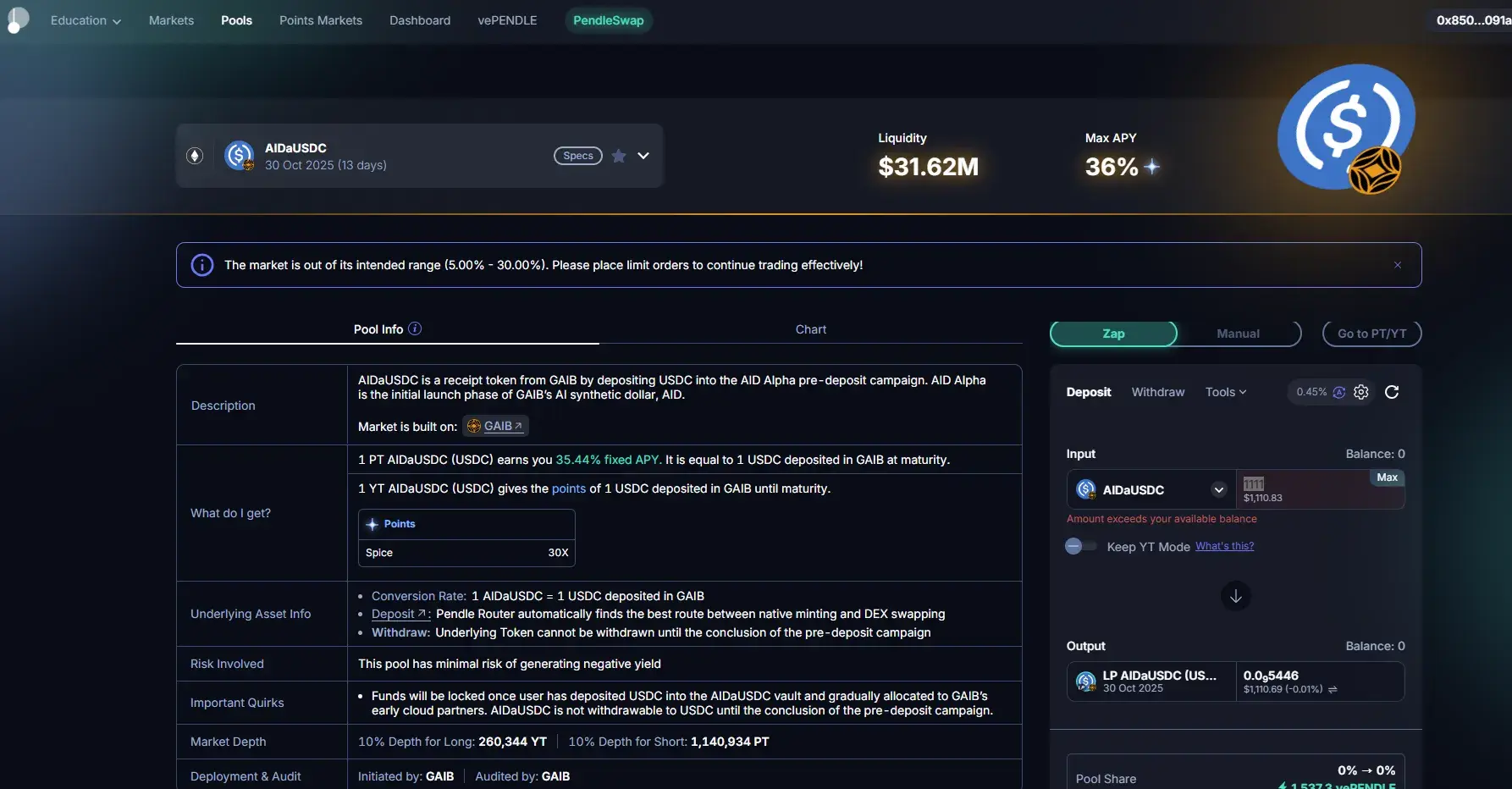
Take Pendle Finance as an example of how AID can be integrated within DeFi. Pendle allows users to split deposited assets into Principal Tokens (PT) and Yield Tokens (YT), enabling investors to trade future yields or lock in fixed income. Pendle currently supports the AID-USDC pool, which—as of October 16—records a TVL of $31.62 million and a maximum APY of 35.99%. By contributing liquidity to the AID-USDC pool, users can earn up to 35.99% additional annualized yield
 Source: Pendle Finance
In conclusion, GAIB enables investors not only to participate in AI data centers and real-world infrastructure investments, but also to earn $GAIB token incentives and enhance yields through DeFi integrations using AID. This creates a unified platform where RWA exposure, token incentives, and DeFi yield generation coexist—maximizing both capital efficiency and strategic flexibility. Ultimately, this integrated structure provides the most intuitive and compelling reason why investors would choose GAIB as their preferred vehicle for AI-era infrastructure investment.
4. Conclusion: Can GAIB Set a Precedent for Capital Formation in Emerging Industries?
For AI data centers, traditional banks failed to recognize GPUs as collateral-worthy assets due to vague valuation standards, venture capital came with prohibitively high costs, and retail investors had virtually no access to the market. In this context, GAIB offers a tangible solution through on-chain transparency and RWA tokenization.
Unlike traditional Web2 industries—where only institutional investors could access structured financial products—GAIB democratizes participation by allowing retail investors to invest directly in early-stage industries through blockchain infrastructure. Sectors once reserved for institutions—AI data centers, robotics, and GPU infrastructure—are now open to anyone, fully on-chain.
Beyond accessibility, GAIB enhances capital efficiency through a combination of $GAIB token incentives and DeFi yield strategies leveraging AID tokens. Investors can earn not only baseline yields from real-world assets but also additional token incentives and DeFi yields, enjoying both profitability and strategic flexibility in a single integrated investment framework.
If models like GAIB succeed, they could open a clear pathway for aggregated retail capital to flow into early, innovation-intensive industries such as AI, Quantum Computing, and Biotechnology—much like how crowdfunding transformed startup financing. While regulatory risks surrounding RWA tokenization remain a key concern, financial authorities are increasingly acknowledging the need for innovative models and are moving toward clearer guidelines. With proactive adaptation, these challenges appear manageable rather than insurmountable.
If GAIB can maintain regulatory compliance while scaling successfully, it would set a significant precedent for capital efficiency in emerging technology sectors. Such a model marks a shift away from a system dominated by major VCs and tech conglomerates, toward one where global retail investors can directly participate in technological innovation. GAIB’s trajectory will reveal whether it can truly become a sustainable capital infrastructure powering the growth of frontier industries.
Disclaimer
I confirm that I have read and understood the following: The information contained in this article is strictly the opinions of the author(s). This article was authored free from any form of coercion or undue influence. The content represents the author's own views and does not represent the official position or opinions of CrossAngle. This article is intended for informational purposes only and should not be construed as investment advice or solicitation. Unless otherwise specified, all users are solely responsible and liable for their own decisions about investments, investment strategies, or the use of products or services. Investment decisions should be made based on the user’s personal investment objectives, circumstances, and financial situation. Please consult a professional financial advisor for more information and guidance. Past returns or projections do not guarantee future results. This article was written at the request of Gaib. All content in this article was written independently by the author(s), and neither CrossAngle nor Gaib had any editorial control or influence over the content. The author(s) may hold the cryptocurrencies mentioned in this article at the time of writing.
Xangle or its affiliated partners own all copyrights of the written or otherwise produced materials and content provided on the platform. Any illegal reproduction of such content, including, but not limited to, unauthorized editing, copying, reprinting, or redistribution will result in immediate legal actions without prior notice.
![[CIS Partner Summit Highlights] Sumsub: AI-Powered Trust Infrastructure for Digital Asset Businesses](https://resource.xangle.io/files/content/746AECF01E9094566488AD287BDF5977_1789025319904.webp)


![[Xangle RWA Series] Compliance](https://resource.xangle.io/files/content/9EB5169D9605BBF00DEC081C07A10955_1784185676780.webp)