Kite AI, Building the Blockchain Rails for Agentic Payments

Table of Contents
1. The Agentic Internet and the Rise of a New Payment Paradigm
2. Why Agentic Payments Require Blockchain Infrastructure
3. Kite AI: Purpose-Built Blockchain Infrastructure for Agentic Payments
3-1. Trust infrastructure: The foundation for AI Agents as economic actors
3-2. Micropayments at machine speed: Infrastructure for real-world agent activity
3-3. Guaranteeing security and trust for mass adoption
3-4. Inside the Kite Agent app store: Key early services
4. Expansion to Scale: Kite AI’s Growth Trajectory
5. Kite AI Closing Statement – Kite AI and the Next Payment Paradigm
1. The Agentic Internet and the Rise of a New Payment Paradigm
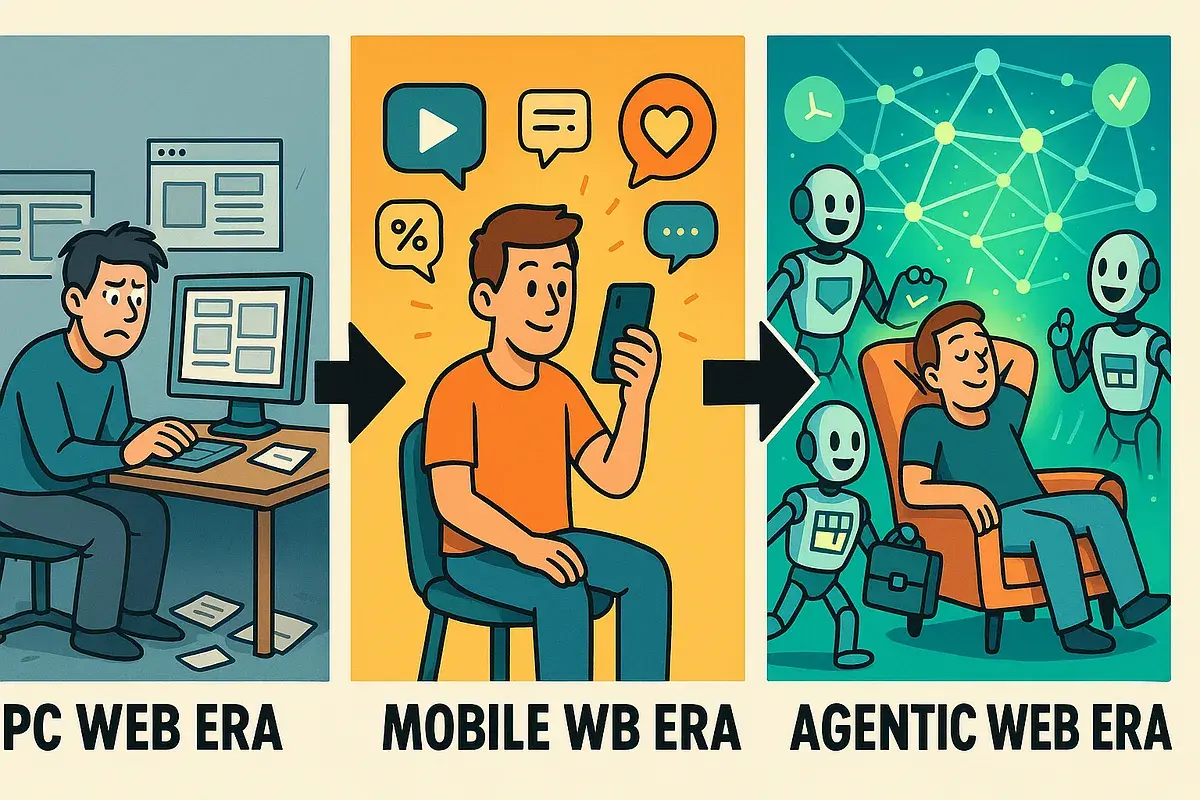
E-commerce has become deeply embedded in daily life, yet consumers still spend significant time and effort searching for products, digging through reviews, and comparing prices across platforms. The recently emerging Agentic Internet, also referred to as the AI Browser or AI Web, fundamentally changes this process. It describes a new paradigm where AI agents directly act and interact on the internet. Notable examples include Comet by Perplexity, Arc by The Browser Company, and GenSpark. These services go beyond simply displaying information; they actively navigate websites and compare products on behalf of users.
Take, for example, a user request: “Recommend me a cost-effective laptop.” An AI browser can simultaneously query major e-commerce platforms, analyze thousands of options across specifications, pricing, and reviews, and then recommend the most rational choice—or even add it directly to the shopping cart. In this way, the Agentic Internet is moving past the role of a search assistant and positioning itself as an autonomous actor: one that understands user goals, formulates plans, executes them, and integrates outcomes back into its reasoning loop. Where traditional large language models (LLMs) functioned as “passive brains” answering questions, Agentic AI represents a new class of intelligent systems that achieve autonomy and goal-orientation by combining tool use, memory, and planning modules.
 Source: Medium(@muthu10star)
As the Agentic Internet matures and automates more of the search-and-compare process, the next logical frontier is payments. Global Big Tech companies are already treating Agentic Payment—where AI agents execute payments directly—as the next growth market. Google has announced a dedicated protocol (AP2), Visa has introduced Intelligent Commerce, and Mastercard has rolled out Agent Pay.
The rationale is straightforward: agentic payments enable more efficient decision-making. Routine expenses such as utility bills, telecom fees, and subscriptions can be managed automatically, while personal data analysis allows users to be seamlessly switched to cheaper plans. Conditional instructions like “If the hotel price drops below $500, pay immediately” become executable. Even in B2B transactions, agents can analyze competitor pricing, FX rates, and supply terms in real time to execute payments at the optimal moment.
In short, the Agentic Internet has already ushered in a world where searching and comparing is easier and smarter. In the near future, a market will fully emerge where AI not only finds but also executes payments on behalf of users. This is not simply the evolution of search—it is the restructuring of the payment paradigm itself.
2. Why Agentic Payments Require Blockchain Infrastructure
Payments executed by AI agents can unlock massive efficiency gains. But for this to materialize, today’s legacy payment infrastructure faces fundamental shortcomings that must be solved.
First, agents must be able to transact independently of human approval. Current Web2 payment infrastructure is human-centric. Credit cards rely on the creditworthiness and bank accounts of cardholders, while online payments require a KYC-verified user to manually authorize. Even if an agent initiates a transaction, the final authentication still depends on a human. This structural dependency is a core barrier preventing agents from acting as autonomous economic actors across the internet.
Second, agents require ultra-high-frequency micropayments. AI workloads—API calls, data queries, second-by-second service consumption—generate continuous streams of small-value transactions. Legacy rails make this economically impossible: processing a $1 payment can incur fees of $0.30 or more. Global remittances remain slow and expensive, often delayed for days—an outright mismatch for agents operating across borders. Moreover, agents demand programmable payment logic such as usage-based billing, streaming flows, and conditional refunds, while traditional systems remain limited to simple value transfers from A to B.
Third, verifiable trust and safety guarantees are essential. Once agents transact autonomously, misuse or error is not hypothetical but inevitable. Under today’s rails, users cannot inspect the code that governs an agent or verify how it executes a payment end-to-end; they are effectively forced to trust centralized intermediaries. At the same time, legacy payment systems lack fine-grained controls such as per-app spend limits or strictly conditional execution. Failures are therefore caught only after the fact, leaving users reactive and exposed, with little ability to prevent harm in advance or to assign responsibility with clarity.
The shortcomings of legacy rails make blockchain the most credible alternative. By design, blockchain enables permissionless, trust-minimized settlement, where anyone can transact. Programmable money unlocks new payment modes such as conditional execution, streaming flows, and automated distribution. And because every transaction is cryptographically recorded, immutable audit trails provide transparency and accountability as a built-in feature—not an afterthought.
3. Kite AI: Purpose-Built Blockchain Infrastructure for Agentic Payments
Kite AI was created to address the core limitations outlined earlier. It is not simply infrastructure to run AI more efficiently; it is designed to give AI agents the authority and credibility required to transact seamlessly, while using blockchain to fairly link contributions with rewards. If Agentic AI is “AI that works autonomously,” then Kite AI provides the foundational layer that allows such autonomy to operate safely within social consensus and economic incentives.
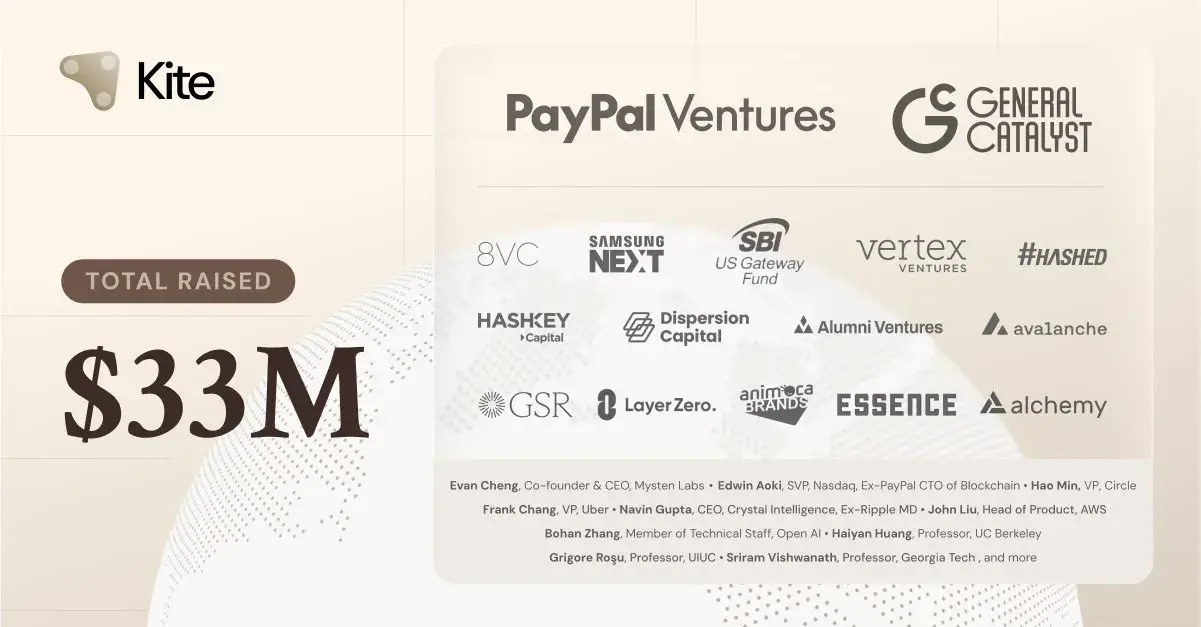
This vision has already attracted strategic validation. Kite AI raised a cumulative $33 million in Series A funding led by PayPal Ventures and General Catalyst. Just as Stripe developed its own Layer-1 (Tempo) to expand blockchain-based payments, PayPal has chosen Kite AI as a strategic partner in its push to build out AI-native payment infrastructure.
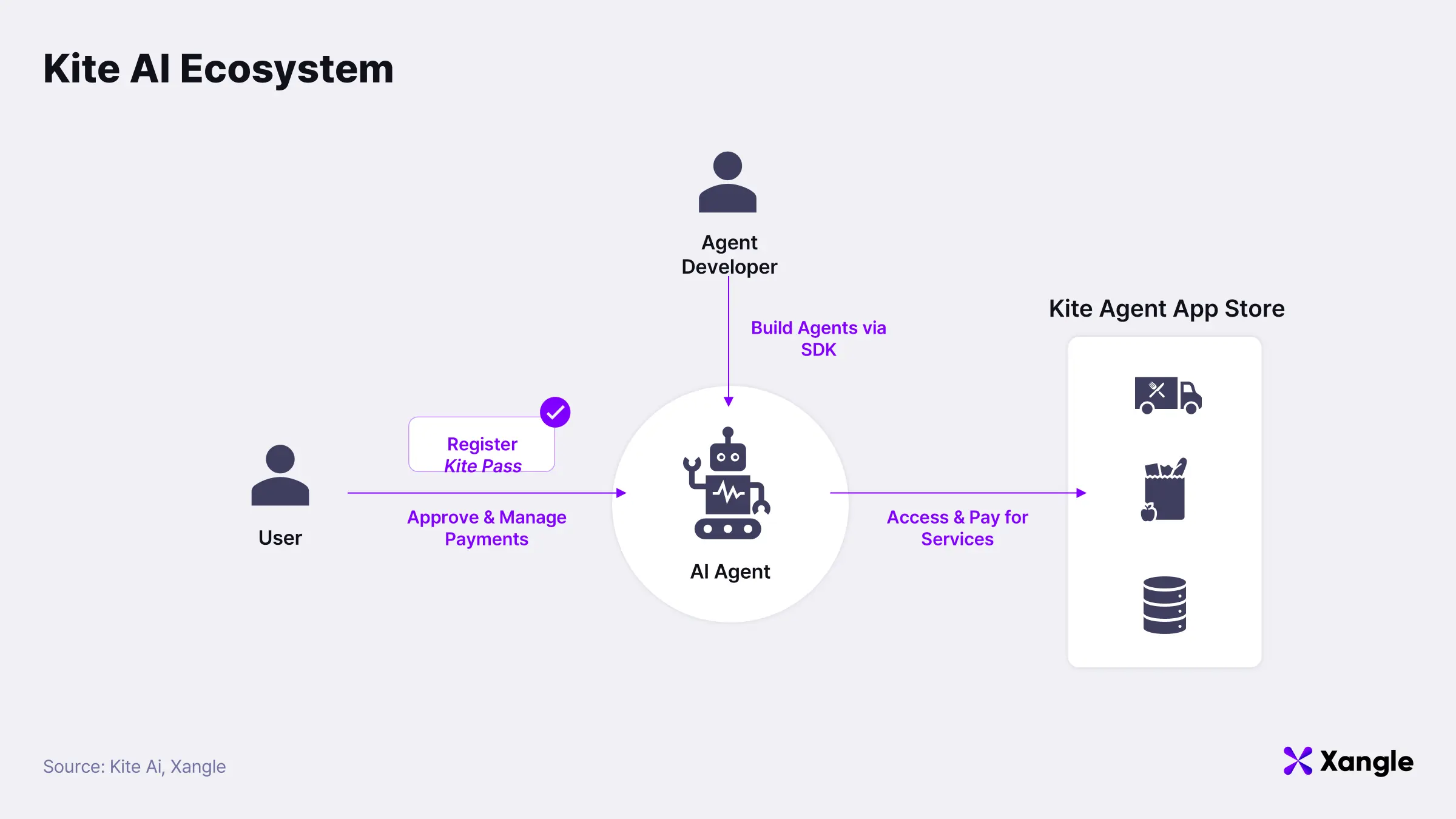
At its core, Kite AI is building an EVM-compatible Layer-1 chain specialized for agentic payments, and on top of it, operating the Kite AIR (Agent Identity Resolution) platform. AIR integrates verifiable identity, programmable payments, and an app store into a unified system. As agents evolve from performing simple tasks to autonomously operating across enterprise and development environments, AIR closes critical gaps in existing infrastructure by delivering trusted identity, shared execution rules, and a runtime environment aligned with machine speed.
The Kite AIR platform is built around three pillars:
- KitePass, which acts as a digital passport and identity credential for agents.
- The Kite Agent App Store, which enables discovery and monetization of AI-native assets.
- An SDK and MCP servers, which allow seamless integration with existing AI applications so developers can easily spin up agent environments.
Put simply, anyone can create an agent and publish it to the app store, while users can access and leverage a wide variety of services with minimal friction.
3-1. Trust infrastructure: The foundation for AI Agents as economic actors
KitePass serves simultaneously as a digital passport, a smart wallet, and a rulebook for AI agents. Just as humans use a passport to verify identity abroad and transact in duty-free shops, AI agents use KitePass to authenticate themselves and participate in economic activity anywhere in the online world.

At the foundation of KitePass is the Decentralized Identifier (DID). Unlike IDs issued by centralized authorities, a DID is a cryptographic identifier generated directly by the user through their own keys. This ensures that every agent possesses a unique, verifiable identity and can prove exactly which human controls it. In practical terms, anyone can confirm that “Alice’s payment agent” is truly acting on Alice’s behalf. KitePass can also be linked to existing Gmail or Twitter accounts, as well as blockchain wallets, making it accessible even to users unfamiliar with Web3 infrastructure.
KitePass is not just identity verification; it is core trust infrastructure for agentic economies. It is required for agents to join marketplaces or interact with other services, enabling them to function as credible actors in the digital economy. From agent-native payments to reputation systems and marketplace access, KitePass is the entry point that underpins nearly every activity across the Kite ecosystem.
3-2. Micropayments at machine speed: Infrastructure for real-world agent activity
For AI agents to operate as economic actors, they need payment infrastructure fundamentally different from today’s human-centric systems. Credit card rails carry fixed per-transaction fees that make micropayments impossible, while general-purpose blockchains suffer from volatile gas prices and processing delays—unsuitable for the ultra-high-frequency, low-cost interactions that agents require. Kite AI addresses these constraints by building its payment infrastructure around two pillars.
First, programmable micropayment channels. Leveraging state channel technology, millions of interactions can be conducted off-chain and settled on-chain in aggregate. Users deposit funds to open a channel, and subsequent interactions are executed via digitally signed vouchers. Only the final outcome is committed to the chain—condensing tens of millions of actions into just two on-chain transactions. This design slashes transaction costs, achieves sub-100 millisecond latency for real-time tasks like inference, and enhances privacy by minimizing disclosure of individual transaction details.
Second, dedicated payment lanes. On general-purpose chains, payment transactions must compete with other operations for blockspace. Kite introduces independent processing lanes reserved for payments, ensuring stable throughput regardless of network congestion. Dedicated mempools and fee markets suppress gas volatility, while fees themselves can be paid in stablecoins for cost predictability. Built-in payment-specific features—such as invoice numbers, merchant category codes (MCC), and batch settlement optimization—meet the requirements of enterprise and regulatory environments.
In sum, Kite AI’s design combines the efficiency of micropayment channels with the predictability and speed of dedicated payment lanes. The result is a scalable, sustainable payment system purpose-built for AI agents—something neither legacy financial infrastructure nor general-purpose blockchains can deliver.
3-3. Guaranteeing security and trust for mass adoption
For institutions and individuals to delegate payment authority to AI agents, security and trust are non-negotiable prerequisites. Kite AI does not assume unconditional trust in agents; instead, it applies the principle of “code as law”—cryptographically enforcing agent behavior and constraining it within predictable boundaries. This design minimizes the blast radius of errors or abuse and ensures that users’ assets and intentions are preserved in a safe execution environment. To achieve this, Kite AI introduces several mechanisms:
Hierarchical identity model and temporary session keys: Permissions are segmented to limit potential damage. Each user maintains a single master account with ultimate authority, functioning like a treasury where all funds are concentrated. Agents never access this treasury directly. Instead, they receive only limited permissions defined in advance by the user. Individual tasks run through disposable session keys, which provide controlled, one-time access.
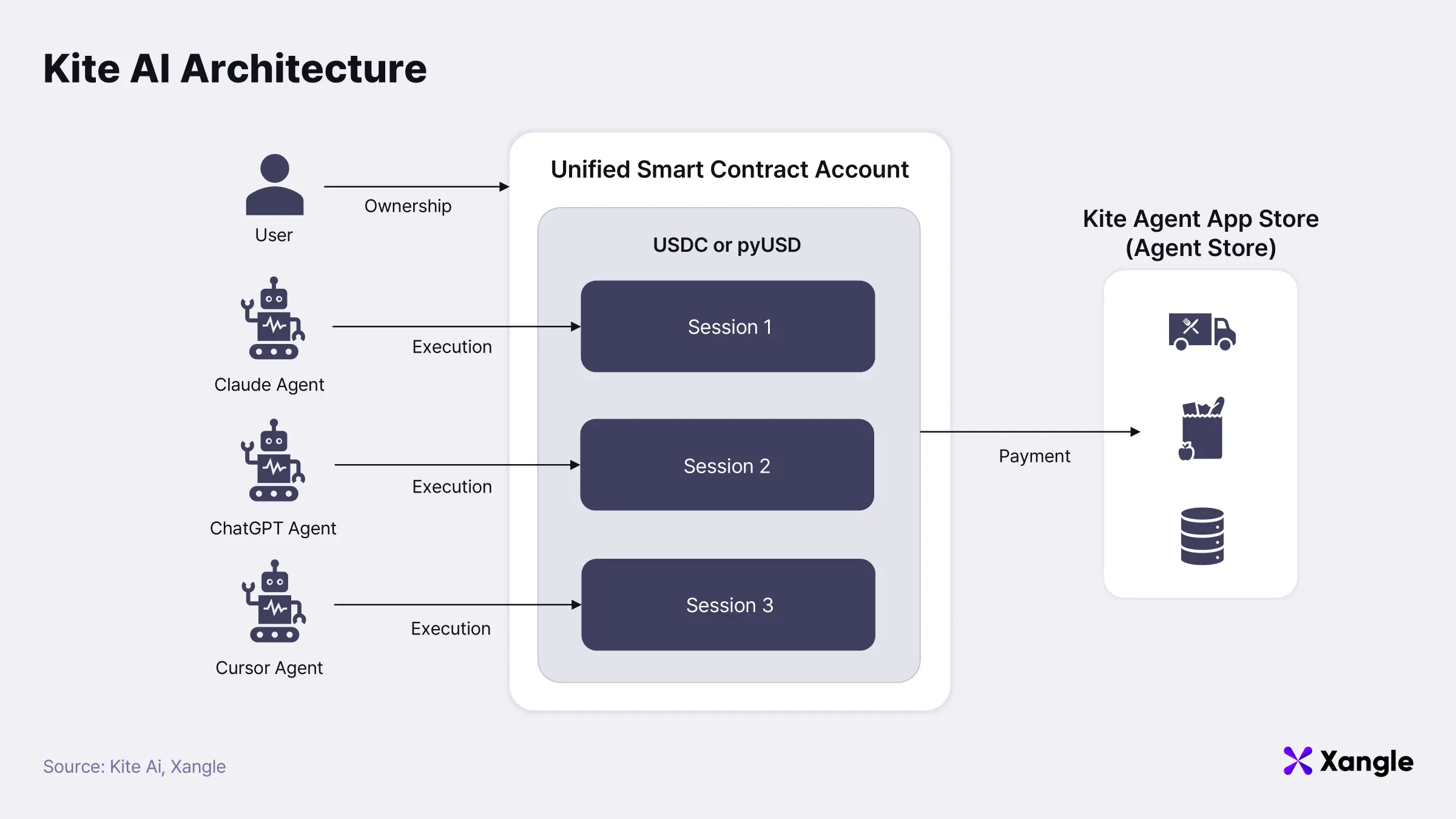
Programmable spending rules: Users can codify granular controls over agent behavior. Daily spend caps, per-transaction maximums, and dynamic constraints based on market conditions are all enforced through smart contracts. Compliance is guaranteed on-chain, eliminating the need to trust any specific agent or service provider.
Cryptographically verifiable trust chains and audit trails: All actions are recorded in tamper-proof audit logs. At any point, anyone can verify what authority an agent used and what action it executed, resolving the black-box opacity of today’s AI systems.
Programmable escrow: Funds remain safeguarded even when the counterparty is untrusted. Payments are released only upon cryptographic proof of service completion, protecting agents from fraud or double-spending.
Dynamic reputation system: Trustworthiness is evaluated based on behavioral history. New agents start with minimal permissions and gradually earn greater authority as they prove reliable. Rule violations are permanently recorded, automatically limiting agent privileges. This creates a strong economic incentive for long-term, trustworthy behavior.
Taken together, these mechanisms give Kite AI the ability to combine flexibility for autonomous agent activity with robust security for asset protection. The result is a next-generation payment model that strikes a balance between autonomy and safety, establishing the trust foundation for the agentic economy.
3-4. Inside the Kite Agent app store: Key early services
The Kite App Store has already onboarded 36 services, spanning both Web2 leaders and AI-native projects. Key examples include:
1) Shopify
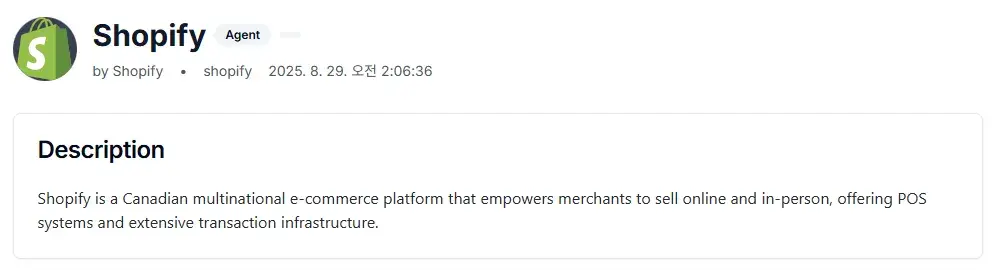
Shopify is a Canadian multinational e-commerce platform that enables retailers to sell across both online and offline channels.
2) Uber
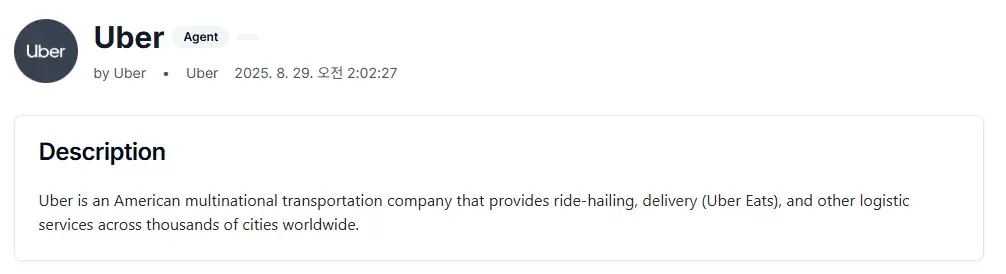
Uber is a U.S. multinational transportation company providing ride-hailing, delivery, and logistics services in thousands of cities worldwide.
3) Codatta
The Codatta agent connects data contributors with AI companies that need structured data. Contributors provide annotation and other data-processing tasks essential for AI development.
4) Masa
The Masa agent supports real-time Twitter data collection and is expected to enhance social data aggregation for agents operating on Kite AI.
5) Vishwa
Vishwa is an intelligent credit infrastructure for the digital agent economy. Via a single trustless API, it orchestrates liquidity across diverse assets and is expected to coordinate liquidity within the Kite AI chain.
6) Irys
Irys is a Layer-1 “datachain” combining low-cost storage, verifiable computing, and AI collaboration. It is currently in close technical partnership with Kite AI.
4. Expansion to Scale: Kite AI’s Growth Trajectory
Kite AI has already proven meaningful traction on-chain. Even at the testnet stage, it has attracted more than 17 million cumulative users and logged roughly 1.7 billion AI agent interactions. Crucially, this is not a one-off spike but sustained engagement: throughout September, both daily transactions and daily active users held steady in the 2–4 million range.
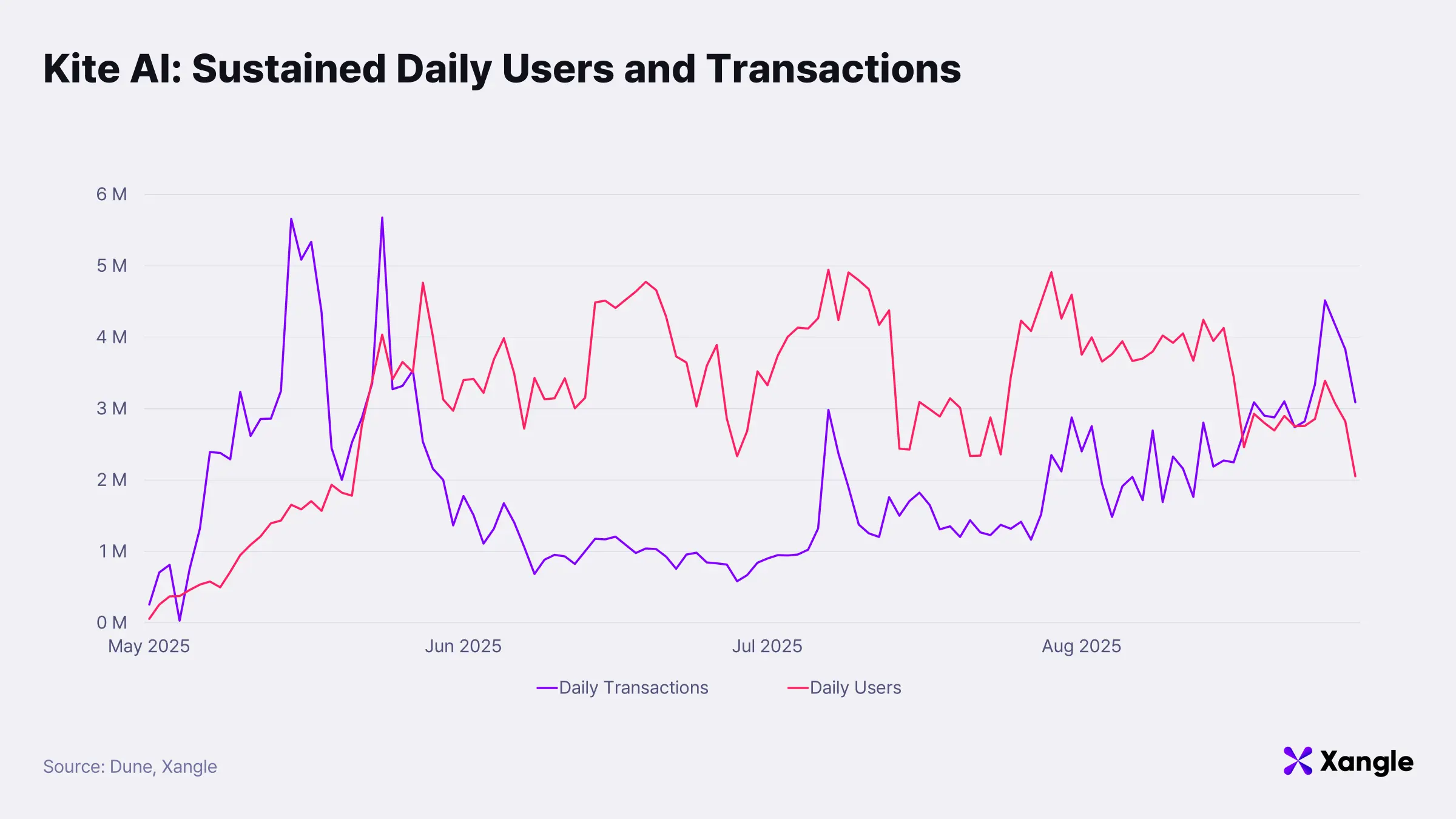
There are three main factors behind Kite AI’s ability to secure a substantial user base at such an early stage. First, testnet campaign design. Through Testnet v1 “Aero,” Kite AI allowed anyone to interact with AI agents in a no-code manner. Second, functional evolution. Testnet v2 “Ozone” lowered onboarding barriers by introducing Web2-friendly experiences such as account abstraction, social login, and universal accounts. It also expanded user experience through native staking, NFT badges, and real-time agent interactions, while maximizing community engagement with participant reward structures like the “Fly the Kite” NFT. Third, ecosystem partnerships. Partners such as Bitte Protocol and Bitmind deployed AI model–based agents directly on-chain, creating genuine AI network effects beyond simple experimentation. In addition, the onboarding of Web2-native teams with large user bases—such as Shopify and Uber—also positively contributed to user acquisition.
Future expansion builds upon these early successes. First, Kite AI plans to launch its mainnet in Q4 2025, establishing itself as an EVM-compatible Layer-1 and transitioning testnet-proven features into a full production environment. On the mainnet, agent IDs and the trust layer will be introduced, enabling issuance, registration, and verification of AI agent identities, alongside the activation of autonomous payments powered by stablecoins.
At the same time, Kite AI aims to diversify its ecosystem through the advancement of the agent network. The App Store is evolving into a platform where AI builders can register and monetize their services, while Passport and SDK have become the core tools supporting this environment. Early integrations with platforms such as Shopify, ChatGPT, and Perplexity serve as launchpads for Kite’s expansion into a practical AI payment infrastructure. On this foundation, Kite AI has secured partnerships with Masa, AI Veronica (Animoca), Bitmind, Irys, GAIB, and Messari, and will continue to grow its ecosystem further.
In summary, Kite AI’s expansion strategy can be understood as a phased trajectory: first, launching its mainnet in a live production environment on the back of early testnet momentum; second, expanding services centered on the Agent App Store and Passport; and third, accelerating ecosystem growth through agile partnerships. This roadmap is not merely a technical upgrade but represents the broader process by which AI agents evolve into on-chain economic actors, anchored in payments and trust.
5. Kite AI Closing Statement – Kite AI and the Next Payment Paradigm
The agent-based payment model introduced by the Agentic Internet is no longer a theoretical possibility—it is an inevitable shift. As adoption accelerates, the core question is not if but how AI agents can transact safely and efficiently on behalf of humans.
Kite AI offers a concrete answer. By integrating cryptographic identity, programmable governance, and efficient payment infrastructure into its own Layer-1 foundation, Kite creates an environment where agents can interact with verifiable trust and without intermediaries. On this trust-based layer, agents are free to authenticate, transact, and collaborate, emerging as new economic actors in their own right.
Still, Kite remains in the testnet phase. The ultimate proof will come post-mainnet launch, when real users put the infrastructure under production load. Equally critical will be the onboarding of a diverse set of apps and services: the pace and effectiveness of ecosystem expansion will determine how quickly agentic payments become embedded in practice.
The vision Kite AI articulates is aligned with a natural and unavoidable trajectory for the digital economy. Within the broader rise of the Agentic Internet, the key will be how effectively Kite positions itself and builds durable competitive advantages. It is a project that demands close attention as the next payment paradigm takes shape.
Disclaimer
I confirm that I have read and understood the following: The information contained in this article is strictly the opinions of the author(s). This article was authored free from any form of coercion or undue influence. The content represents the author's own views and does not represent the official position or opinions of CrossAngle. This article is intended for informational purposes only and should not be construed as investment advice or solicitation. Unless otherwise specified, all users are solely responsible and liable for their own decisions about investments, investment strategies, or the use of products or services. Investment decisions should be made based on the user’s personal investment objectives, circumstances, and financial situation. Please consult a professional financial advisor for more information and guidance. Past returns or projections do not guarantee future results. This article was written at the request of Kite AI. All content in this article was written independently by the author(s), and neither CrossAngle nor Kite AI had any editorial control or influence over the content. The author(s) may hold the cryptocurrencies mentioned in this article at the time of writing.
Xangle or its affiliated partners own all copyrights of the written or otherwise produced materials and content provided on the platform. Any illegal reproduction of such content, including, but not limited to, unauthorized editing, copying, reprinting, or redistribution will result in immediate legal actions without prior notice.
![[CIS Partner Summit Highlights] Ault's Financial Super App Strategy: OnlyBulls](https://resource.xangle.io/files/content/C1A19E1DB41B7FB86076143803C40D8E_1790125531662.webp)
![[Xangle RWA Series] Solana RWA: A Look at the Key Players](https://resource.xangle.io/files/content/F779A005246C0299246537AACB3A39F2_1782287059970.webp)