Supra’s Integrated Infrastructure and the Future of Blockchain

Table of Contents
1. The Power of Functional Integration: Lessons from Mobile for Blockchain
2. How Supra Plans to Redefine Blockchain Through Functional Integration
2-1. Supra’s high-performance core: Moonshot Consensus and MoveVM
2-2. Embedding middleware infrastructure directly into the network
2-3. Smarter and more sustainable DeFi through integrated infrastructure
3. Supra’s Strategy for Ecosystem Expansion
3-1. The AutoFi flywheel: Growth through revenue redistribution
3-2. IntraLayer Vault and PoEL: Unlocking capital efficiency for DeFi
3-3. $SUPRA tokenomics: The core ecosystem expansion and sustainability
4. Final Remarks – Can Supra Become DeFi’s Central Hub?
1. The Power of Functional Integration: Lessons from Mobile for Blockchain
Just 40 years ago, the idea of taking photos, listening to music, or browsing the internet on a mobile phone was almost unimaginable. The first mobile phone, Motorola’s DynaTAC 8000x, released in 1983, weighed nearly 1 kg—earning it the nickname “brick phone.” Its battery supported only 30 minutes of talk time, and it could store just 30 phone numbers. At the time, it was nothing more than a “portable telephone,” yet it was revolutionary in its own right.
Technology advanced quickly thereafter. With the advent of second-generation, text messaging transformed mobile phones from simple voice devices into personal communication tools that could transmit written messages. Handsets became smaller and more affordable, gradually evolving into devices “anyone could own.” By the third generation, the integration of cameras, MP3 players, and DMB turned phones into pocket-sized multimedia hubs that far surpassed their original role as telephones.
As innovation compounded, adoption accelerated. What began as a call-only device became a multifunctional “super-device”—a phone, camera, computer, MP3 player, and gaming console all in one. Mobile phones shifted from being optional consumer electronics to indispensable daily infrastructure. In Korea, penetration stood at just 53% in 2012, yet within four years it surged past 90% by late 2016. By 2024, the rate had reached 98%, making it harder to find someone without a mobile phone than with one.
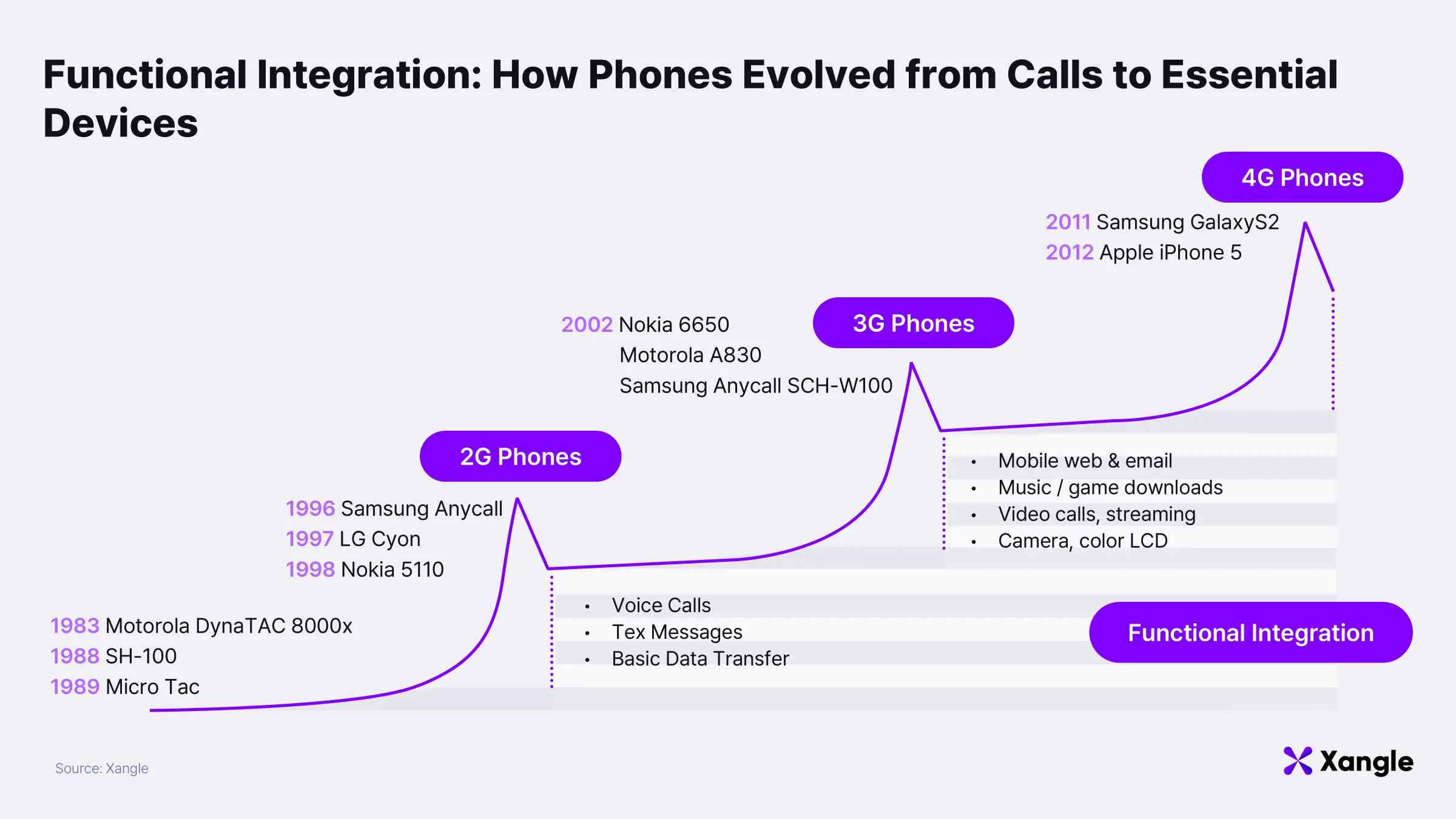
This report begins with the story of mobile evolution because the Layer 1 network under review, Supra ($SUPRA), aims to catalyze a similar transformation in blockchain infrastructure through an integrated approach.
The current blockchain ecosystem remains fragmented. Core services such as oracles, cross-chain bridges, keepers, and VRFs each operate as independent protocols, forcing applications to stitch together multiple external solutions. The result is high costs, cumbersome integration, and structural inefficiencies in trust distribution.
Supra’s vision is to consolidate these disparate components into a unified, first-class blockchain network; just as smartphones combined multiple functions into a single indispensable device. In doing so, Supra seeks to elevate blockchains from simple transaction ledgers into comprehensive infrastructure platforms, embodying in technical form the principle that “the whole is greater than the sum of its parts.”
The following sections will examine Supra’s vision in detail, outline the elements that set it apart, and project how these factors may shape its future.
2. How Supra Plans to Redefine Blockchain Through Functional Integration
2-1. Supra’s high-performance core: Moonshot Consensus and MoveVM
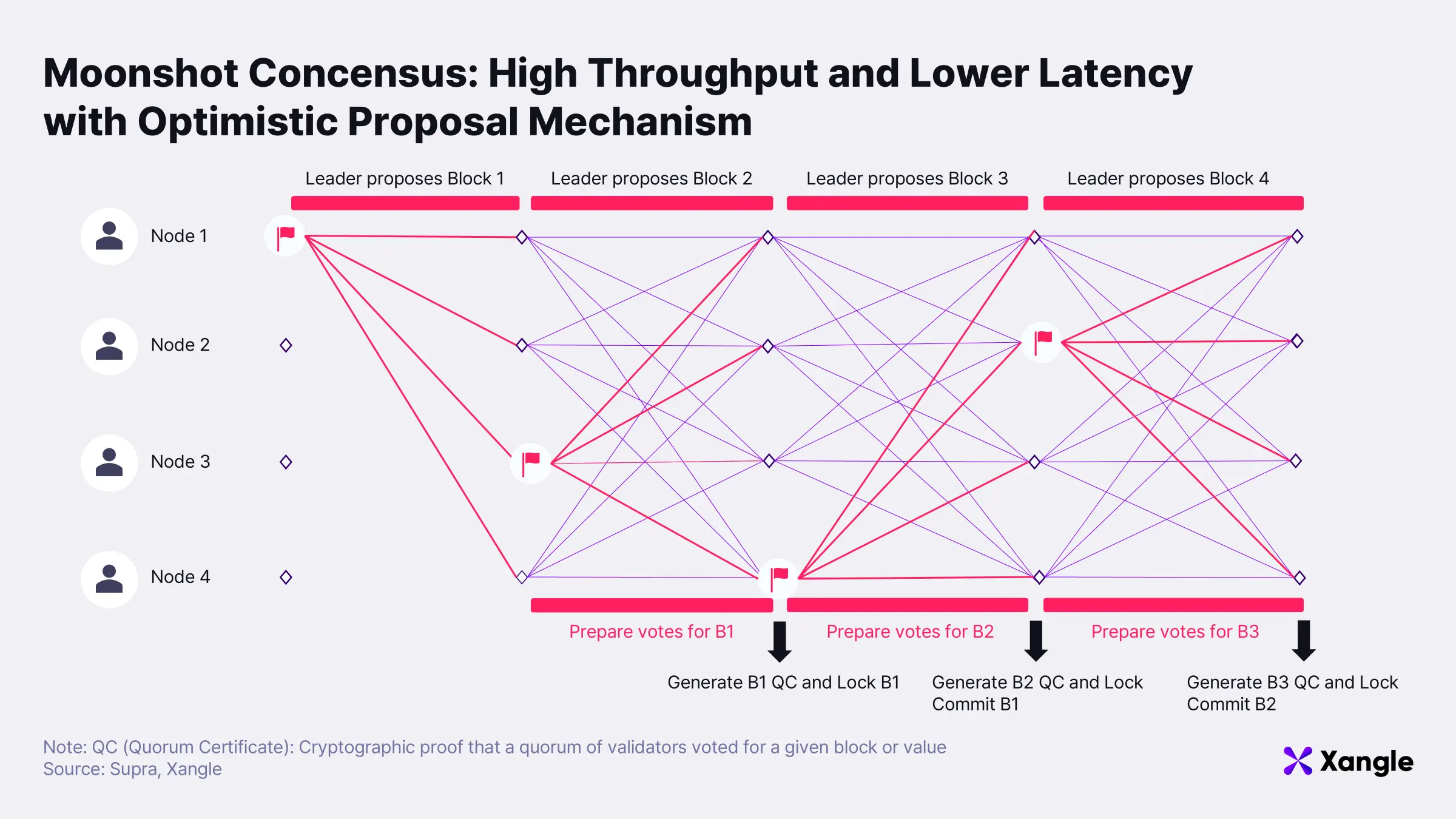
Supra is a high-performance Layer 1 built on Move, leveraging its proprietary Moonshot consensus mechanism. Moonshot Consensus is an enhancement of the PBFT (Practical Byzantine Fault Tolerance) family, engineered to achieve ultra-low latency finality (sub-second finality).
In traditional PBFT, once a leader node propagates a block, every node must cross-verify with one another. Since all nodes must communicate with each other, scalability becomes limited. Moonshot Consensus improves this by introducing an “Optimistic Proposal” mechanism: instead of waiting for the final confirmation of the previous block, the next leader can propose a new block immediately upon receiving the prior one. While block proposal and commitment follow the same method as PBFT, the block production cycle is shortened. This allows Supra to reduce block times to the theoretical minimum, achieving significantly lower latency and higher throughput compared to conventional consensus protocols.
Supra further innovates by separating transaction transmission and ordering into a three-layer structure—Family, Clan, and Tribe—rather than handling them in a single process. In this model: ① Family proposes transaction batches, ② Clan validates data availability and handles execution, and ③ Tribe finalizes transactions through Moonshot Consensus.
This separation of roles, combined with the Moonshot algorithm, minimizes redundant data and network congestion while reinforcing censorship resistance and data integrity. Security is further strengthened through randomized clan assignments and role shuffling. Complementing this, Supra’s proprietary STM-based parallel execution engine processes non-conflicting transactions concurrently, enabling throughput in the hundreds of thousands of TPS with sub-second latency.
2-2. Embedding middleware infrastructure directly into the network
In today’s blockchain ecosystem, core infrastructure such as oracles, VRF, cross-chain bridges, and automation tools has largely been delivered as external middleware services. This architecture forces decentralized applications to source critical modules from outside the chain, inevitably introducing latency, additional costs, and security risks. Indeed, oracle manipulation attacks, bridge exploits, and keeper delays all trace back to the structural vulnerabilities of this external dependency model.
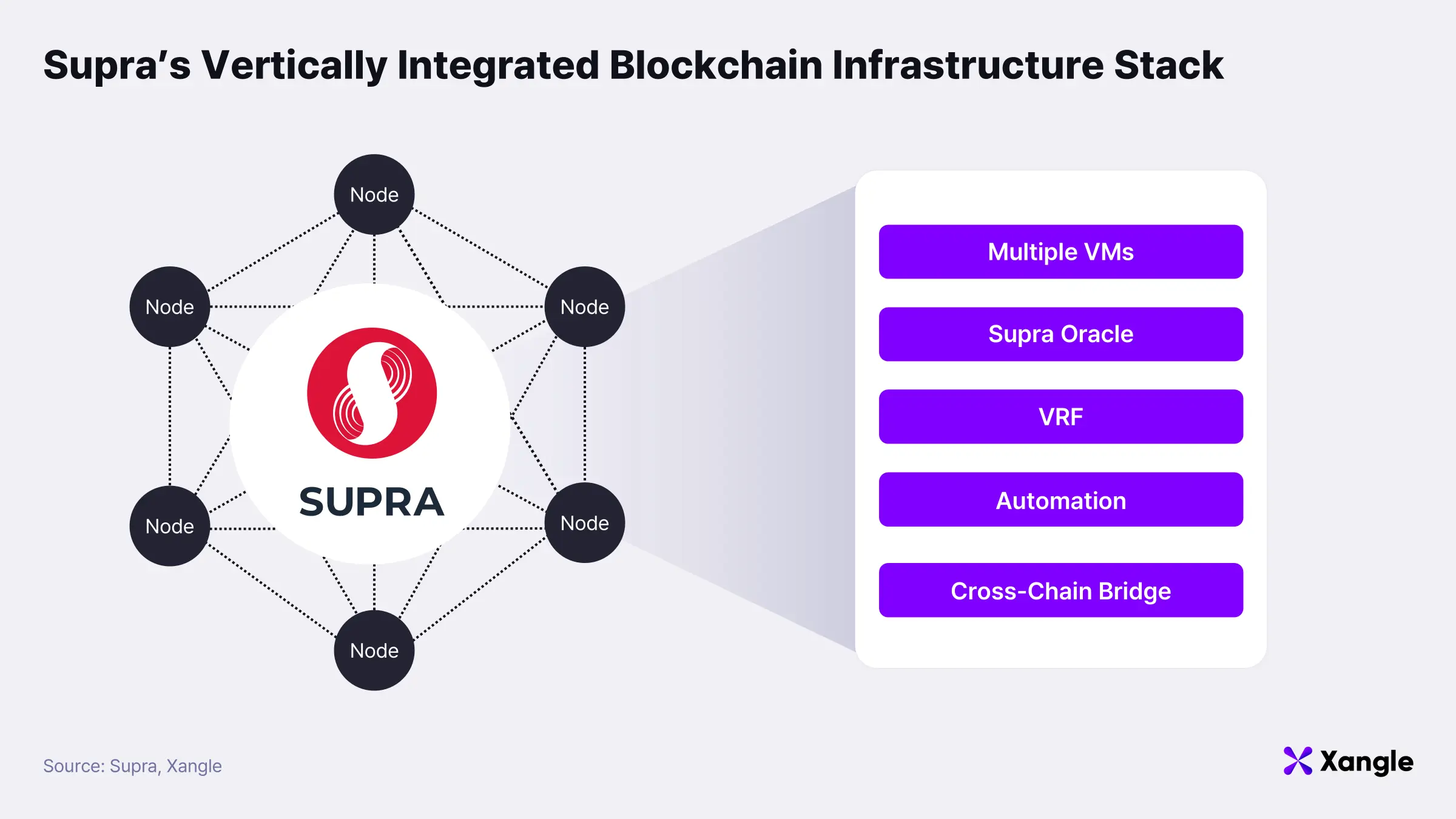
Supra addresses these limitations by embedding essential middleware functions directly into the network itself. Oracles, VRF, cross-chain bridges, and automation modules are tightly integrated with the consensus and execution layers, elevating their security to the baseline guarantees of the blockchain, minimizing latency, and giving dApp developers instant, cost-free access. The key components Supra has natively integrated are outlined below:
Multi-VM
Supra adopts a multi-VM architecture to support diverse development environments within a single network. At its core, Supra provides MoveVM for asset-optimized smart contract execution, while simultaneously operating a Solidity-compatible SupraEVM, allowing existing Ethereum developers to use familiar tools such as Remix and Hardhat seamlessly.
Over time, Supra plans to integrate additional VMs such as Solana VM (SVM) and CosmWasm, expanding support to Rust and C/C++ development. This architecture not only broadens the programming paradigms available on a single chain but also increases the flexibility and universality of dApp development. Cross-VM messaging is also on the roadmap, enabling smart contracts across different VMs to interact composably.
Native Oracle
Supra embeds a native oracle directly into its Layer 1, making the blockchain itself a trusted data feed provider. This is powered by the Distributed Oracle Agreement (DORA) protocol, which securely delivers real-time data, ranging from crypto prices and FX rates to stock indices and weather, on-chain and, when needed, transmits it to other blockchains.
DORA follows a Tribe–Clan–Aggregator structure: the full set of oracle nodes (Tribe) is randomly divided into Clans, each producing independent data outputs, which are then aggregated and finalized. This parallelized execution enables execution sharding, supporting horizontal scalability of the oracle network.
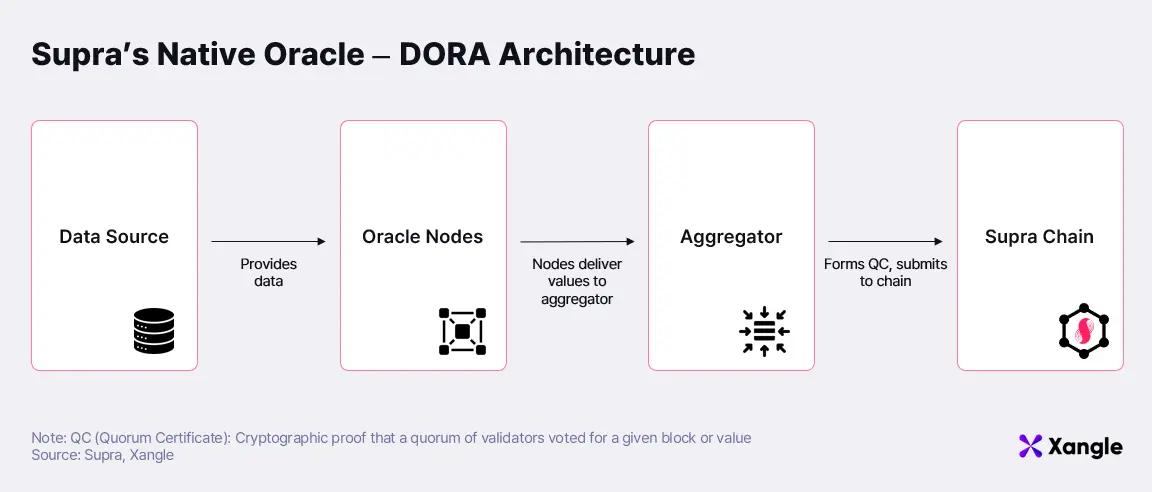
Reliability and efficiency are reinforced by three mechanisms:
- The “agreement distance” model, which reduces the number of nodes required for consensus (only 2f+1).
- Multiple aggregators, ensuring consensus continuity even if some fail.
- VRF-based randomization and fallback mechanisms, which protect against collusion and network anomalies.
The result is an oracle service that achieves: (1) low-cost, low-latency data delivery, (2) new protocol-level revenue models, (3) high scalability with minimal delay, and (4) strong security guarantees.
Native Cross-Chain Bridge
Supra ensures interoperability through its native cross-chain bridge, HyperNova. HyperNova employs a relay bridge architecture, where the destination chain verifies the source chain’s events directly. Relay nodes only forward events and inclusion proofs to the destination chain, while verification is handled entirely by smart contracts on the destination chain. Even if relay nodes act maliciously, forged data is rejected at the L1 consensus level, eliminating the possibility of asset forgery without source-chain asset lockups.
This design delivers three clear advantages: (1) relay nodes only transmit data, so security holds even if relay node is malicious; (2) system liveness requires only a single honest relay node; (3) participation is permissionless—no registration or staking is required.
Native VRF
Supra’s VRF combines Distributed VRF (DVRF) with Privacy-preserving VRF (PVRF), ensuring both decentralization and confidentiality. In this system, multiple VRF nodes, organized into Clans, use Shamir’s Secret Sharing and Distributed Key Generation (DKG) to jointly manage keys. Each node produces partial outputs, which are aggregated into the final result. This design remains secure even if up to t nodes are malicious. PVRF further enhances privacy: user inputs are blinded so that only the requester can see the final output, while other nodes see only masked values.
Efficiency is also optimized. Supra batches multiple requests into a single process and verifies them with one aggregated signature, significantly reducing gas costs and latency. The request–response pathway is standardized: developers simply provide an input and a callback, and randomness is securely returned. The result is a next-generation randomness infrastructure that balances decentralization, privacy, and efficiency; applicable across gaming, NFTs, DeFi, and beyond.
In sum, Supra integrates critical middleware, such as multi-VM architecture, native oracles, native cross-chain bridging, and distributed VRF, at the network level. This transforms blockchain from a simple transaction ledger into a next-generation Layer 1 infrastructure encompassing real-time data, finance, and automation.
2-3. Smarter and more sustainable DeFi through integrated infrastructure
Traditional DeFi has long been constrained by structural inefficiencies. Core functions such as liquidation, risk management, and arbitrage relied heavily on external bots and manual intervention, introducing latency and operational inefficiency. Validators compounded this by manipulating transaction ordering to extract MEV, eroding fairness across the system. Critical operations, including liquidations and vault stabilization, were processed with the same priority as routine transactions, leaving them without guaranteed execution. Meanwhile, incentive models leaned on inflationary token rewards, a mechanism unsustainable in the long run.
Supra tackles these issues by embedding middleware infrastructure directly into the network and, on top of it, constructing an automated DeFi framework called AutoFi. AutoFi integrates automation, oracle feeds, and risk management modules to fundamentally address the design flaws of legacy DeFi architectures.
AutoFi generates protocol-level revenue through built-in modules for automated liquidation and arbitrage. High-value operations such as these are executed via competitive auctions, both mitigating MEV extraction and capturing additional revenue for the protocol. Further income streams are unlocked through automated liquidity provisioning and vault management.
The future AutoFi envisions is one of self-operating finance: protocols that autonomously sense market conditions, manage risk, and execute strategies without external intervention. Developers can compose new financial products atop pre-audited modules, while users gain access to automated strategies and predictable incentives without complex infrastructure overhead. Looking ahead, AutoFi is designed to integrate with AI agents, enabling dynamic, market-responsive strategies, the creation of new financial primitives, and the blueprint for an expanded DeFi future.
3. Supra’s Strategy for Ecosystem Expansion
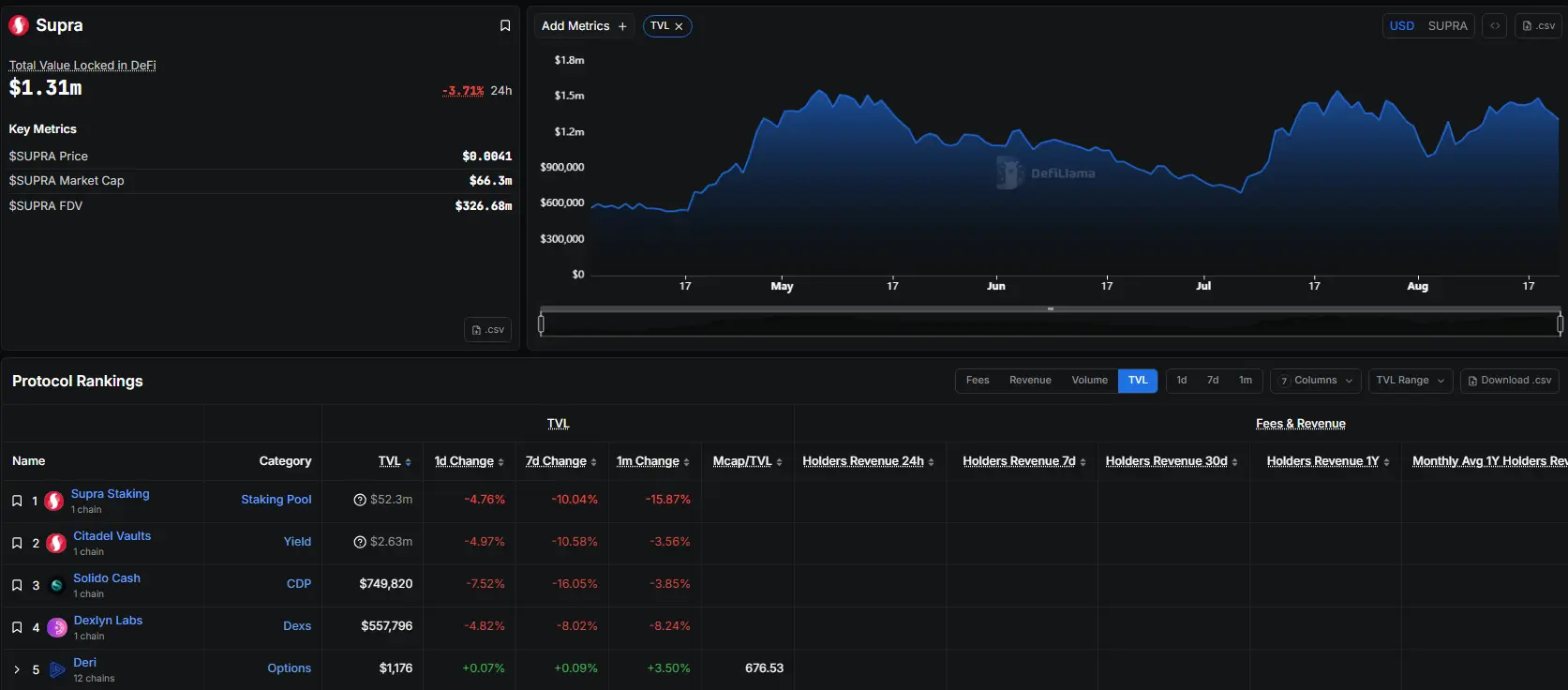
As a vertically integrated Layer 1, Supra has built foundational infrastructure for dApps. However, its ecosystem is still in its early stages, and its path to expansion warrants close observation.
Supra’s goal is to establish a sustainable ecosystem by redistributing protocol revenue and maximizing capital efficiency. The key directions of Supra’s expansion strategy are as follows:
3-1. The AutoFi flywheel: Growth through revenue redistribution
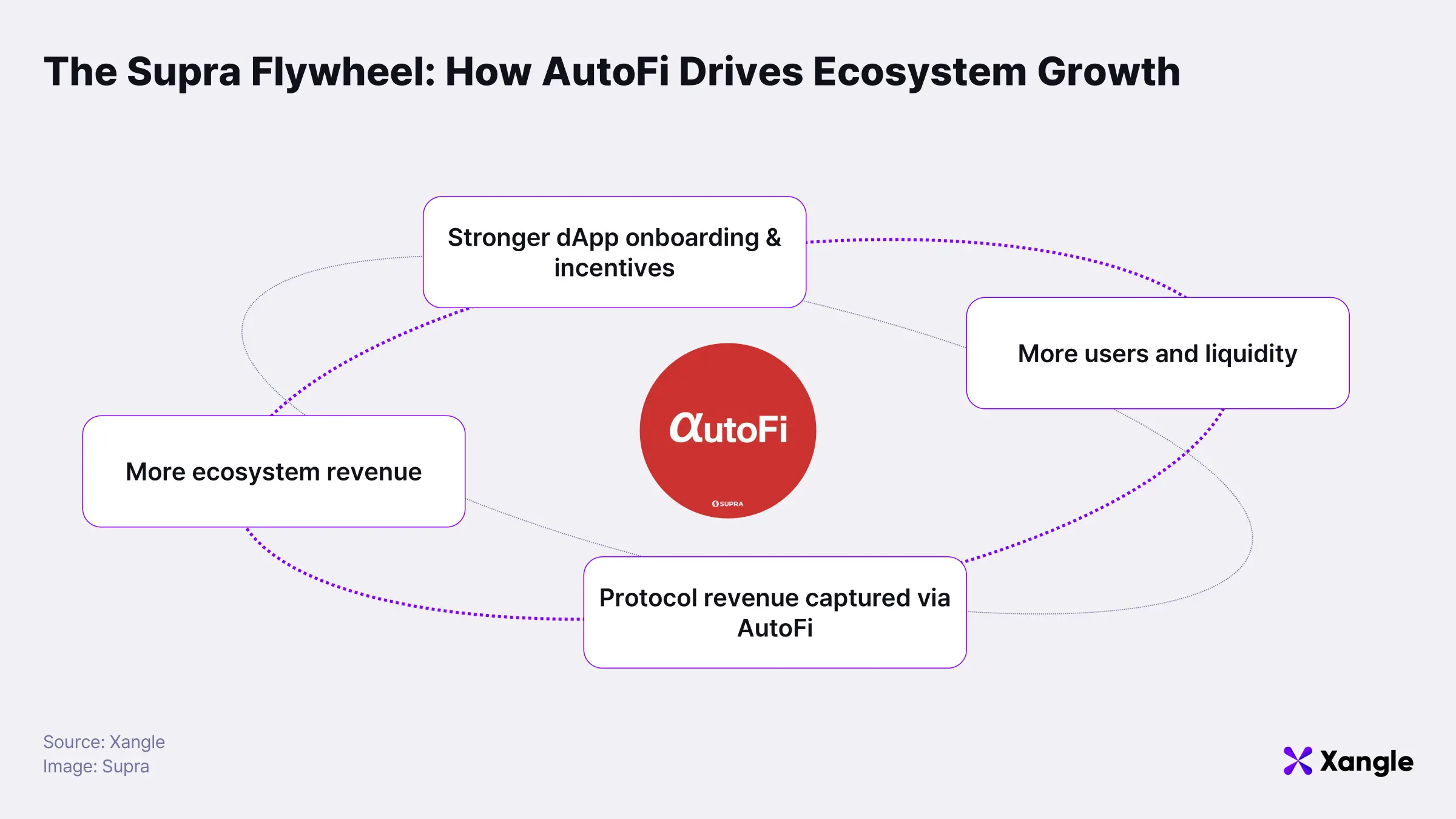
Within the AutoFi framework, Supra establishes new protocol-level revenue streams and redistributes them to ecosystem participants, creating a flywheel effect. By internalizing usage-based revenue models, previously captured by external actors, and redistributing them transparently, Supra seeks to anchor long-term drivers of network growth.
The revenue distribution is structured as follows: 50% to the treasury, 25% to dApp developers, and 25% to validators. Developer allocations can fund new service development or be redistributed directly to users as rewards, while validator allocations serve as supplemental incentives beyond baseline block rewards. The treasury’s half is reinvested under governance oversight, functioning both as a reserve for network expansion and as an operational stability fund.
This distribution mechanism generates a flywheel effect that strengthens the entire ecosystem as network activity increases. Growing dApp revenues incentivize developers to build more innovative services or pass value back to users, fueling adoption and engagement. Rising user activity, in turn, drives higher protocol revenues, which are recycled back to dApps and validators—further incentivizing participation and reinforcing network value. The outcome is a sustainable, self-reinforcing growth cycle marked by continuous dApp launches, deeper user engagement, and compounding ecosystem expansion.
That said, the structure introduces a tradeoff. Because the bulk of rewards flow to developers, validators, and end users, intermediaries who typically profit from MEV extraction or arbitrage may have diminished incentives to participate. Given that such intermediaries still play a significant role in generating demand across current blockchain networks, this could place Supra at a relative disadvantage during its early bootstrapping phase.
3-2. IntraLayer Vault and PoEL: Unlocking capital efficiency for DeFi
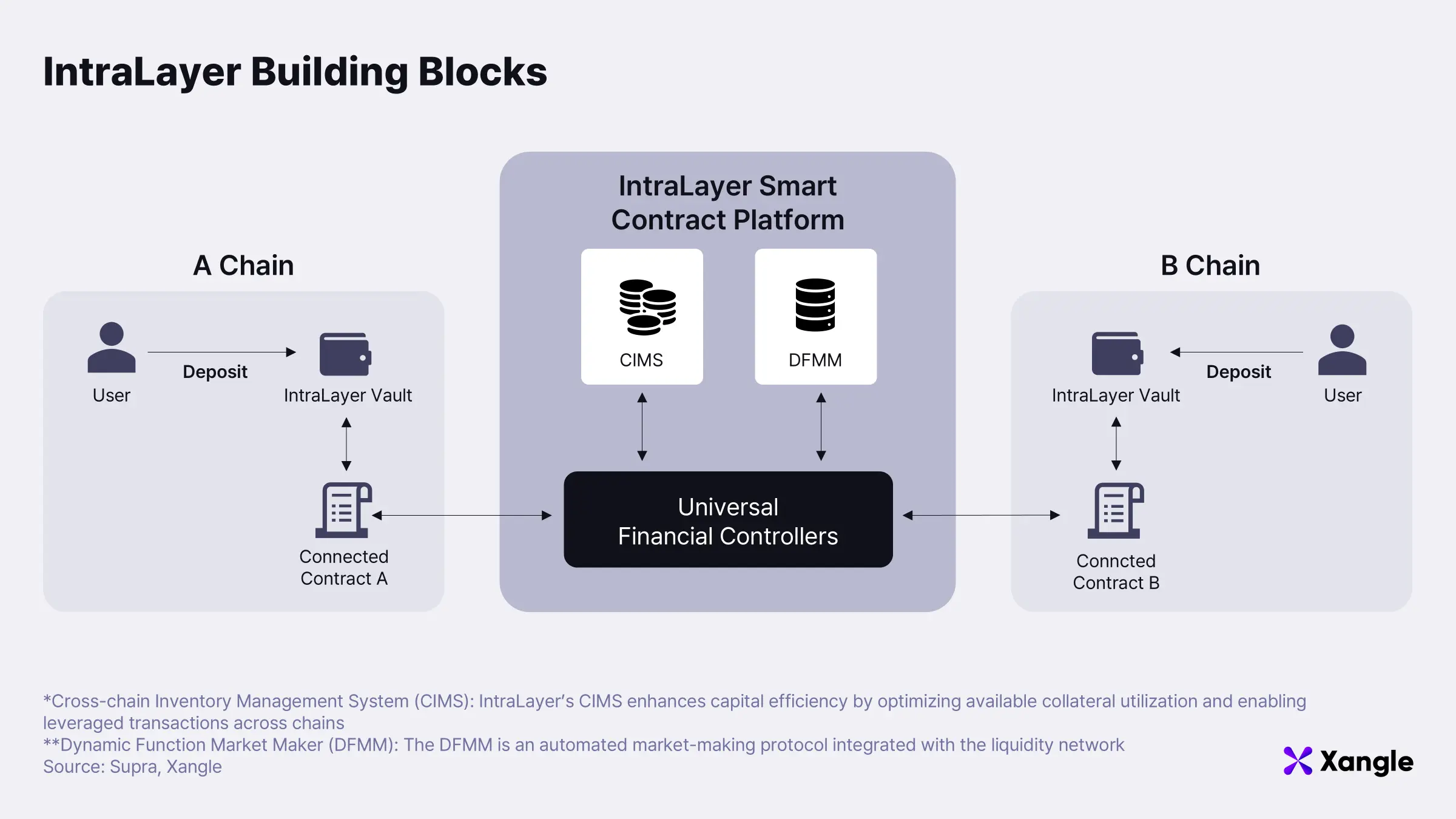
Another pillar of Supra’s expansion strategy is the radical improvement of capital efficiency. To achieve this, Supra introduces the concept of IntraLayer Vaults—a system that aggregates and centrally manages liquidity spread across multiple chains. Each vault deployed on an individual chain acts as that chain’s liquidity pool while also following directives from Supra’s central clearing layer (SCP) to rebalance assets and maintain price stability.
With IntraLayer Vaults, Supra can reallocate liquidity across chains or arbitrage when asset prices deviate significantly in one market, thereby mitigating slippage. At the chain level, this reduces inefficiencies caused by liquidity shortages; at the global level, it promotes price convergence and minimizes transaction costs. The result is higher utilization even with the same TVL, enabling more transaction volume to be processed and strengthening the scalability of the DeFi ecosystem as a whole. IntraLayer Vaults thus function as a global liquidity hub, unifying fragmented capital to maximize efficiency and dramatically expanding the scope and scale of Supra-centered DeFi activity.
In addition, Supra introduces PoEL (Proof of Efficient Liquidity) to further maximize capital efficiency. In traditional PoS chains, capital must be locked in staking to secure the network, while DeFi applications simultaneously require liquidity for trading and lending. With limited capital, staking and liquidity pools compete against one another, creating an early-stage dilemma where networks risk either weak security or insufficient liquidity.
PoEL resolves this tension by allowing assets to serve dual purposes. When liquidity providers deposit assets into a pool, they receive LP tokens. These LP tokens can then be used as collateral to borrow native tokens, which are staked to secure the network. This design allows the same underlying asset to contribute simultaneously to liquidity provision and network security. Participants, in turn, earn dual rewards: liquidity provision fees plus staking rewards.
By enabling capital to perform multiple functions, PoEL draws more capital into the platform with the same level of rewards. This ensures that even at an early stage, the network achieves robust security and sufficient liquidity. Over the long term, PoEL aligns capital efficiency with sustainable growth, establishing a foundation for durable ecosystem expansion.
3-3. $SUPRA tokenomics: The core ecosystem expansion and sustainability
Supra’s governance and tokenomics are designed with long-term sustainability at their core. The native token, $SUPRA, goes far beyond governance rights or gas payments; it functions as a universal utility asset across the protocol. $SUPRA underpins oracle validation, automation task execution, random number generation, and nearly all operational processes on the network. Put simply, virtually every activity within the network creates direct demand for the token.
The design ensures that token demand scales naturally with network activity. As automated transaction volume grows, usage of $SUPRA increases across gas fees, oracle fees, and automation costs, reinforcing its intrinsic value. The aim is to align token economics with actual protocol utilization, rather than relying on artificial, inflationary rewards.
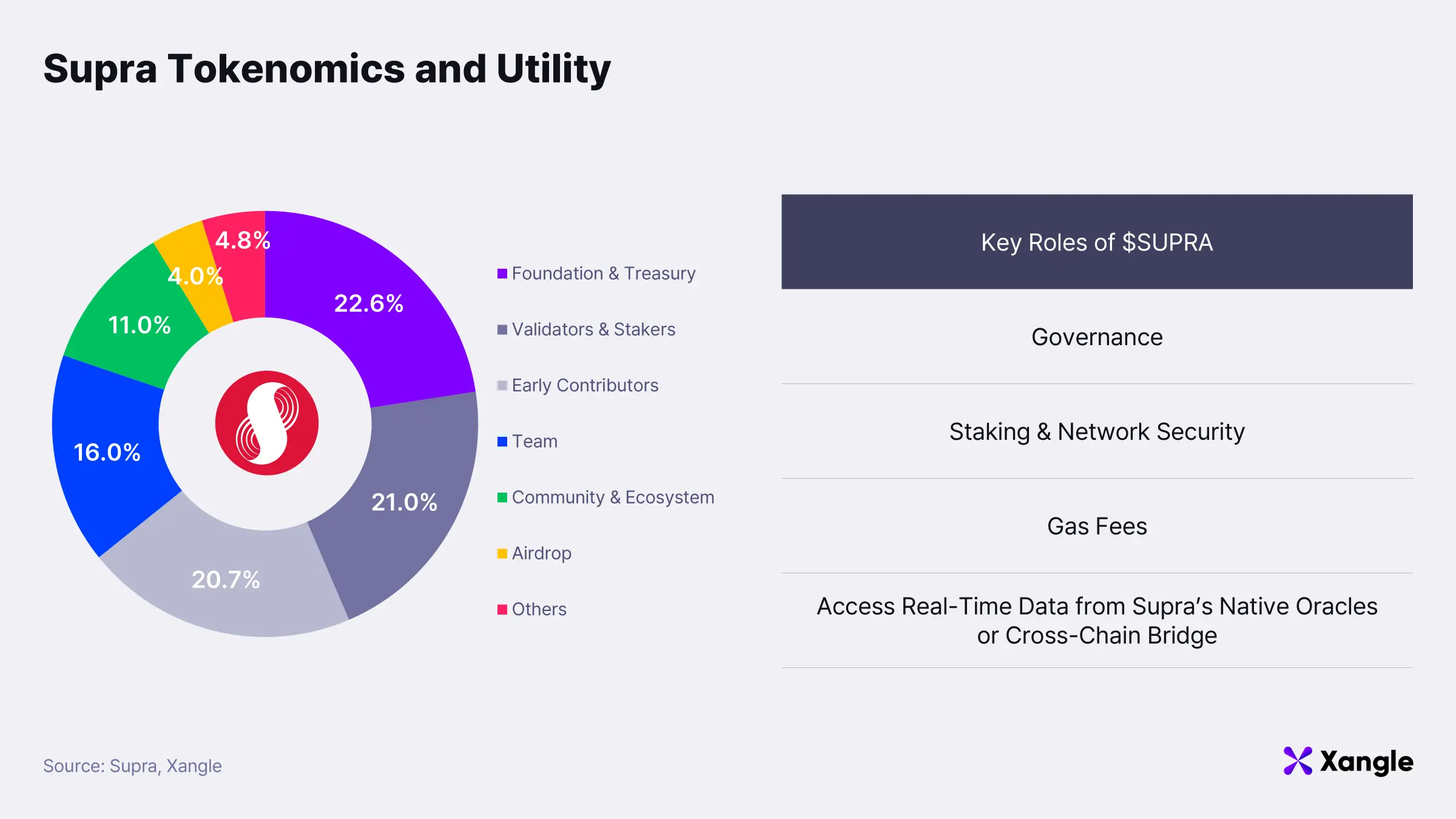
As a result, $SUPRA is not a passive token whose value depends on mere holding. It is an asset that mediates rewards for active contribution—whether building, operating, validating, or providing data within the network. At the same time, it acts as a structural mechanism ensuring that all stakeholders share in the upside of protocol growth. This utility-driven tokenomics model positions $SUPRA as the central axis for Supra’s ecosystem expansion and its long-term, self-sustaining development.
4. Final Remarks – Can Supra Become DeFi’s Central Hub?
Just as mobile devices evolved from basic communication tools into comprehensive platforms, blockchain is also advancing beyond a simple transaction-processing layer toward integrating core infrastructure for finance, data, and automation. Supra stands out as one of the most ambitious attempts to realize this evolution—combining the Moonshot consensus mechanism, a multi-VM architecture, native oracle/bridge/VRF services, and the AutoFi framework.
Supra’s strategy goes far beyond incremental performance gains or the addition of isolated features. By embedding financial infrastructure directly into the base layer, it aims to deliver security, efficiency, and automation simultaneously. This approach addresses many of DeFi’s persistent weaknesses: external dependencies, inefficient liquidation mechanisms, MEV distortions, and inflation-driven incentive models. Moreover, with AutoFi and IntraLayer Vaults, Supra envisions a flywheel in which the protocol generates its own revenue and transparently redistributes it across the ecosystem.
Still, the ecosystem is at an early stage, and the success of Supra will ultimately hinge on real-world adoption. The decisive factors will include attracting developers and users, coordinating with existing blockchain stakeholders such as MEV participants, securing sufficient liquidity in the early phases, and delivering a developer experience that meaningfully differentiates Supra from other Layer 1 platforms.
Even so, Supra’s vision is clear: to eliminate the fragmentation of blockchain infrastructure and consolidate critical functionalities into a single, integrated layer, positioning itself as the “main hub of DeFi.” If this strategy succeeds, Supra has the potential to evolve beyond the definition of a Layer 1 and emerge as the next-generation standard providing the foundational base for decentralized finance.
Disclaimer
I confirm that I have read and understood the following: The information contained in this article is strictly the opinions of the author(s). This article was authored free from any form of coercion or undue influence. The content represents the author's own views and does not represent the official position or opinions of CrossAngle. This article is intended for informational purposes only and should not be construed as investment advice or solicitation. Unless otherwise specified, all users are solely responsible and liable for their own decisions about investments, investment strategies, or the use of products or services. Investment decisions should be made based on the user’s personal investment objectives, circumstances, and financial situation. Please consult a professional financial advisor for more information and guidance. Past returns or projections do not guarantee future results. This article was written at the request of Supra. All content in this article was written independently by the author(s), and neither CrossAngle nor Supra had any editorial control or influence over the content. The author(s) may hold the cryptocurrencies mentioned in this article at the time of writing.
Xangle or its affiliated partners own all copyrights of the written or otherwise produced materials and content provided on the platform. Any illegal reproduction of such content, including, but not limited to, unauthorized editing, copying, reprinting, or redistribution will result in immediate legal actions without prior notice.
![[CIS Partner Summit Highlights] Ault's Financial Super App Strategy: OnlyBulls](https://resource.xangle.io/files/content/C1A19E1DB41B7FB86076143803C40D8E_1790125531662.webp)
![[Xangle RWA Series] Solana RWA: A Look at the Key Players](https://resource.xangle.io/files/content/F779A005246C0299246537AACB3A39F2_1782287059970.webp)