Somnia: Where Web3 Finally Outperforms Web2

Table of Contents
1. Introduction: Why Blockchains Struggle to Power Real-Time Applications Compared to Web2
2. Somnia: Delivering Web3 at Web2 Speed
3. The Four Core Technologies Powering Somnia’s 1M+ TPS
4. Somnia Ecosystem dApps
5. Tokenomics & Roadmap
6. Closing Statement: Somnia’s Vision for Web3 Mass Adoption
Appendix. Somnia’s Organizational Structure, Investment, and Ecosystem Fund
1. Introduction: Why Blockchains Struggle to Power Real-Time Applications Compared to Web2
The fundamental reason is that most blockchains are far too slow to deliver a real-time user experience. According to usability expert Dr. Jakob Nielsen, for users to perceive a response as “instant,” the system must react within 0.1 seconds (100ms).
- 100ms (0.1 seconds): The threshold for instant response. If a system reacts within this window, users perceive it as immediate.
- 1.0 second: The limit for maintaining a natural flow. Once delays exceed one second, users begin to feel they are waiting, and if a response does not arrive within this period, the interaction flow is disrupted.
- 10 seconds: The limit for holding user attention. Beyond ten seconds, the likelihood of users abandoning the task rises dramatically.
For real-time multiplayer games, the standard is even higher. Latency is generally expected to be under 50ms (0.05 seconds), and for reaction-intensive genres such as FPS titles, under 20ms (0.02 seconds) is considered ideal. Once latency exceeds 150ms (0.15 seconds), visible lag occurs and the overall gameplay experience deteriorates sharply.
This is why fully on-chain games remain rare. The majority of blockchain-based dApps and games adopt hybrid architectures that combine on-chain and off-chain components.
Somnia seeks to break these limitations by delivering over 1 million transactions per second (1M+ TPS), sub-second finality, transaction fees under one cent, and full EVM compatibility. These technical advantages remove the cost and performance bottlenecks of existing blockchains, creating the foundation for games, dApps, and real-time services—previously constrained to hybrid models—to operate entirely on-chain.
2. Somnia: Delivering Web3 at Web2 Speed
2-1. Why Somnia chose the EVM
Somnia is an EVM-based Layer-1 blockchain, and this choice was deliberate for two primary reasons. First, the vast majority of Web3 developers already build using Solidity, the programming language of the EVM. Second, EVM compatibility guarantees interoperability with major dApps.
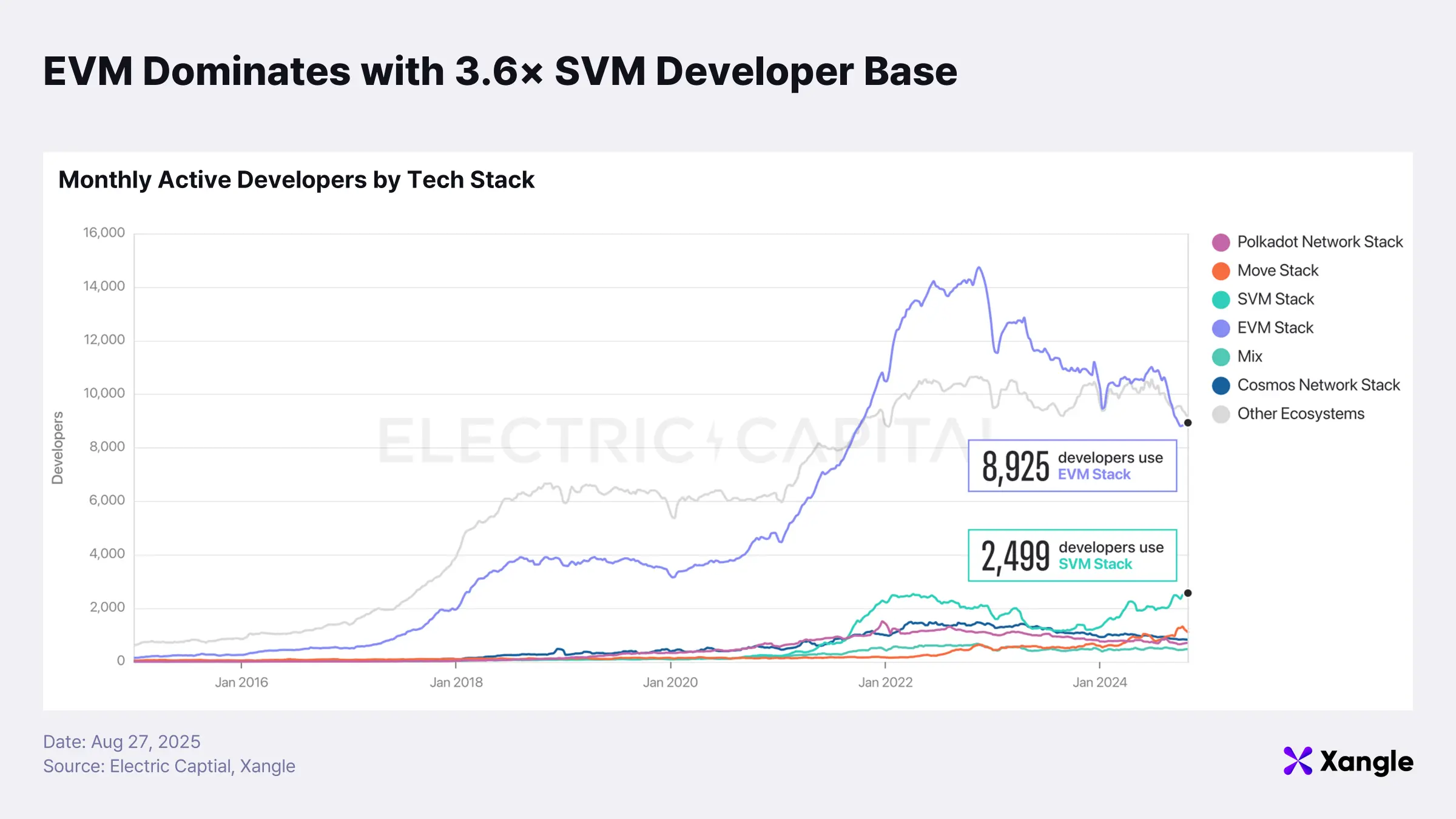
Since most Web3 development has historically centered on Ethereum, both the EVM and Solidity have effectively become the industry standard. According to Electric Capital’s 2024 Developer Report, the EVM stack has 8,925 monthly active developers—3.6x more than the second-ranked SVM stack. This dominance gives Somnia a clear advantage: by maintaining EVM compatibility, it can seamlessly attract existing developers into its ecosystem, driving rapid and organic growth.
At the same time, many flagship dApps, including Uniswap, Aave, and 1inch, are EVM-exclusive. Non-EVM chains therefore face significant hurdles in onboarding these popular applications. Somnia avoids this barrier. By embracing full EVM compatibility, it enables quick integration of proven, high-demand dApps without requiring massive resources to develop new native alternatives or bootstrap liquidity from scratch. In this way, Somnia leverages the EVM’s strengths to establish the core services essential for its ecosystem.
2-2. The speed bottleneck of EVM Chains
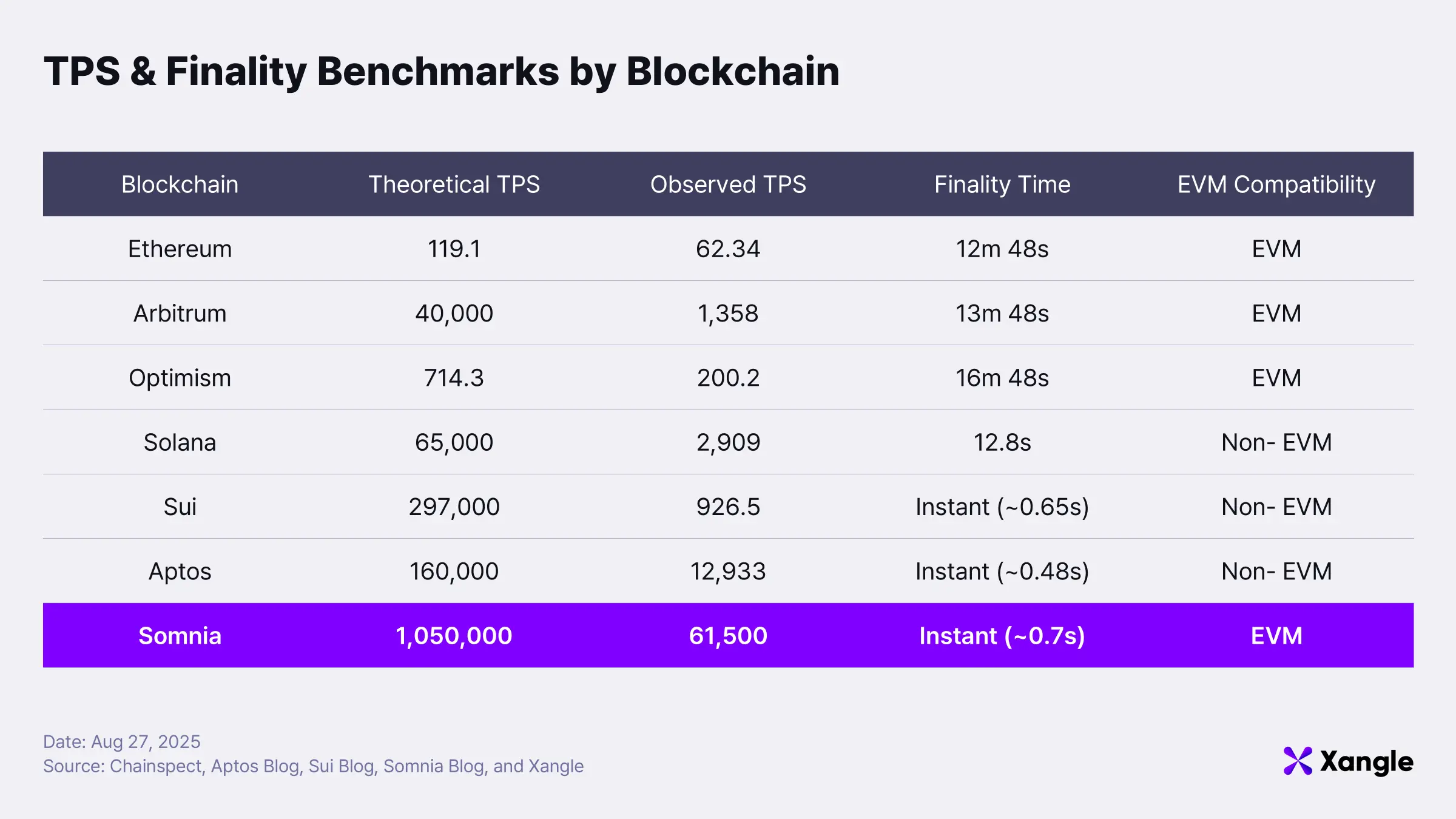
Despite the significant strengths of the EVM, Non-EVM chains such as Solana, Sui, and Aptos continue to emerge. The main driver behind this wave of new Non-EVM launches is the inherent slowness of EVM-based chains. Ethereum’s limited throughput spurred the rise of Layer-2 networks like Arbitrum and Optimism. While these solutions improve scalability, they remain tied to Ethereum mainnet’s consensus structure and sequential execution model, leaving fundamental speed bottlenecks unresolved.
In contrast, Non-EVM chains introduced novel consensus mechanisms and parallel execution models, enabling dramatic increases in TPS. However, this comes at a cost: by moving away from the EVM, they forfeit two of the ecosystem’s most valuable advantages—access to a vast developer base and seamless compatibility with major dApps.
Somnia addresses this trade-off directly. It combines the scalability and speed gains of Non-EVM architectures with full EVM compatibility. This hybrid approach allows Somnia to capture the best of both worlds: leveraging the deep pool of EVM developers and existing dApp ecosystem while still achieving 1M+ TPS and sub-second finality.
2-3. Speed and finality: The prerequisites for Web3 mass adoption
As noted earlier, Somnia supports over one million transactions per second and sub-second finality. But why are such extreme performance benchmarks necessary for blockchain? At first glance, the throughput of Ethereum, Arbitrum, or Solana may seem sufficient for Web3 use cases. The reality is different: this perception comes from users already accustomed to Web3’s limitations. Seasoned Web3 users have normalized waiting tens of seconds, enduring failed transactions, and paying several dollars in gas fees. For the broader Web2 audience, however, these experiences feel foreign and irrational.
Consider the following: waiting an extended time for a money transfer to arrive, paying high fees to prevent a failed transaction, or even being charged just to send a single in-game item. These frictions deviate sharply from mainstream digital experiences. Over time, they create barriers for new users and ultimately block Web3 from achieving mass adoption.
Finality is just as important as throughput. Imagine an online marketplace transaction. A bank transfer typically confirms within seconds, giving the seller confidence to ship the product. But what if the deposit appeared confirmed, only to later be reversed due to a system error? The seller would lose both the product and the payment.
Blockchain faces the same risk. On Ethereum, where finality averages 13 minutes, transactions can still be invalidated after appearing confirmed. Rapid finality removes this uncertainty, enabling secure and reliable transactions.
High TPS and fast finality are therefore not just performance metrics; they define what kinds of services can realistically be built on-chain. By delivering both, Somnia creates the foundation for applications where real-time interaction and reliability are non-negotiable—ranging from real-time apps and prediction markets to composable games and fully on-chain CLOBs.
- CLOB(Central Limit Order Book): A traditional financial system that sorts and matches buy and sell orders by price. Historically, implementing a CLOB fully on-chain was impractical due to speed and cost constraints. With Somnia’s high TPS and rapid finality, the entire order-matching process can now be executed entirely on-chain.
2-4. Why Web2 infrastructure isn’t enough
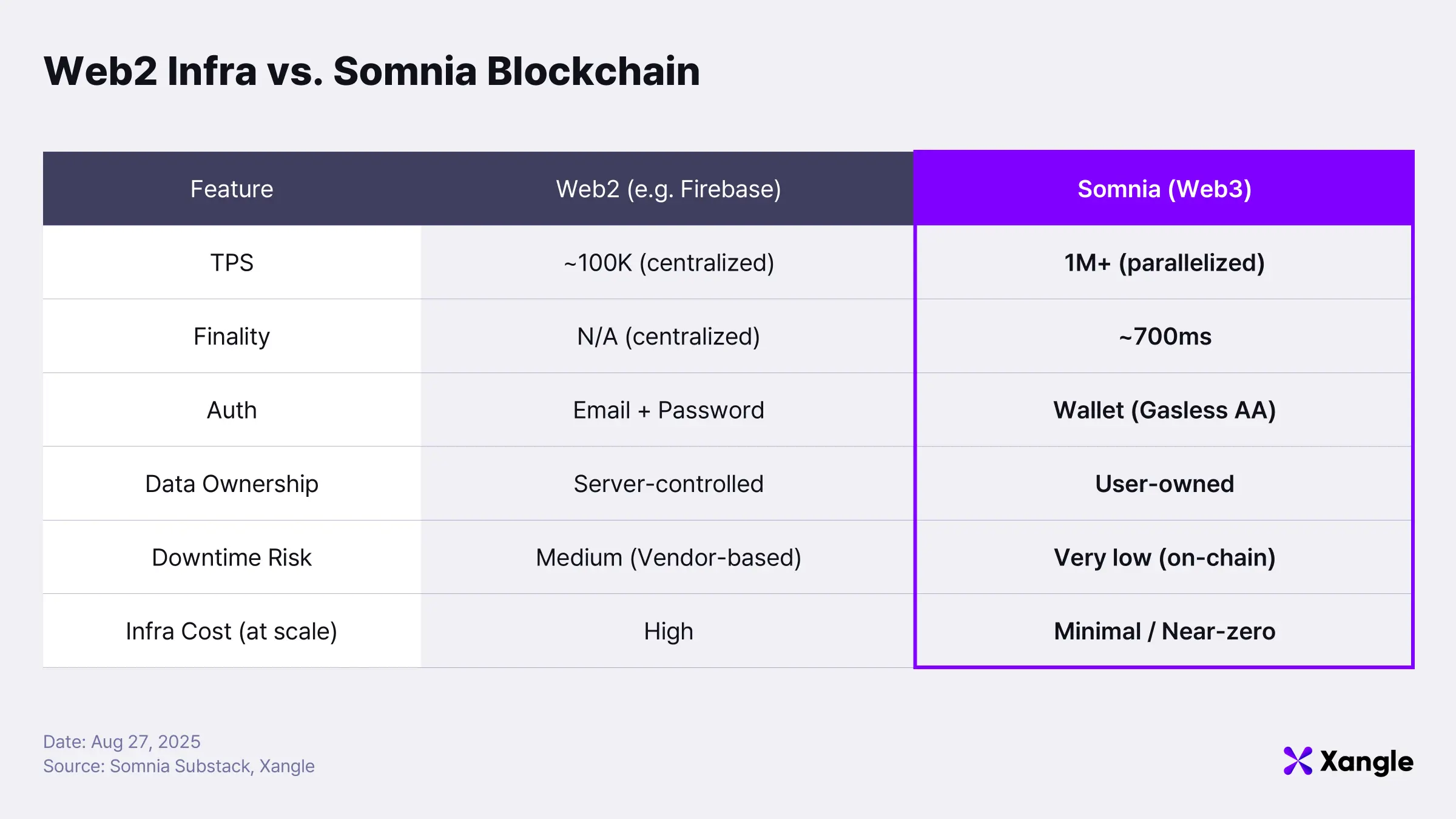
From a performance perspective, Web2 infrastructure already delivers ultra-low latency and high throughput, making it well-suited for real-time applications. Services such as Firebase or Supabase, for instance, are easy and fast to set up. But as user bases scale into the tens or hundreds of thousands, costs rise steeply. More critically, these systems impose structural limitations around data ownership: the data ultimately resides with centralized providers, not with users—fundamentally at odds with Web3’s ethos of decentralization.
Somnia takes a different path. It achieves Web2-level speed while guaranteeing that every message and data entry is written on-chain and remains owned by the user. Authentication is wallet-based, allowing users to log in directly with their wallets, eliminating the need for emails and passwords. By leveraging Thirdweb’s account abstraction, Somnia also supports gasless login options, ensuring users enjoy the same ease of access they expect from Web2. In doing so, Somnia combines the intuitive user experience of Web2 with the core values of Web3; decentralization and true ownership.
3. The Four Core Technologies Powering Somnia’s 1M+ TPS
How does Somnia achieve both extremely high throughput and rapid finality? The answer lies in four core innovations, each of which we will examine in detail.
3-1. MultiStream Consensus
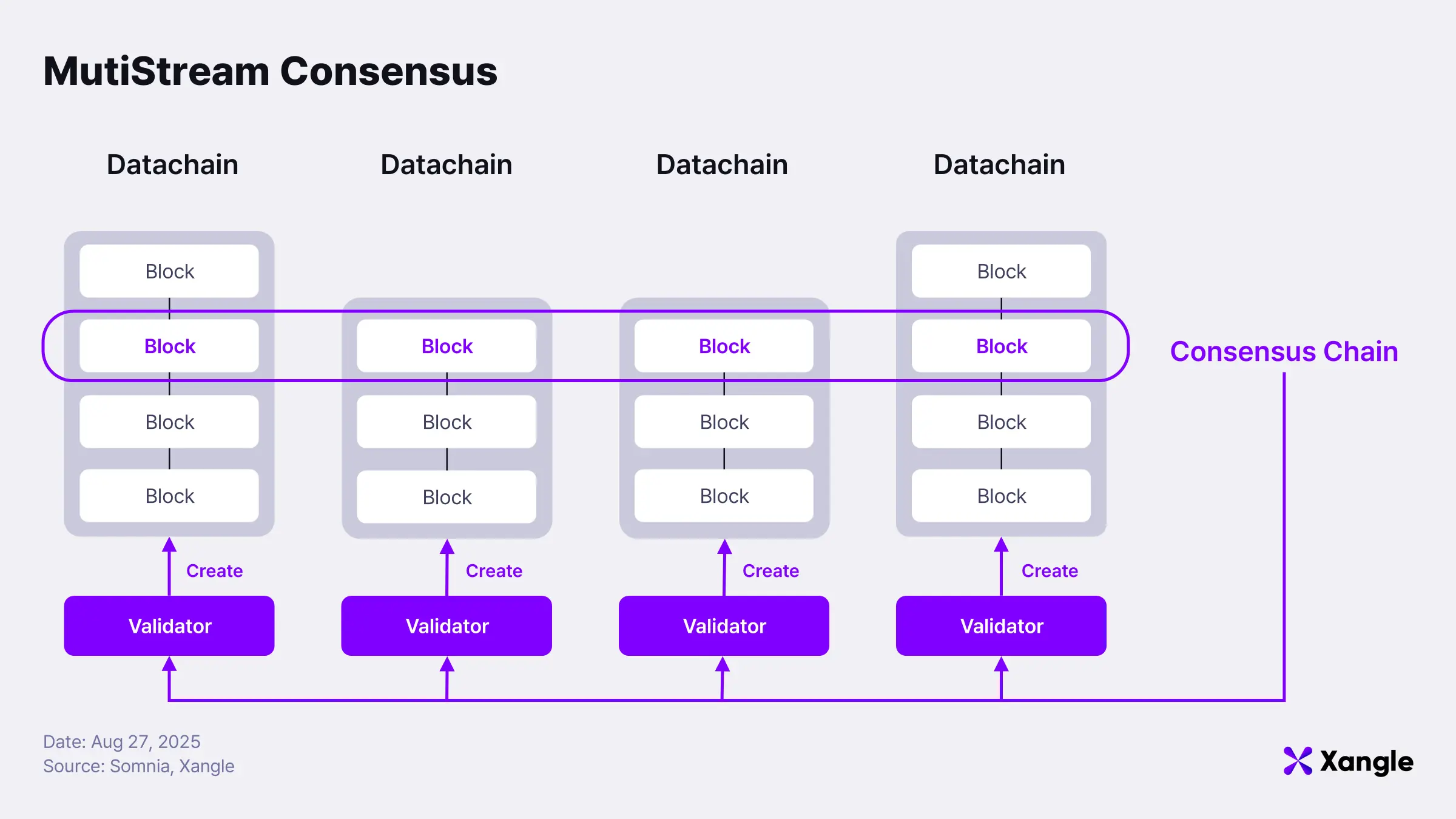
Somnia adopts a MultiStream consensus architecture inspired by Autobahn BFT, implementing a design that completely separates the processes of transaction data generation and consensus. This structure consists of two key components:
- Data Chains: Independent blockchains where each validator records its own transaction data. Here, blocks can be created without a separate consensus process.
- Consensus Chain: Collects the latest block headers from all data chains and bundles them into a single consensus block. Consensus is conducted through a modified PBFT-based Proof-of-Stake structure, which determines the overall order of all transactions recorded in the data chains.
By separating data chains and the consensus chain, multiple validators can generate blocks simultaneously, after which consensus and ordering are finalized. This architecture enables both sub-second finality and throughput exceeding one million TPS.
3-2. Accelerated Sequential Execution
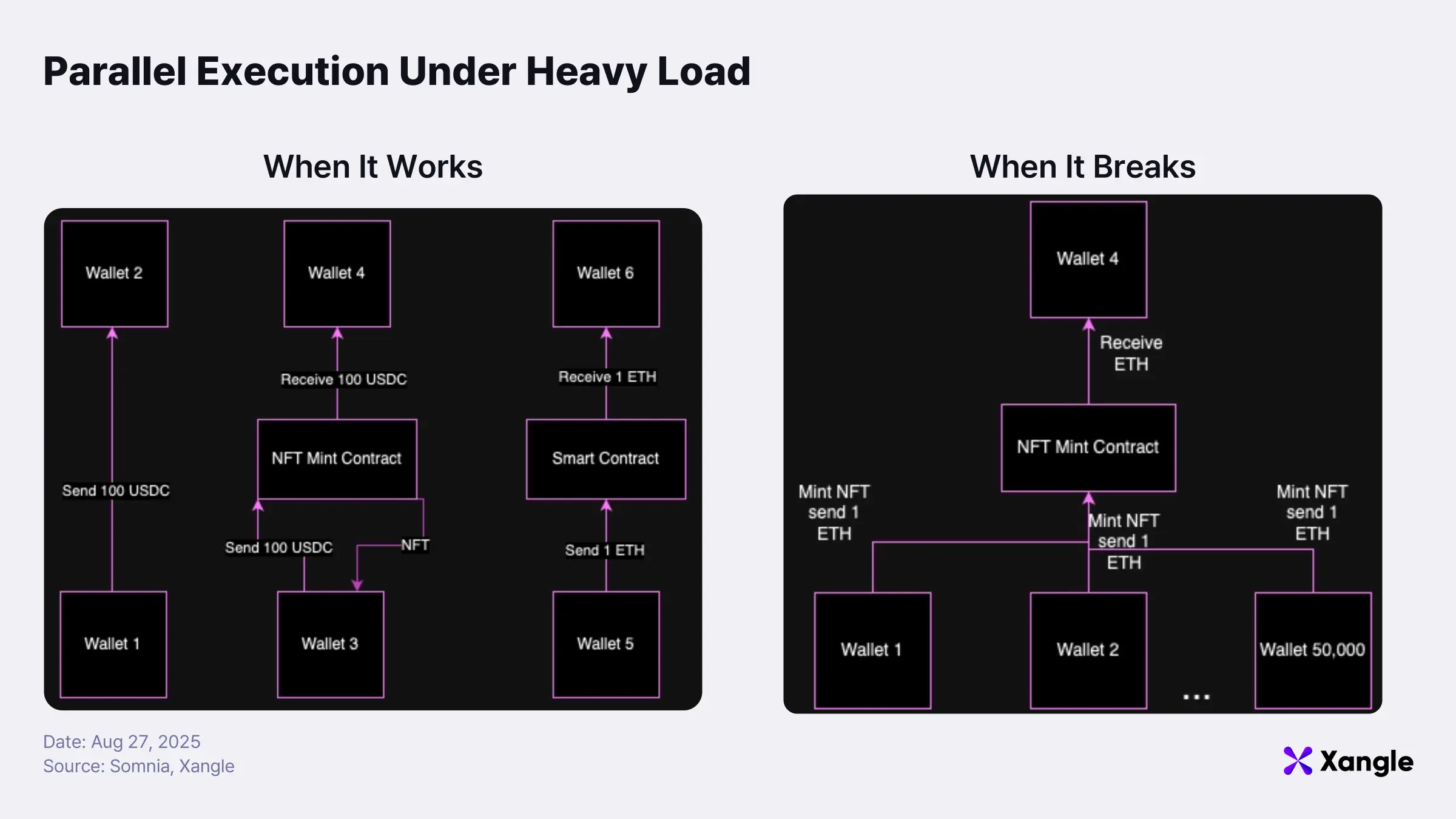
Unlike many new L1 chains that pursue performance gains primarily through parallel execution, Somnia focuses on maximizing single-core performance. Parallelization is effective when transactions touch unrelated applications or smart contracts. However, when multiple transactions interact with the same state, as in the case of transactions hitting the same dApp or contract, parallel execution is difficult to implement effectively.
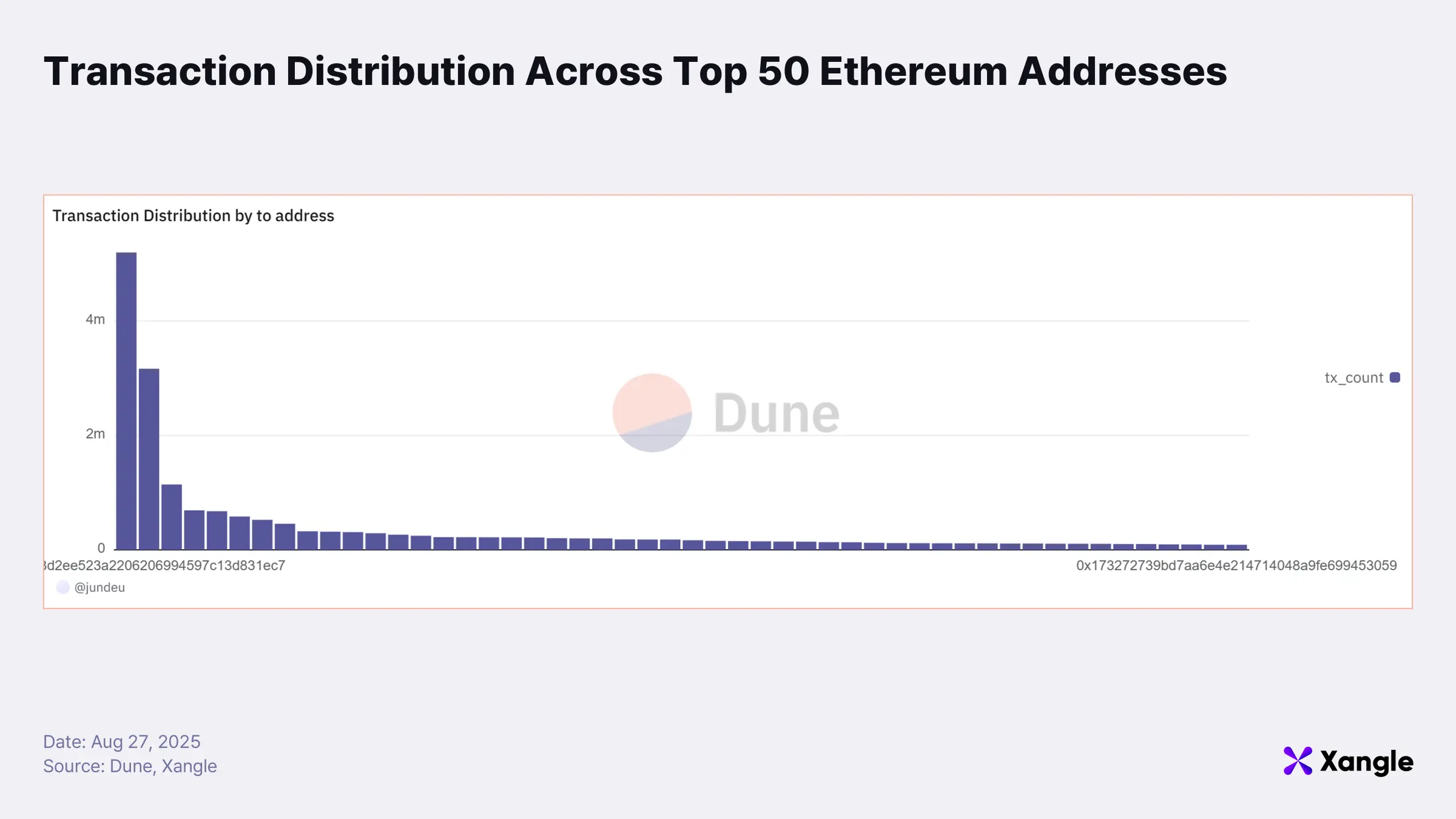
The chart above shows transaction distribution among Ethereum’s top 50 addresses over the past 30 days. The vast majority of activity is concentrated within the top ~10 addresses. This reflects a key reality: network congestion in Web3 typically clusters around the same dApps or contracts. Under such conditions, simple parallel execution offers limited benefits. Somnia addresses this by accelerating sequential execution instead. To do so, it introduces a proprietary EVM bytecode compiler and leverages hardware-level parallelism—achieving breakthrough performance even without parallel execution at the blockchain layer.
EVM Bytecode Compiler
Most EVM blockchains, including Ethereum, execute EVM bytecode through an interpreter. This method is significantly slower compared to native execution, where code is directly passed to the CPU. Somnia overcomes this by compiling EVM bytecode into native machine code that the CPU can execute directly. This results in far higher transaction throughput compared to interpreter-based execution.
Hardware-Level Parallelism
Once converted to native code, transactions can fully exploit the CPU’s built-in parallelism features—such as pipelining and out-of-order execution—to run faster. For example, while one instruction waits for memory access, another can be processed simultaneously. Traditional interpreter-based EVM execution blocks these optimizations, but Somnia’s compiler enables the CPU’s native parallelism to be fully utilized, maximizing single-core performance.
3-3. IceDB
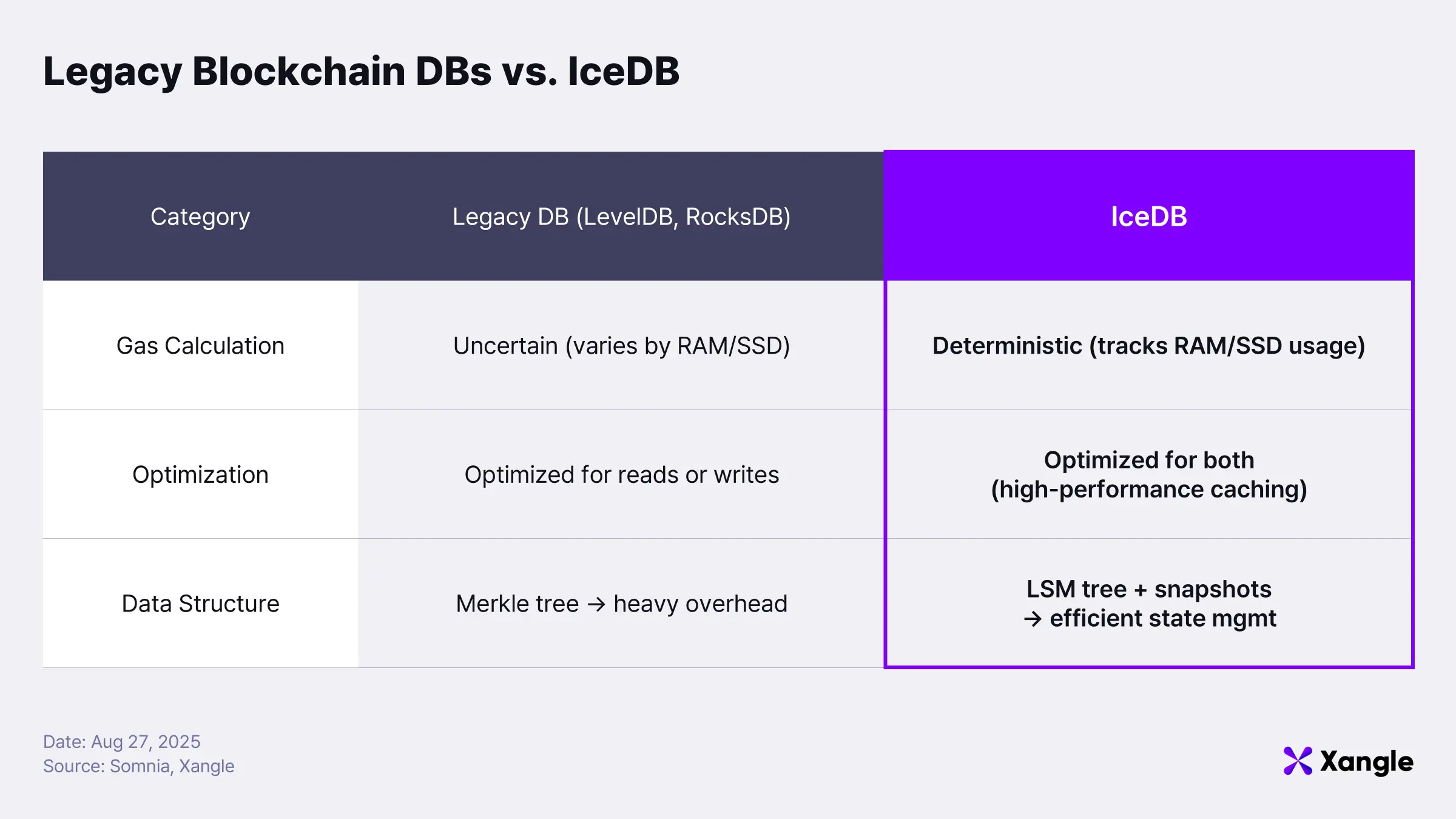
Somnia’s IceDB is a purpose-built database engineered to overcome the limitations of conventional blockchain data layers. Traditional systems such as LevelDB or RocksDB exhibit highly variable performance depending on whether data is accessed from RAM or SSD. This variability makes gas fees difficult to price accurately and prevents reliable performance forecasting.
In contrast, IceDB provides deterministic performance reporting by precisely recording RAM and SSD usage for every read and write operation. This enables gas fees to be calculated with precision, directly reflecting actual system load. Moreover, unlike most existing databases, which are typically optimized for either reads or writes but not both, IceDB incorporates a high-performance caching system tuned for both operations, maximizing data throughput.
Finally, instead of relying on complex Merkle tree structures, IceDB leverages the database’s native Log-Structured Merge tree (LSM tree) architecture and integrates built-in state snapshot functionality. This design reduces overhead and enables efficient state management. Taken together, these innovations allow IceDB to deliver predictable performance and high efficiency—a critical foundation for running high-throughput, real-time applications on-chain.
3-4. Advanced Compression Techniques
High TPS inevitably increases the cost of data propagation and verification. To mitigate this, Somnia applies stream-based compression to transaction data, eliminating redundancy and maximizing transmission efficiency. By detecting and compressing recurring patterns within each validator’s data chain, Somnia achieves up to 10–20x more efficient propagation under equivalent traffic conditions.
In addition, Somnia leverages BLS aggregated signatures. Since each transaction normally carries a unique signature that resists compression, Somnia aggregates multiple signatures into a single one—dramatically reducing both signature verification overhead and overall data size. These optimizations ensure that even under ultra-high-throughput conditions, Somnia maintains smooth node-to-node synchronization without network bottlenecks.
- Stream-Based Compression: This method assumes that both sender and receiver share the same data history. Instead of retransmitting redundant data, it replaces them with short reference instructions, such as “use the address sent 3.2MB ago.” This drastically reduces data transmission volume.
4. Somnia Ecosystem dApps
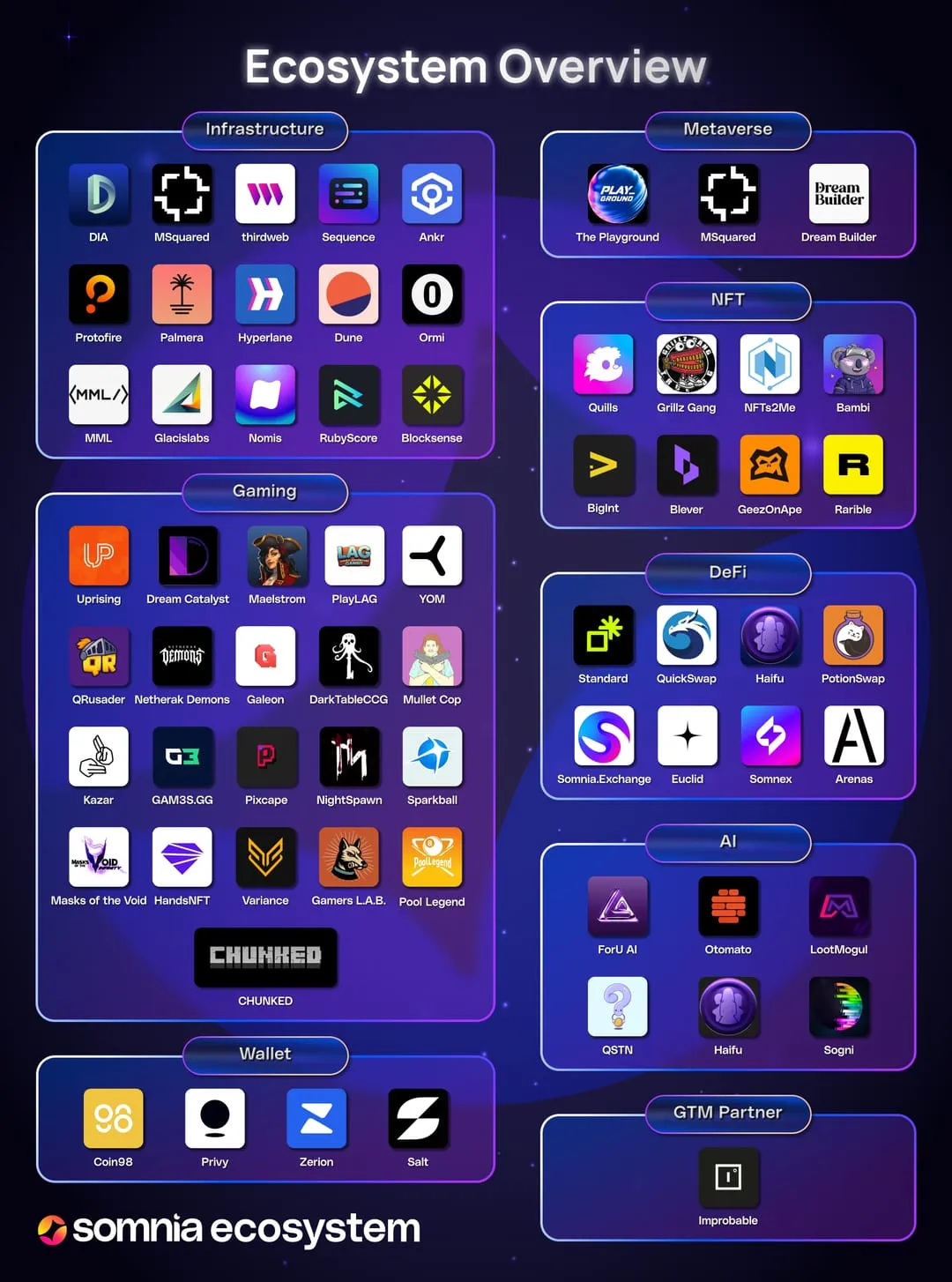
Somnia provides an environment purpose-built for applications where real-time interaction is critical—including gaming, DeFi, AI, metaverse, and social apps. Backed by Somnia’s high TPS and rapid finality, a diverse range of dApps across these verticals are actively onboarding into the ecosystem.
4-1. Gaming
Gaming is the vertical where Somnia is most actively investing and scaling. In partnership with Uprising Labs, a strategic publishing and development partner, Somnia is onboarding a broad portfolio of titles into its ecosystem. The focus is on games that integrate real-time interactivity with on-chain asset ownership, showcasing how Somnia’s high-performance infrastructure and rapid finality elevate gameplay experiences.
Uprising Labs – A Web3 publisher and developer collaborating with Somnia to onboard multiple titles. It also operates the $10M “Dream Catalyst” game fund, designed to accelerate the growth and Web3 transition of studios through developer funding, investment connections, marketing, and blockchain integration.
Flagship Projects
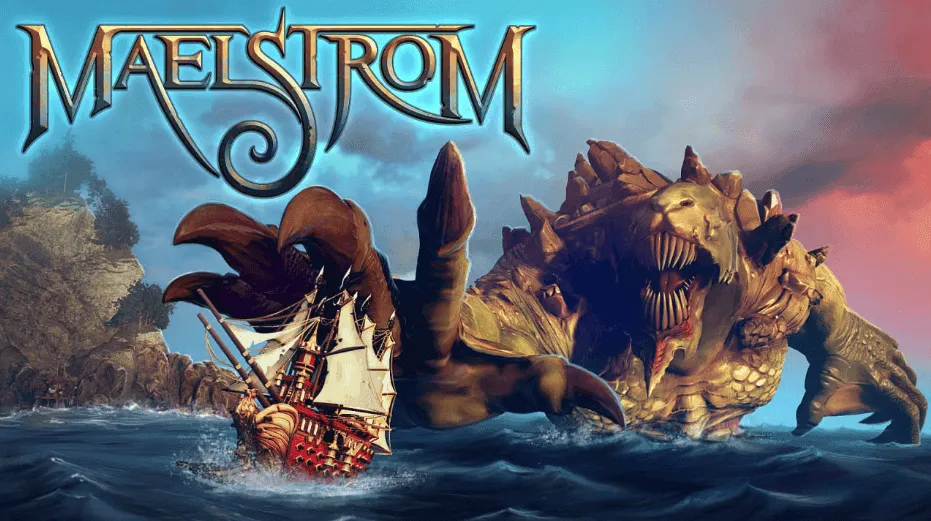
- Maelstrom: A PvP/PvE naval battle royale published by Uprising Labs. Players control warships to fight monsters and enemy fleets, with loot and achievements recorded on-chain. Also available for download on Steam.
- Dark Table CCG: A four-player competitive card game set in a Lovecraft-inspired universe, where card assets are tradable on-chain. Also downloadable on Steam.
- Sparkball: A 4v4 sports brawler developed by Opti Games, blending MOBA strategy with action gameplay. Supports on-chain betting, AI matchmaking, and tournaments.
- Variance: Somnia’s first anime-style roguelike RPG developed by Realm Studios. Built as a live-service game, it features ongoing updates and events, with characters and equipment issued as on-chain assets to guarantee ownership.
4-2. DeFi
DeFi forms the financial backbone of the Somnia ecosystem, providing core primitives such as payments, trading, and asset management. With Somnia’s ultra-fast, low-cost infrastructure, fully on-chain Central Limit Order Books (CLOBs) become feasible; overcoming long-standing limitations of DeFi and enabling scalable, reliable services even under heavy user load.
Flagship Projects
- Somnia.exchange: A gamified Play-to-Earn DEX where users earn NFTs, points, and other rewards while swapping.
- Standard: A decentralized exchange leveraging Somnia’s rapid finality and low transaction costs to support fully on-chain CLOBs. Runs a high-performance matching engine directly on-chain, maximizing transparency and security in trading.
4-3. NFT Projects
NFTs are a core pillar of Somnia’s ecosystem, reinforcing digital ownership and the creator economy. Somnia’s high-speed, low-cost infrastructure enables efficient handling of the entire NFT lifecycle, minting, trading, and burning, opening the door for broad adoption across gaming, metaverse, and digital art use cases.
Flagship Projects
- Quills: The first PFP collection in the Somnia ecosystem, comprising 3,333 unique avatars.
- Rarible: A multi-chain NFT marketplace that includes Somnia, supporting minting, listing, and trading of Somnia-based NFTs.
4-4. AI
The AI vertical in Somnia leverages real-time processing power and on-chain transparency, enabling entirely new types of AI-driven applications. Crucially, this is achieved while preserving user data ownership and privacy, allowing for real-time analytics, recommendations, and social interactions without compromising sovereignty.
Flagship Projects
- ForU AI: An AI engine for on-chain communities, enabling users to create, own, and tokenize their on-chain identity via AI-DID.
- Otomata: A no-code tool for building AI agents that autonomously execute complex DeFi strategies. Operates with a revenue-sharing model.
- Sogni AI: A decentralized AI image generation platform where users can provide their device resources in “worker mode” and earn Sogni tokens as rewards.
4-5. Ecosystem Infrastructure
Somnia’s ecosystem infrastructure underpins network operations and developer environments, spanning wallets, bridges, developer tools, data, and security.
Flagship Projects
- Wallets: Coin98, Privy, Salt – Multi-chain support, easy wallet integration, decentralized asset management.
- Bridges: Hyperlane – A cross-chain protocol connecting with over 150 blockchains.
- Developer Tools: thirdweb, Protofire, Sequence – SDKs, APIs, oracles, subgraphs, and smart wallets.
- Oracles: DIA – Provides real-time price feeds.
- RPC: Ankr – Reliable node and subgraph infrastructure.
- Data Analytics: Dune, Ormi – On-chain data analysis and visualization platforms.
- Security & Management: Glacis Labs, Palmera DAO – Cross-chain messaging security and multi-sig asset management.
5. Tokenomics & Roadmap
5-1. $SOMI tokenomics
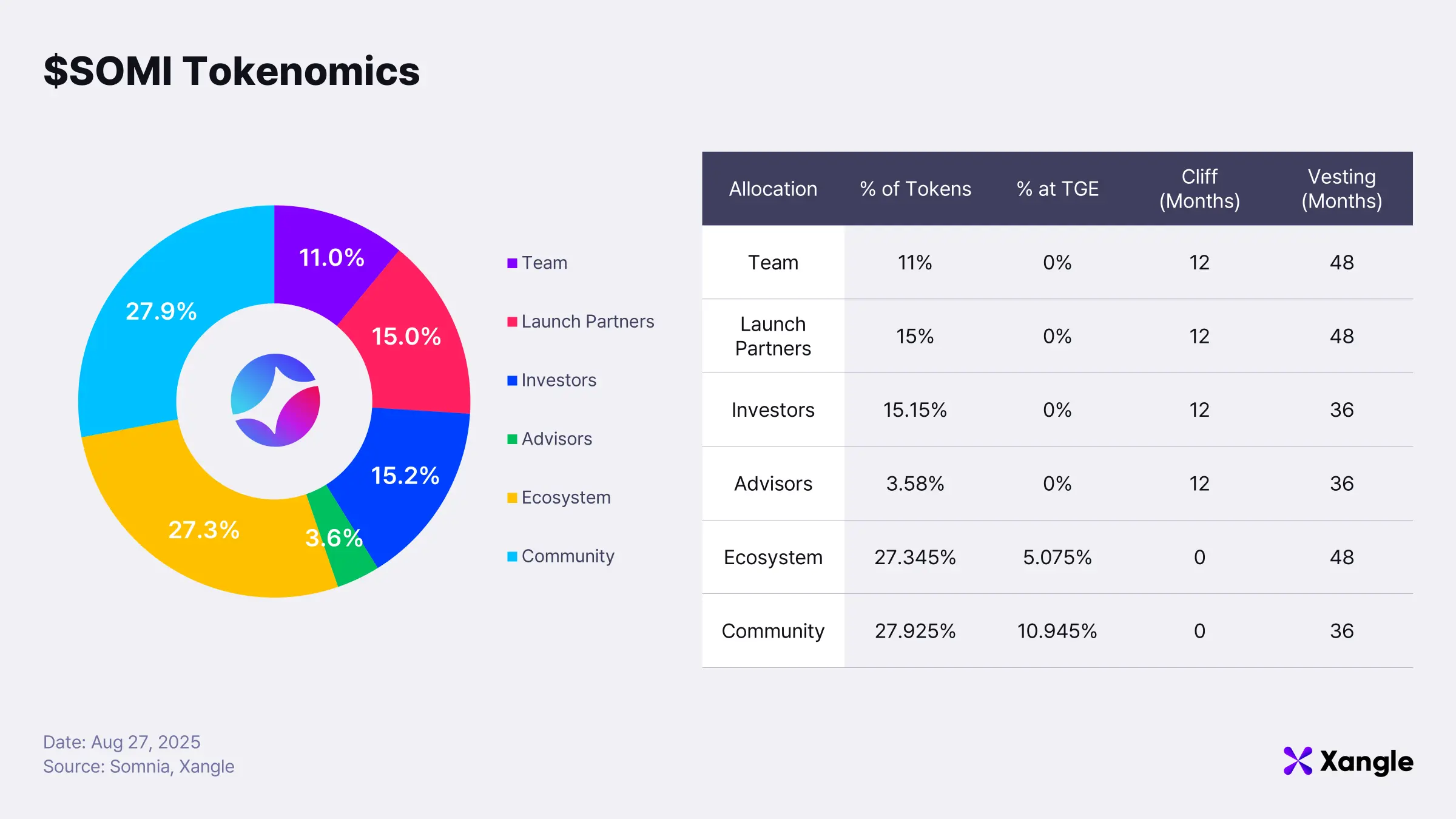
- Total Supply: 1,000,000,000 (1B) $SOMI
- Initial Circulating Supply: 160,200,000 (160.2M) $SOMI
- Token Allocation:
- Team (11%) – Allocated to team members and founders
- Launch Partners (15%) – Allocated to early contributors to the Somnia ecosystem
- Investors (15.15%) – Allocated to seed investors
- Advisors (3.58%) – Allocated to Somnia’s key advisors
- Ecosystem (27.345%) – Reserved for ecosystem development and foundation funding
- Community (27.925%) – Allocated to users contributing to the ecosystem, validator rewards, and liquidity
- Token Utility:
- Staking: Required to become a validator; delegation is supported
- Governance: Major network decisions will be made via token governance (details TBD)
- Gas Fees: Gas fees on the Somnia blockchain are paid in $SOMI; 50% of fees go to validator rewards and 50% are burned
To mitigate sell pressure at launch, team and investor allocations are subject to a full one-year lockup. By contrast, a larger share of tokens is released early to ecosystem and community pools, ensuring that initial rewards flow primarily to contributors. Within the community allocation, testnet airdrops follow a staggered schedule: 20% unlocks on Day 1, while the remaining 80% unlocks progressively over 60 days, conditional on completing specific missions. This structure is designed to discourage early exits and sustain user engagement.
Certain community members—including SomniYaps holders, Quills holders, and users with designated Discord roles—are eligible for 100% immediate unlock of their airdrop allocation. In addition, Somnia is preparing a new airdrop campaign called “Somnia Mines,” allocating 8% of total supply as post-TGE incentives. The program is intended to provide long-term engagement hooks, ensuring continued ecosystem activity well beyond the initial token generation event.
5-2. A gas fee model optimized for high TPS
Among Somnia’s newly introduced token utilities, the gas-fee mechanism stands out for its unconventional structure. This section takes a closer look at its design.
At its foundation, Somnia’s gas-fee model builds on Ethereum’s framework, following the formula:
Total Fee = Gas Used × Gas Price
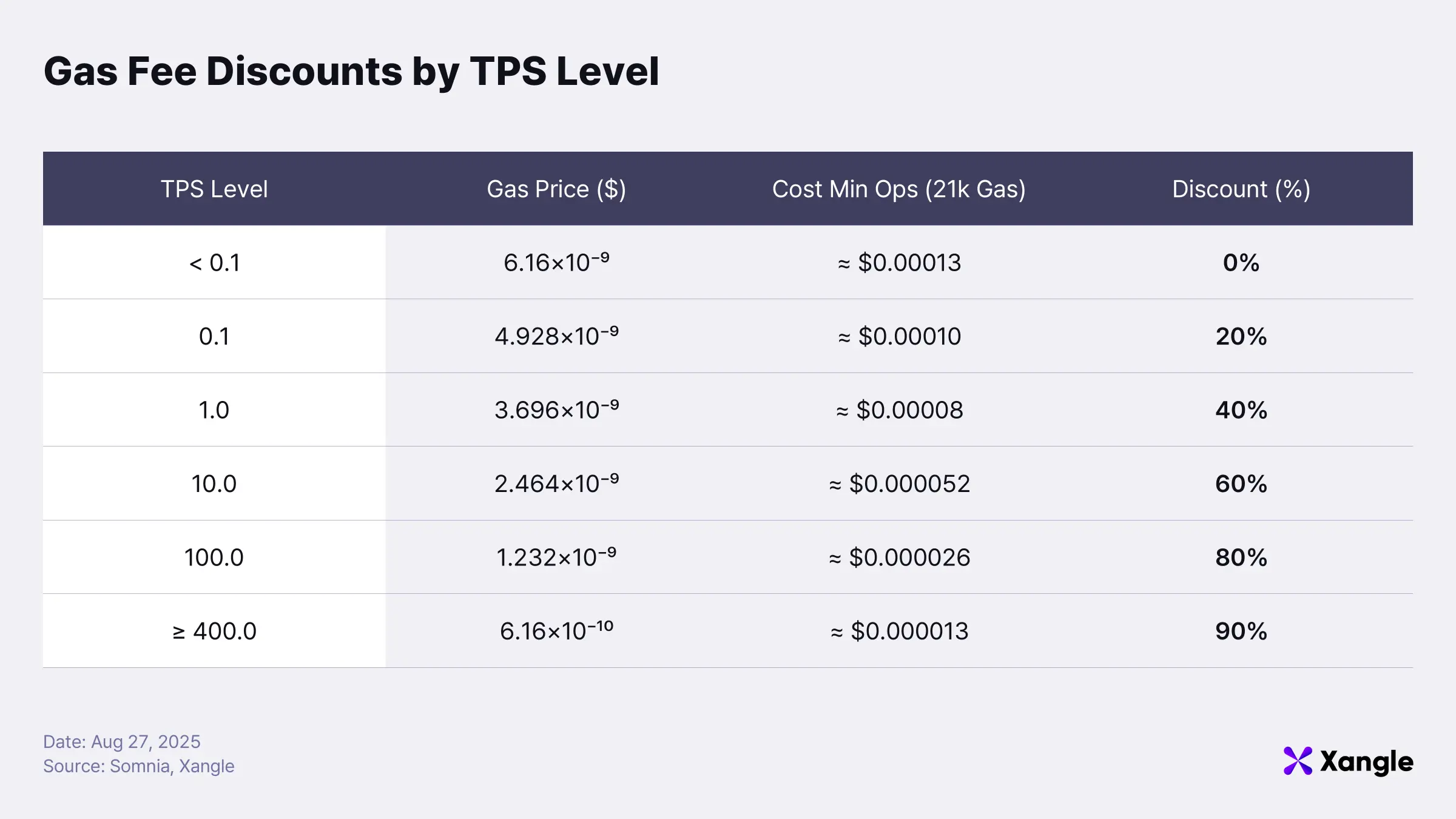
- Gas Used: As with Ethereum, each transaction requires a minimum of 21,000 gas. The actual usage then varies depending on the size of the transaction data and the specific opcodes executed.
- Gas Price Discounts: Somnia introduces a distinctive discount model for gas pricing. While most would expect transaction fees to rise as activity increases, Somnia takes the opposite approach. As a contract’s TPS surpasses thresholds of 0.1 / 1 / 10 / 100 / 400 TPS, the gas price applied to that contract decreases step by step. TPS is measured based on the contract’s average throughput over a one-hour period. This reverse-discount structure ensures that high-throughput environments—such as real-time applications and fully on-chain games—can operate smoothly and cost-effectively. (This feature is not yet live on mainnet and is scheduled for release by year-end.)
Somnia’s fee model also introduces Transient Storage. In most blockchains, once state data is written, it is stored permanently, leading to rapid chain growth and higher costs when handling large datasets. By contrast, fully on-chain games often require temporary states, such as a character’s position or movement, that do not need to be preserved indefinitely. To address this, Somnia allows such data to be written into time-limited storage that is automatically deleted after a specified duration. This design reduces both gas costs and overall chain bloat, creating a more efficient and sustainable environment for real-time, high-throughput applications.
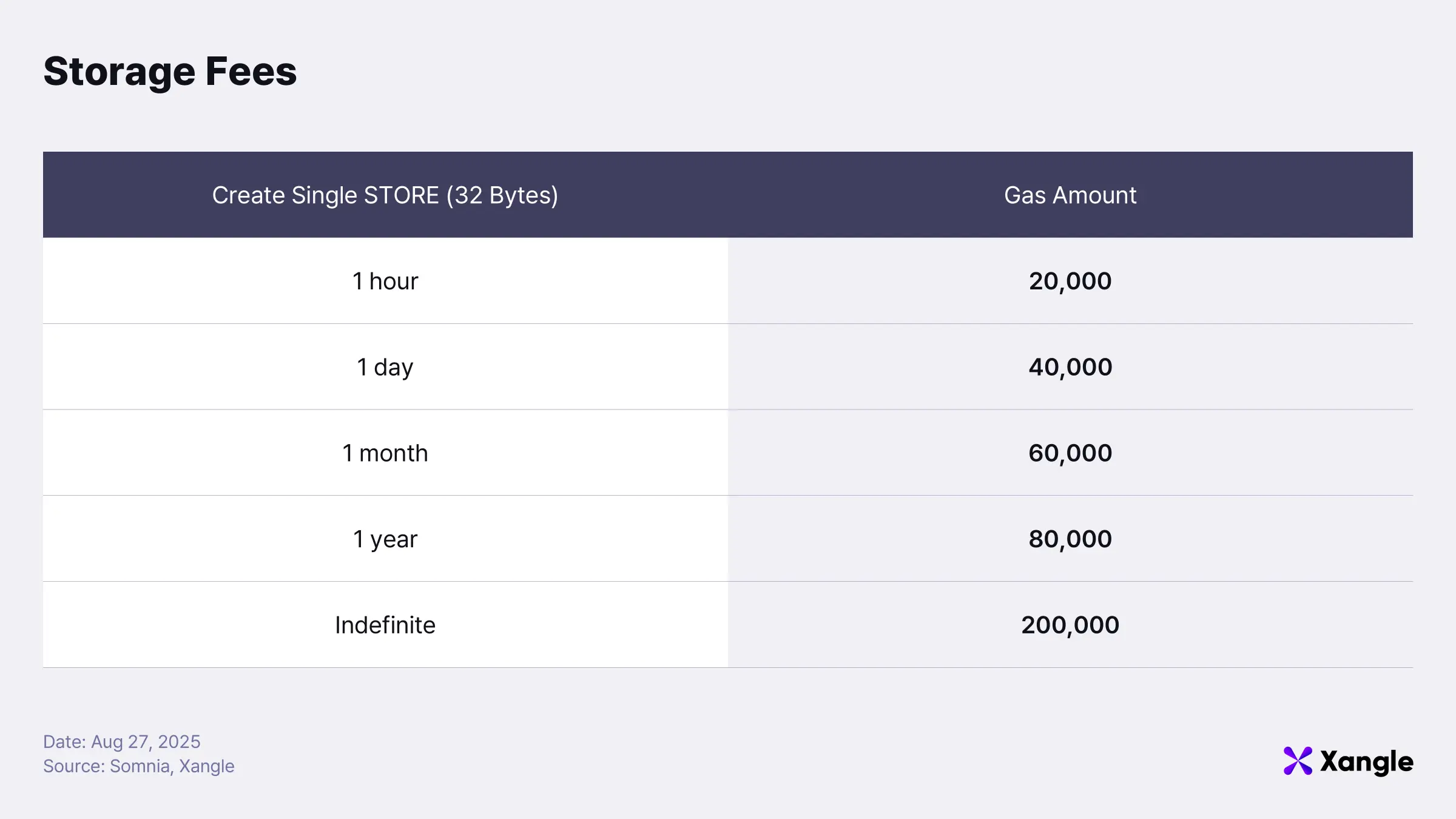
For example, storing 32 bytes (1× SSTORE):
- Permanent storage: 200,000 gas
- 1-hour storage: 20,000 gas (~90% discount)
- Scaling by duration: 1 day = 40,000 → 1 month = 60,000 → 1 year = 80,000 → Permanent = 200,000 (no discount applied)
This structure allows ephemeral states—such as in-game character positions—to be recorded cheaply in transient storage, while only essential data such as results or assets are kept in permanent storage. In practice, this enables high-TPS real-time applications and fully on-chain games to operate cost-effectively. This feature has not yet been activated on mainnet and is scheduled for release by year-end.
Somnia also incorporates a Dynamic Base Fee Adjustment to guard against network congestion and mitigate DDoS attacks. If block execution time exceeds 95ms, validators vote to double the base fee. If execution is faster, the base fee is reduced by 50% (with a floor of 21,000 gas). Finally, gas fees paid by users are split evenly: 50% distributed to validators, 50% burned—ensuring $SOMI maintains a deflationary supply structure.
5-3. Roadmap beyond TGE
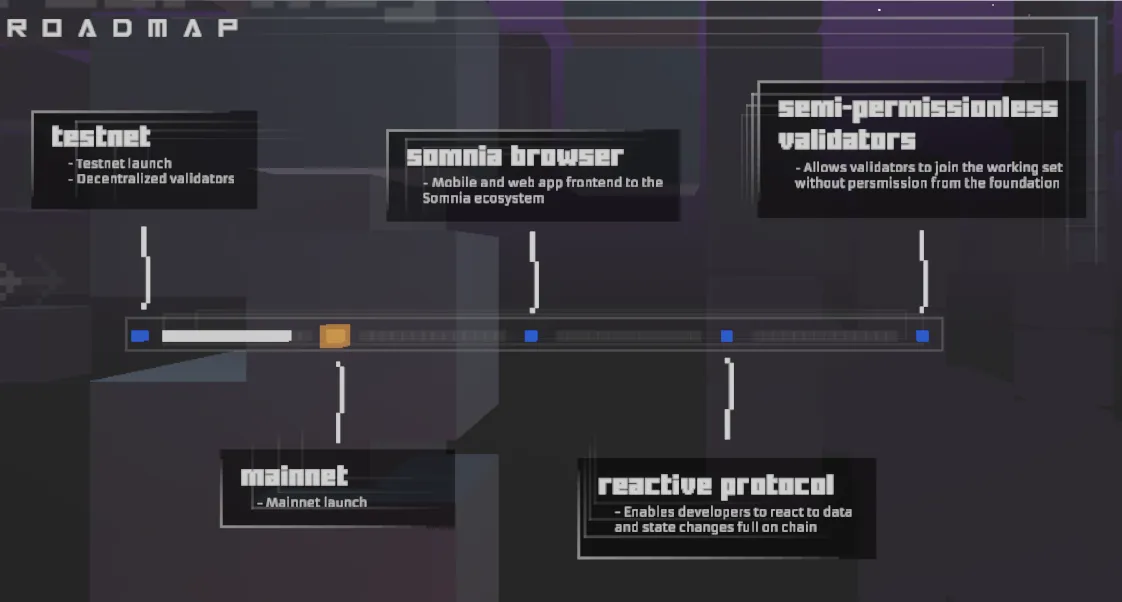
Somnia has outlined a series of major upgrades planned beyond mainnet launch. Key initiatives include:
- Somnia Browser: The mobile/web frontend for the Somnia ecosystem, enabling users to easily interact with multiple dApps.
- Reactive Protocol: A framework allowing developers to interact with on-chain data and states in real time, making it easier to build real-time apps directly on Somnia.
- Semi-Permissionless Validators: A system allowing validators to join the active set without explicit foundation approval, strengthening decentralization and network security.
6. Closing Statement: Somnia’s Vision for Web3 Mass Adoption
Somnia’s vision is clear: to preserve Web3’s core values, decentralization, censorship resistance, and user ownership, while delivering Web2-level performance and user experience. The goal is a Web3 future where anyone can access and naturally interact with fully on-chain, real-time, large-scale applications.
Somnia has already secured the technological foundation for this vision: 1M+ TPS, sub-second finality, ultra-low fees, and full EVM compatibility. Its ecosystem is expanding rapidly across gaming, DeFi, NFTs, and AI. To further accelerate adoption, Somnia is actively supporting developers and users through a $270M ecosystem fund.
With the recent unveiling of its tokenomics and the conclusion of its testnet airdrop campaign, Somnia is now approaching its TGE and mainnet launch. The key challenge ahead is proving that real-time dApps and seamless on-chain experiences can be delivered effectively at mainnet scale. If achieved, Somnia’s mainnet will represent a pivotal milestone in the long-sought path toward true Web3 mass adoption.
Appendix. Somnia’s Organizational Structure, Investment, and Ecosystem Fund
Somnia is a project launched with the financial, technological, and network support of Improbable, MSquared, and the Virtual Society Foundation (VSF). Their respective roles and relationships can be summarized as follows:
- Improbable: A technology company with over a decade of experience building distributed systems and metaverse infrastructure. Today, it acts as a venture builder for frontier domains such as AI, Web3, and the metaverse. Improbable has raised a total of $822M over the past 10 years, of which $150M was used to establish MSquared, its metaverse platform subsidiary.
- MSquared: A metaverse-focused subsidiary established by Improbable with investment from global firms such as a16z and SoftBank. MSquared develops platforms capable of hosting massive virtual worlds and provided Somnia with its initial funding support.
- Somnia Foundation (Prev. Virtual Society Foundation-VSF): An independent organization backed by Improbable and MSquared. Somnia Foundation launched Somnia as a Layer-1 mainnet project to build the economic infrastructure for the metaverse.
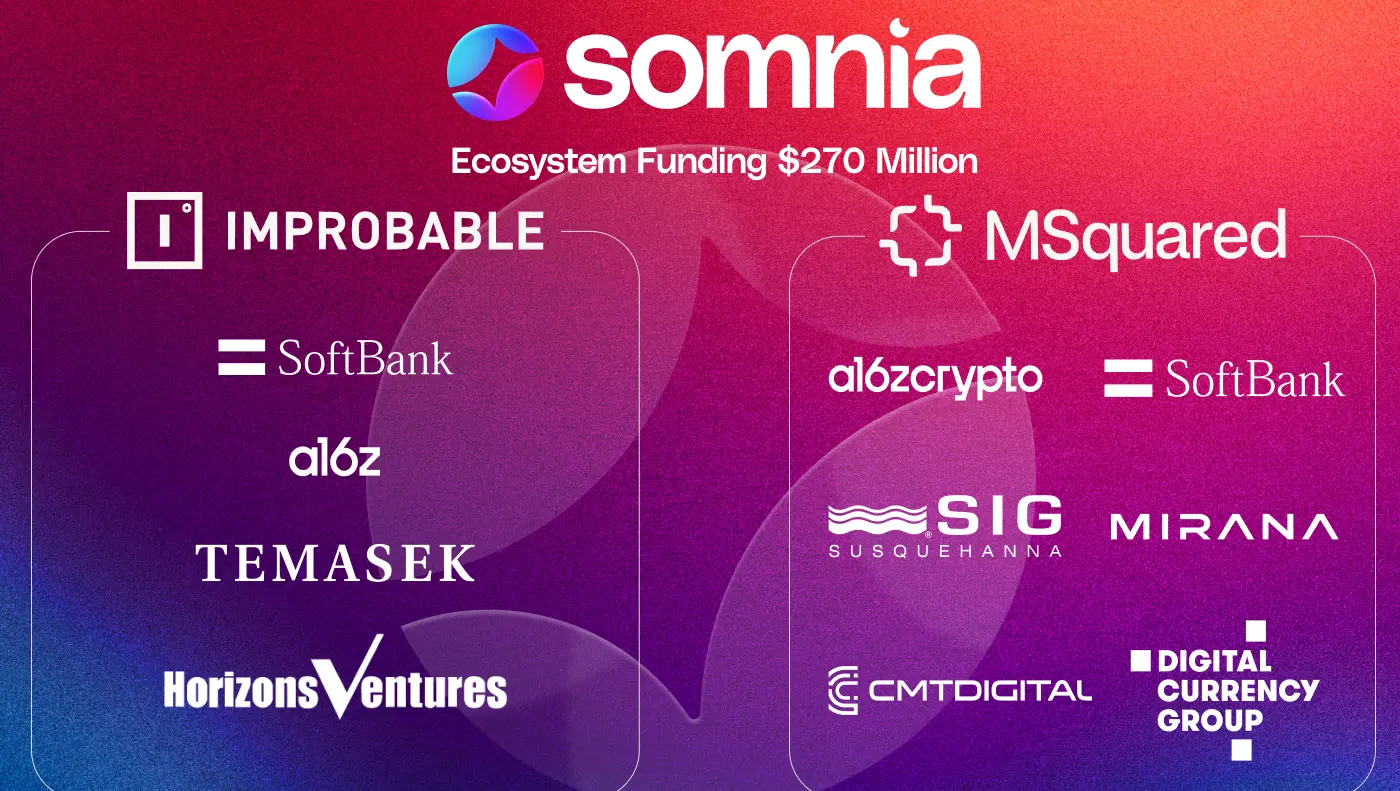
Together, these three entities have established a $270M ecosystem fund to support the growth of the Somnia ecosystem. In parallel, Somnia and Uprising Labs jointly operate an accelerator program called Dream Catalyst, providing $10M in funding to Web3 gaming studios. Additionally, a separate $10M developer grant program has been set up to encourage the development of Somnia-native dApps and actively drive ecosystem expansion.
Disclaimer
I confirm that I have read and understood the following: The information contained in this article is strictly the opinions of the author(s). This article was authored free from any form of coercion or undue influence. The content represents the author's own views and does not represent the official position or opinions of CrossAngle. This article is intended for informational purposes only and should not be construed as investment advice or solicitation. Unless otherwise specified, all users are solely responsible and liable for their own decisions about investments, investment strategies, or the use of products or services. Investment decisions should be made based on the user’s personal investment objectives, circumstances, and financial situation. Please consult a professional financial advisor for more information and guidance. Past returns or projections do not guarantee future results. This article was written at the request of Somnia. All content in this article was written independently by the author(s), and neither CrossAngle nor Somnia had any editorial control or influence over the content. The author(s) may hold the cryptocurrencies mentioned in this article at the time of writing.
Xangle or its affiliated partners own all copyrights of the written or otherwise produced materials and content provided on the platform. Any illegal reproduction of such content, including, but not limited to, unauthorized editing, copying, reprinting, or redistribution will result in immediate legal actions without prior notice.
![[CIS Partner Summit Highlights] Ault's Financial Super App Strategy: OnlyBulls](https://resource.xangle.io/files/content/C1A19E1DB41B7FB86076143803C40D8E_1790125531662.webp)
![[Xangle RWA Series] Solana RWA: A Look at the Key Players](https://resource.xangle.io/files/content/F779A005246C0299246537AACB3A39F2_1782287059970.webp)