Retail Strikes Back — With Mitosis

Table of Contents
1. Why Are Retail Investors Still Left Behind?
2. How Does Mitosis Resolve Market Imbalances?
3. What Is Mitosis’s Ecosystem Expansion Strategy?
4. Mitosis Is What Comes After
Appendix: Strategy Guide for Using Mitosis
1. Why Are Retail Investors Still Left Behind?
In traditional finance, centralized institutions such as exchanges and banks monopolize profits through transaction fees and interest spreads, while also collecting and repurposing users’ financial data. The result is a concentration of financial benefits and information in the hands of a few—leading to a lack of transparency, asymmetrical access to information, and high user costs. These conditions ultimately undermine accessibility and fairness across the financial system.
DeFi (Decentralized Finance) emerged to challenge this model. By replacing intermediaries with smart contracts, DeFi allows anyone to provide liquidity to decentralized exchanges (DEXs) or deposit assets into lending protocols. This permissionless infrastructure enables users to both deliver and consume financial services directly, restoring control over value distribution and data ownership to individuals—core principles DeFi set out to achieve.
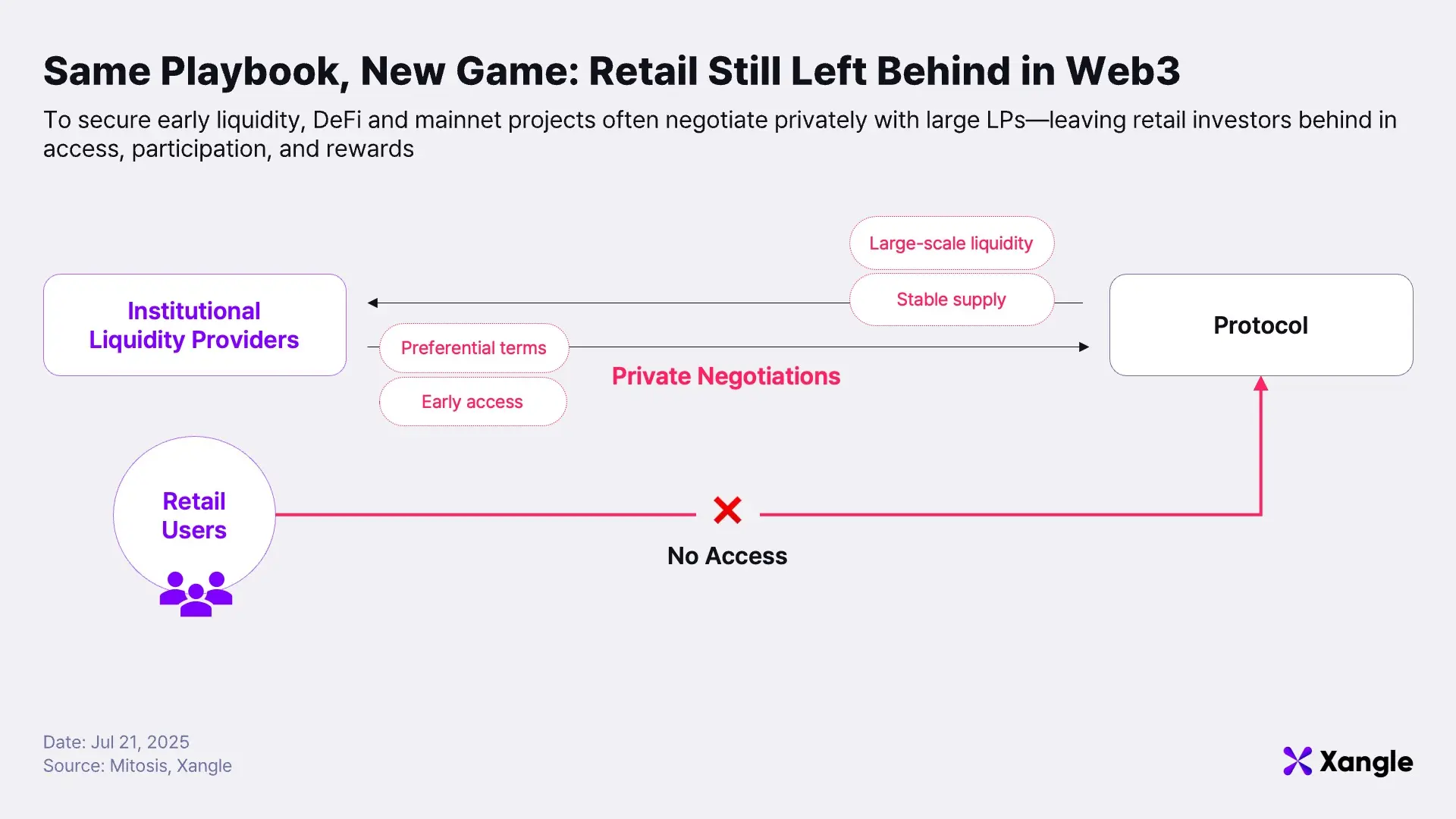
Yet even within this new paradigm, the ideal of finance for all remains elusive. Structural advantages persist for a select few, particularly in areas such as access to opportunities, reward mechanisms, and informational symmetry. Retail investors, in particular, continue to be excluded from meaningful participation.
One of the clearest manifestations of this imbalance is the continued use of side letters—private agreements extended exclusively to large institutional liquidity providers (LPs). Borrowed from private equity practices, these agreements offer select investors preferential access to liquidity provisioning, superior terms, and privileged information. While such asymmetrical arrangements were common in Web2 finance, they have reappeared in Web3, perpetuated by the aligned interests of protocols and institutional LPs.
The issue is especially pronounced in PoS-based mainnets and DeFi protocols, where early liquidity often determines the trajectory of a project. In mainnets, liquidity directly underpins network security. In DeFi, insufficient liquidity can lead to price distortions, excessive slippage, and user attrition. To secure early stability and scale, many projects depend on private, off-market negotiations with institutional LPs to onboard liquidity—thereby reinforcing a closed-loop system.
This dynamic grants institutional LPs access to outsized rewards, lower risk exposure, and prioritized entry, while retail investors are pushed to the sidelines—granted access only after the most valuable opportunities have already passed. The result is more than just a disparity in incentives; it is a systemic reinforcement of inequality across DeFi. Retail investors are relegated to after-the-fact participants, with no visibility into reward structures, no clear criteria for distribution, and no equitable access to information. Despite DeFi’s claims of decentralization, value and control are once again concentrated in the hands of a few.
2. How Does Mitosis Resolve Market Imbalances?
2-1. Mitosis L1: Aggregating liquidity to expand market influence
Mitosis is a Layer 1 blockchain built on the Cosmos SDK with an EVM-compatible execution environment. Its architecture is designed to handle the full lifecycle of liquidity management—ranging from asset deposits and strategy deployment to yield settlement and capital re-utilization—within a unified system. This enables Mitosis to consolidate assets from multiple chains into a single liquidity pool, allowing for more precise and predictable strategic allocation.
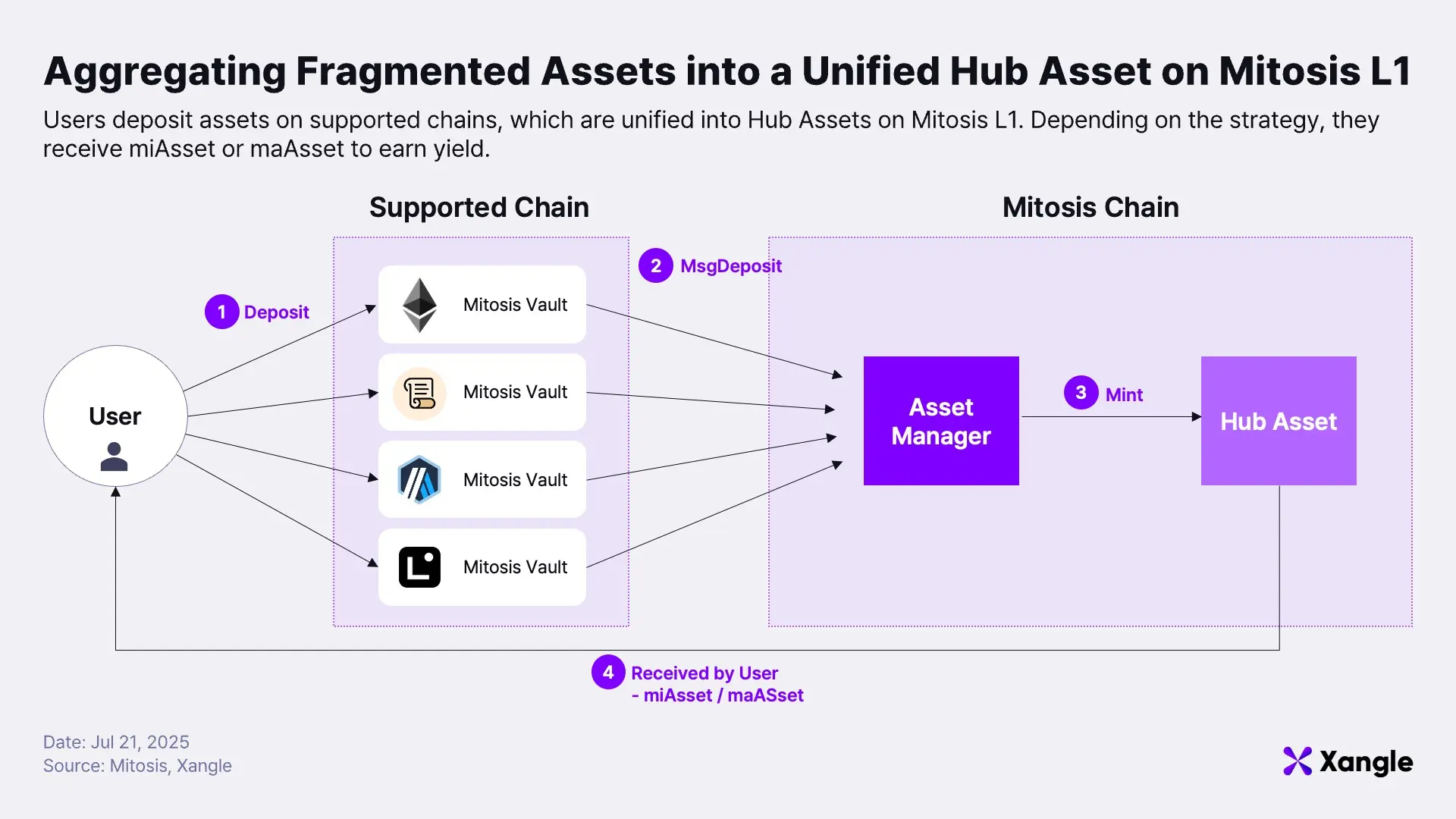
At the core of this infrastructure are three key components: Vaults, Hub Assets, and tokenized liquidity assets. When users deposit assets on a chain supported by Mitosis, those assets are securely stored in that chain’s Vault. Deposit information is then relayed to the Mitosis L1 Asset Manager, which mints a corresponding Hub Asset on a 1:1 basis and transfers it to the user’s wallet. The Hub Asset acts as a standardized unit of capital that can be deployed across various strategies, enabling unified management of multi-chain assets on the Mitosis L1 chain.
Once a user holds Hub Assets, they can allocate them into strategies offered within the Mitosis ecosystem to earn yield. Depending on the strategy type, the user receives a tokenized liquidity asset—either miAsset or maAsset:
- miAsset is issued through participation in EOL (Ecosystem-Owned Liquidity), a governance-driven framework. It provides both yield claim rights and voting power on strategic decisions.
- maAsset is issued via Matrix, an individual liquidity campaign that rewards users for locking up assets over a set period in exchange for higher returns.
Both token types are fully composable within DeFi and can be reused across protocols, significantly improving capital efficiency.
Mitosis L1 is not just a chain that aggregates liquidity—it is explicitly designed to concentrate fragmented assets, increase market-level liquidity influence, and make advanced yield opportunities accessible to all participants. Previously exclusive to institutional investors, these strategic structures are now opened to users of all sizes. By abstracting the liquidity of individual chains into a unified Hub Asset standard, Mitosis levels the playing field, allowing broader participation under equal conditions. The tokenized liquidity assets (miAsset and maAsset) also transform previously idle LP capital into actively deployable financial instruments, addressing both capital efficiency and structural barriers to strategy access.
To date, Mitosis has attracted approximately $73 million in deposited liquidity and has signed private agreements with two projects—early indicators of the protocol’s strategic vision coming to life. The majority of this liquidity is currently sourced from eETH, a restaked liquid token offered by Ether.fi. Users depositing eETH simultaneously earn Ethereum staking yield, EigenLayer restaking rewards, and points from EigenLayer, Ether.fi, and Mitosis, making the platform particularly attractive for multi-layer yield farmers.
2-2. Democratizing access to institutional-grade liquidity strategies
Liquidity aggregated on Mitosis L1 is deployed via a structured framework that removes barriers to entry based on capital size or privileged access to information. Regardless of asset scale or insider connections, all users can participate in strategies and generate yield under the same terms. Central to this vision is Mitosis’s practice of pre-negotiating liquidity campaigns with DeFi protocols under fixed conditions—then opening those campaigns to the public. What was once the domain of institutional investors is now accessible to retail participants.
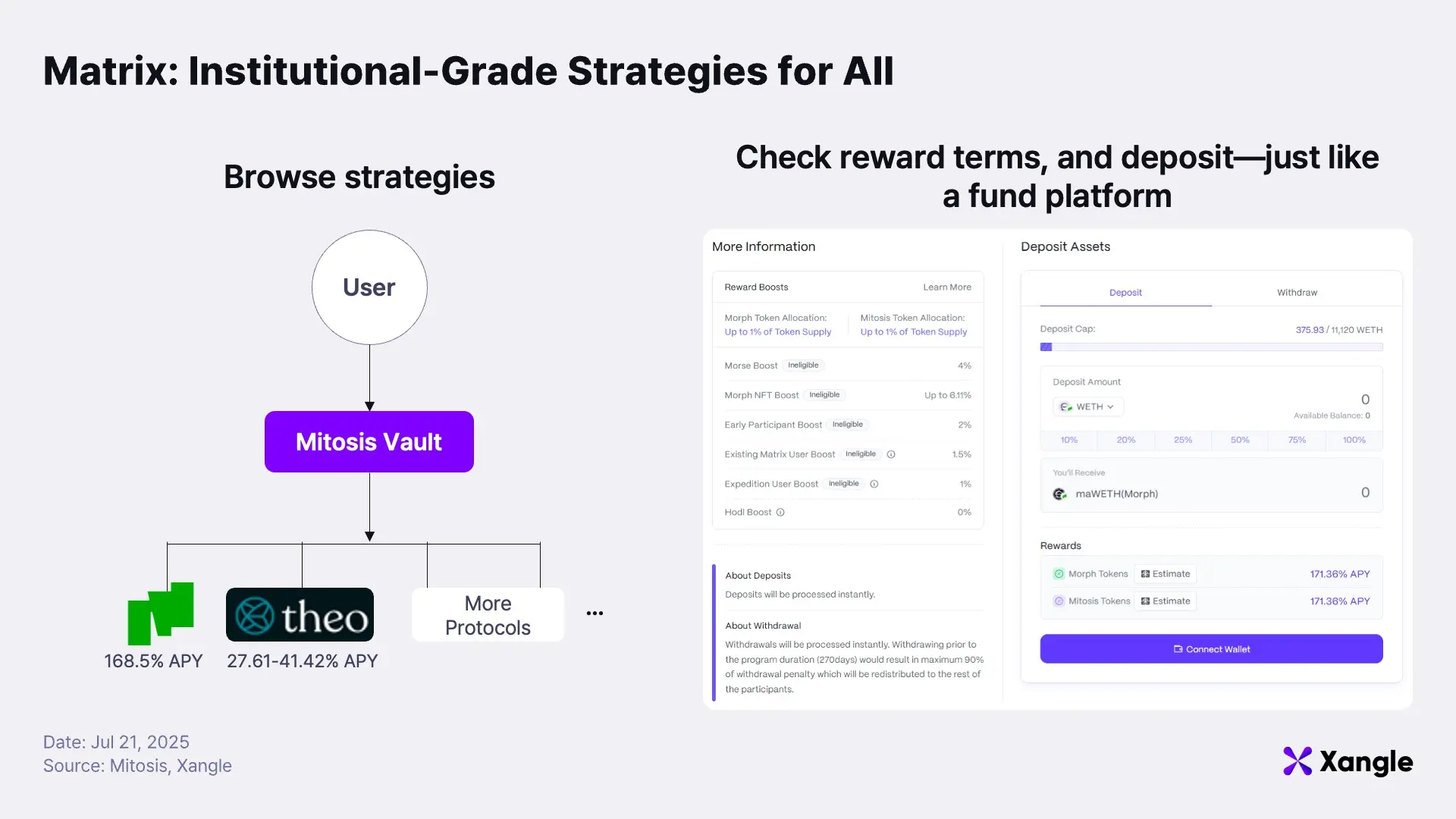
The clearest embodiment of this approach is the Matrix framework. Matrix enables users to participate in pre-arranged fixed-yield campaigns, where parameters such as interest rate, lock-up duration, and reward terms are transparently set in advance. After reviewing the terms, users can deposit their assets into a selected campaign and receive maAsset—a tokenized representation of their locked position. Upon maturity, the user redeems both their principal and the agreed-upon yield.
A notable example currently in progress involves Morph, a ZK-based Ethereum Layer 2 project. As of July 18, users can deposit WETH, USDT, and other supported assets into a campaign offering an APY of up to 340%. This unusually high return is made possible by a prearranged agreement in which both Mitosis and Morph allocated 0.135% of their native token supplies to fund the campaign. What distinguishes this structure is its openness: retail users now receive the same terms that would previously have been available only to large institutional LPs.
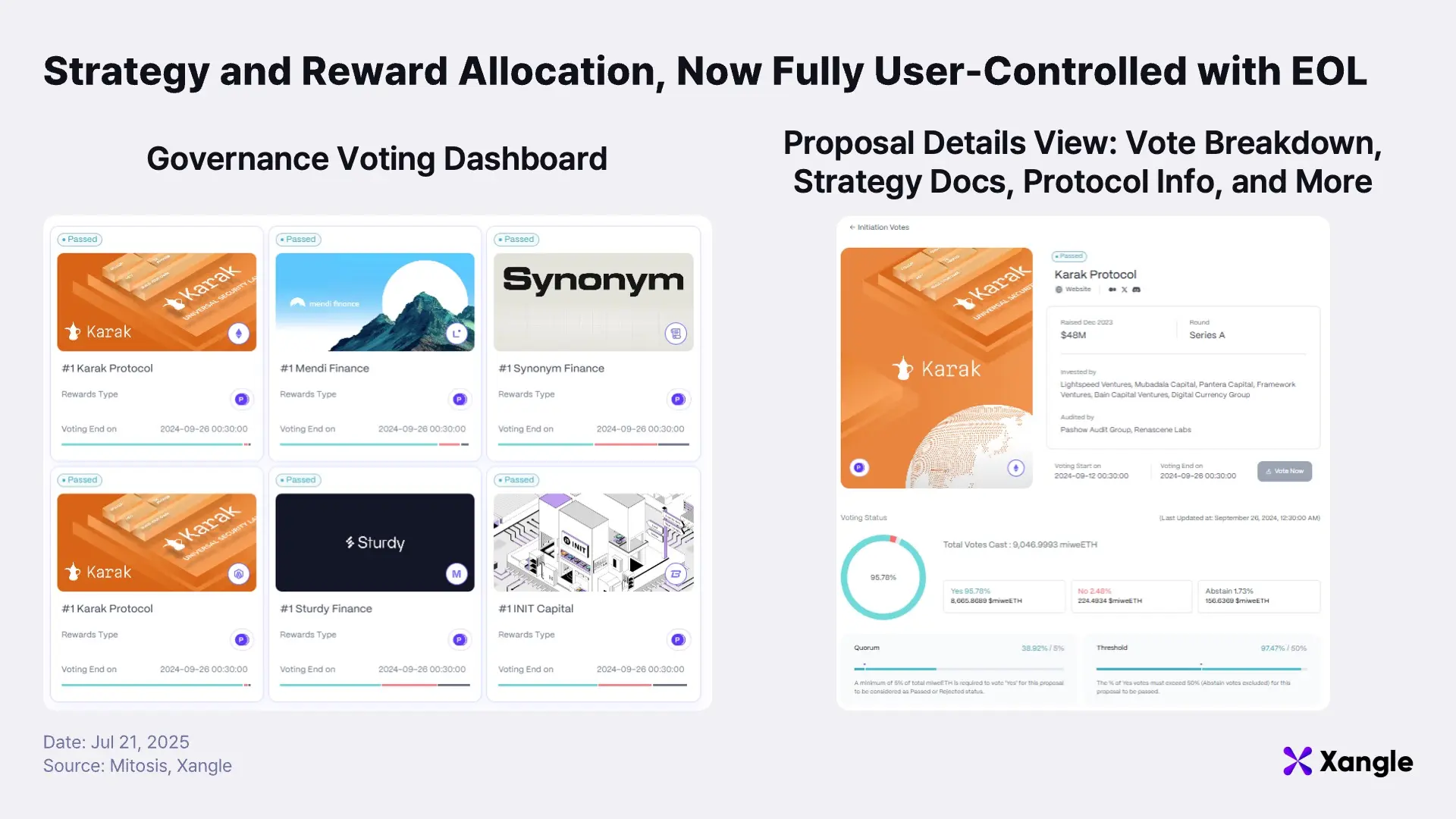
In parallel, Mitosis is preparing to introduce EOL (Ecosystem-Owned Liquidity)—a governance-led framework that allows users not only to participate in strategies, but to propose them and vote on how liquidity should be allocated. EOL is expected to serve as the backbone of Mitosis’s decentralized liquidity management model, shifting control over capital direction from protocol teams to the broader community.
While Matrix and EOL differ in mechanism, both reflect the same underlying philosophy: dismantling structural privilege in DeFi and granting retail users real access to yield opportunities. Mitosis is constructing a system in which users can engage directly in strategy design and reward earning on the same footing as institutions.
3. What Is Mitosis’s Ecosystem Expansion Strategy?
3-1. Securing liquidity through cross-chain expansion
As the DeFi ecosystem evolves into a multi-chain environment, assets have become increasingly fragmented across networks such as Ethereum, Arbitrum, Optimism, Solana, and others. This dispersion has led to a structural problem: liquidity fragmentation. Assets remain siloed on their respective chains, forcing users to navigate complex bridging mechanisms, pay high transaction fees, and assume security risks—while protocols struggle to aggregate the capital needed to sustain their operations.
Mitosis addresses this challenge with an expansion strategy built around cross-chain liquidity integration. The objective is not merely to establish a new deposit-based chain, but to unify asset flows from across chains and protocols into a single, cohesive liquidity layer and interface.
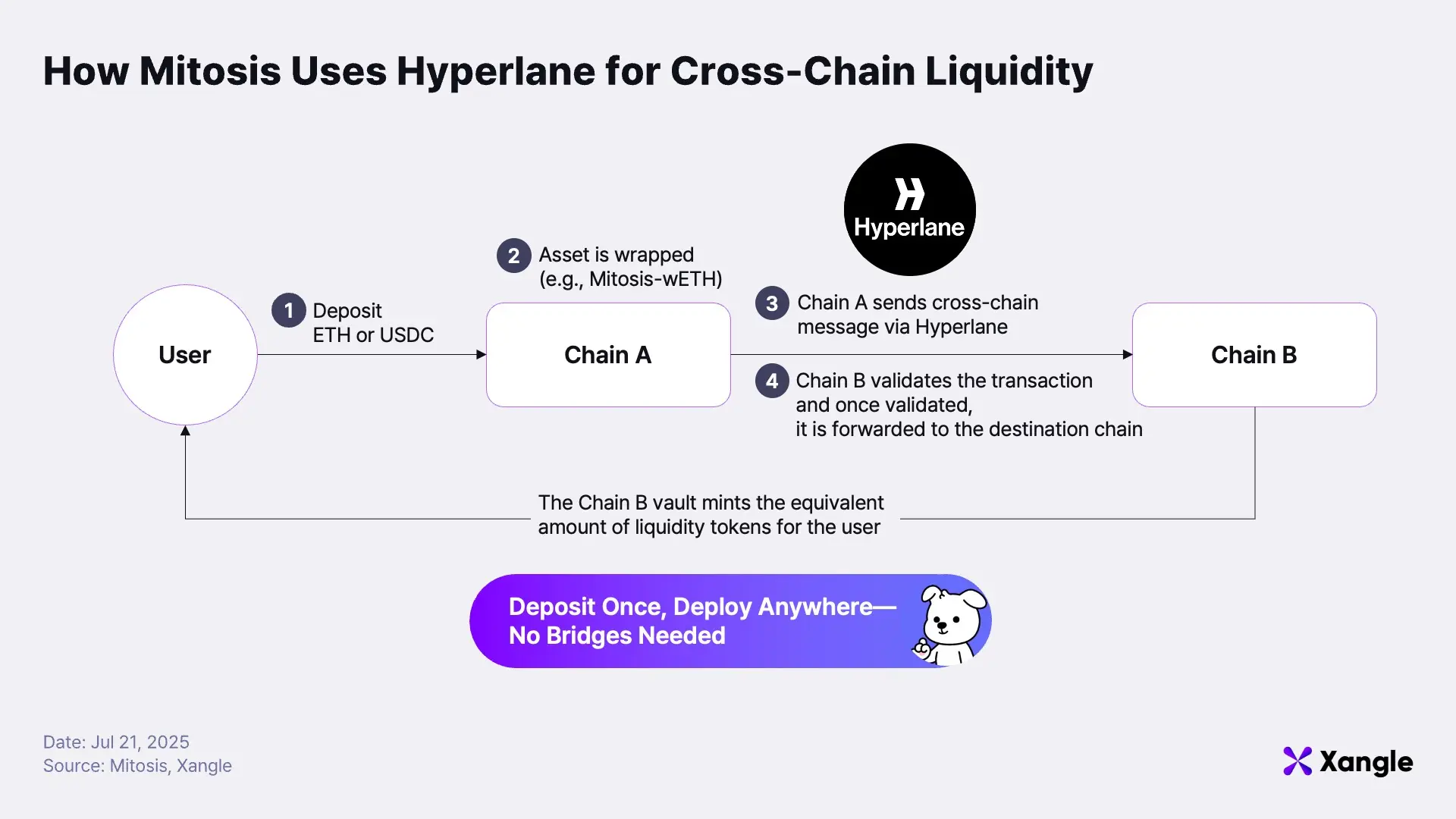
At the heart of this strategy is Mitosis’s integration with Hyperlane, a modular cross-chain messaging protocol selected for its trust-minimized architecture. This setup allows Mitosis to enable cross-chain asset utilization without relying on traditional bridging or wrapping mechanisms. In practice, users can deposit assets into a Mitosis Vault on Ethereum and have that liquidity deployed directly on other chains, such as Arbitrum, Optimism, or Solana, without the assets themselves ever moving. This architecture reframes the concept of cross-chain liquidity: it’s not about asset transfer, but about enabling strategic and capital coordination across networks. For example, liquidity deposited into Ethereum-based Vaults can be tapped and utilized by dApps on other chains, simply by relaying messages via Hyperlane.
Mitosis is also expanding its liquidity funnel through a growing network of ecosystem partners. Collaborations with platforms such as Capsule, Jumper, Hyperlane, and Zerion extend far beyond user interface enhancements. These integrations serve as strategic conduits that route assets directly into the Mitosis hub. Funds deposited via these partners are automatically allocated into Mitosis-native strategies, including Expedition, EOL, and Matrix, allowing users to contribute liquidity without needing to manually navigate between chains or bridges.
This approach marks a deliberate shift from the legacy DeFi model, where liquidity was often locked within siloed ecosystems. Instead, Mitosis is building a system where liquidity is freed from geographic constraints and redeployed across chains wherever it is most productive. This architecture sets the foundation for a unified liquidity network; one that connects disparate chains, protocols, and users under a single, interoperable framework.
3-2. Social capital as liquidity: Introducing Yarm, a social-driven liquidity platform co-built with Kaito
Yarm is a socially-driven liquidity provisioning platform currently incubated by Mitosis in collaboration with Kaito AI. Traditional DeFi has long favored users with large capital reserves, granting them privileged access to high-yield strategies and governance power. Yarm seeks to overturn this paradigm by rewarding not just financial capital, but social influence—empowering community participants and content creators who actively shape narratives and build trust within ecosystems.
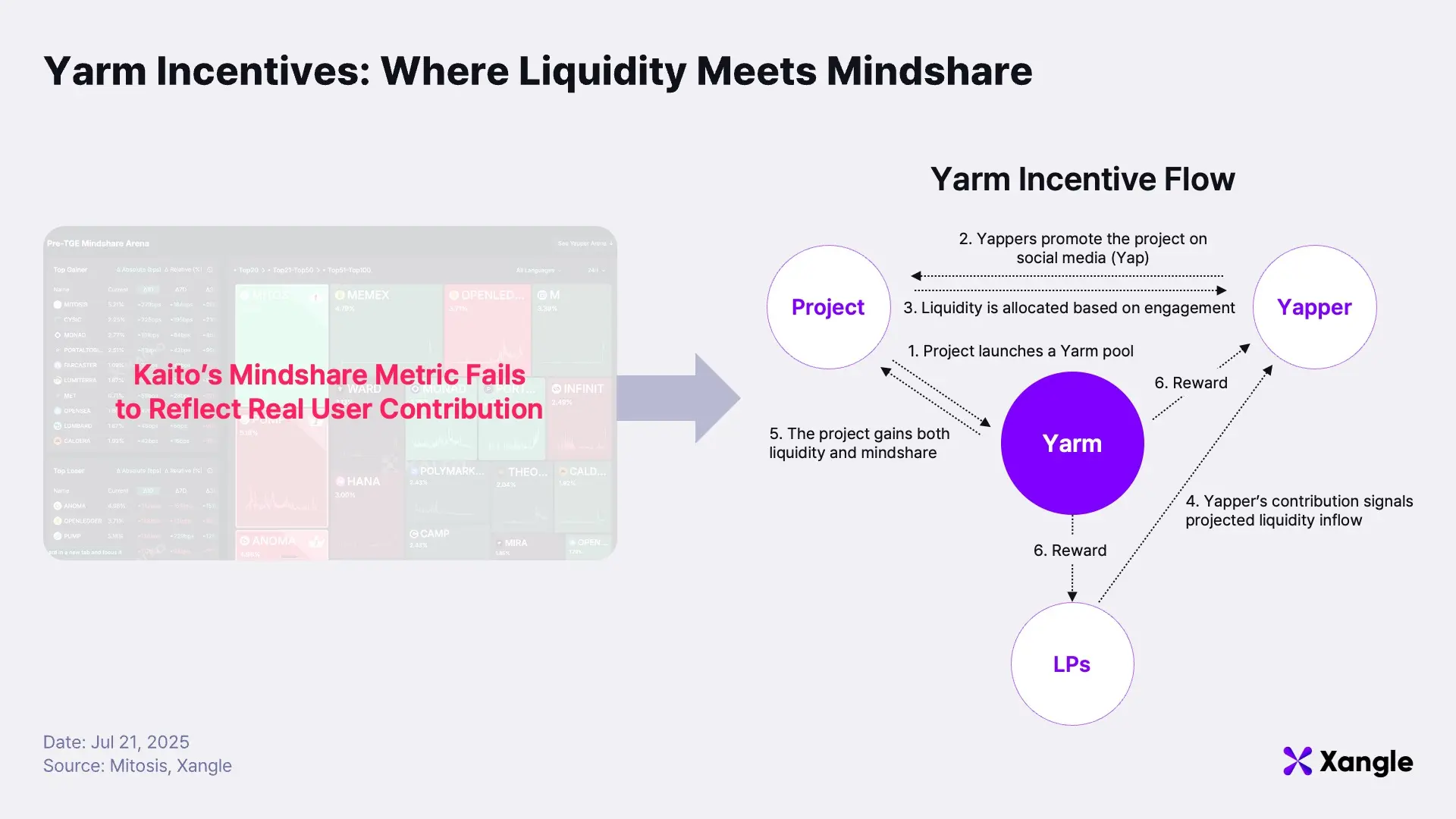
In this model, content creators (referred to as Yappers) are directly linked with liquidity providers on a unified platform. For instance, a user who consistently shares high-quality insights or community posts about a project can accumulate “Mindshare,” a metric quantified through Kaito’s DAX system. Based on their Mindshare score, these users are granted priority allocation rights to participate in project liquidity pools. Liquidity providers, in turn, can choose to stake capital into pools associated with Yappers they trust. A portion of the generated rewards is then distributed back to the respective Yappers. As a result, content transforms from mere communication into a yield-bearing asset class.
A core mechanism behind this model is the Overlap Score, which measures the collective engagement of influential users within the Yarm ecosystem around specific projects. When multiple high-impact Yappers organically promote a project, its Overlap Score increases, raising the incentive pool allocated to participants. This mechanism ensures alignment between liquidity flow and authentic community attention.
Yarm introduces a new level of opportunity for retail users with limited capital. Instead of participating solely through deposits, users can now gain influence and access to high-yield allocations by generating quality content and amplifying project narratives within their networks. In doing so, they move from passive contributors to active stakeholders in the liquidity cycle.
From a project’s perspective, this architecture offers more than capital inflow. It turns users into organic promoters who voluntarily engage in narrative building and user acquisition. Marketing and liquidity provision become two sides of the same coin; interwoven in a system that supports sustainable, bottom-up growth. Ultimately, Yarm redefines user participation, enabling individuals to become not just participants in a product, but true agents of influence.
3-3. The DNA Program: A key to ecosystem expansion and sustainable growth
The early era of DeFi often paired utility tokens with short-term incentives to drive participation. While effective at capturing attention, this model came at the cost of long-term alignment. Users chased the highest APYs; validators focused only on block rewards; developers operated in silos, disconnected from community needs; and liquidity providers were consistently excluded from protocol governance. These misaligned incentives made sustainable growth and governance exceptionally difficult to maintain.
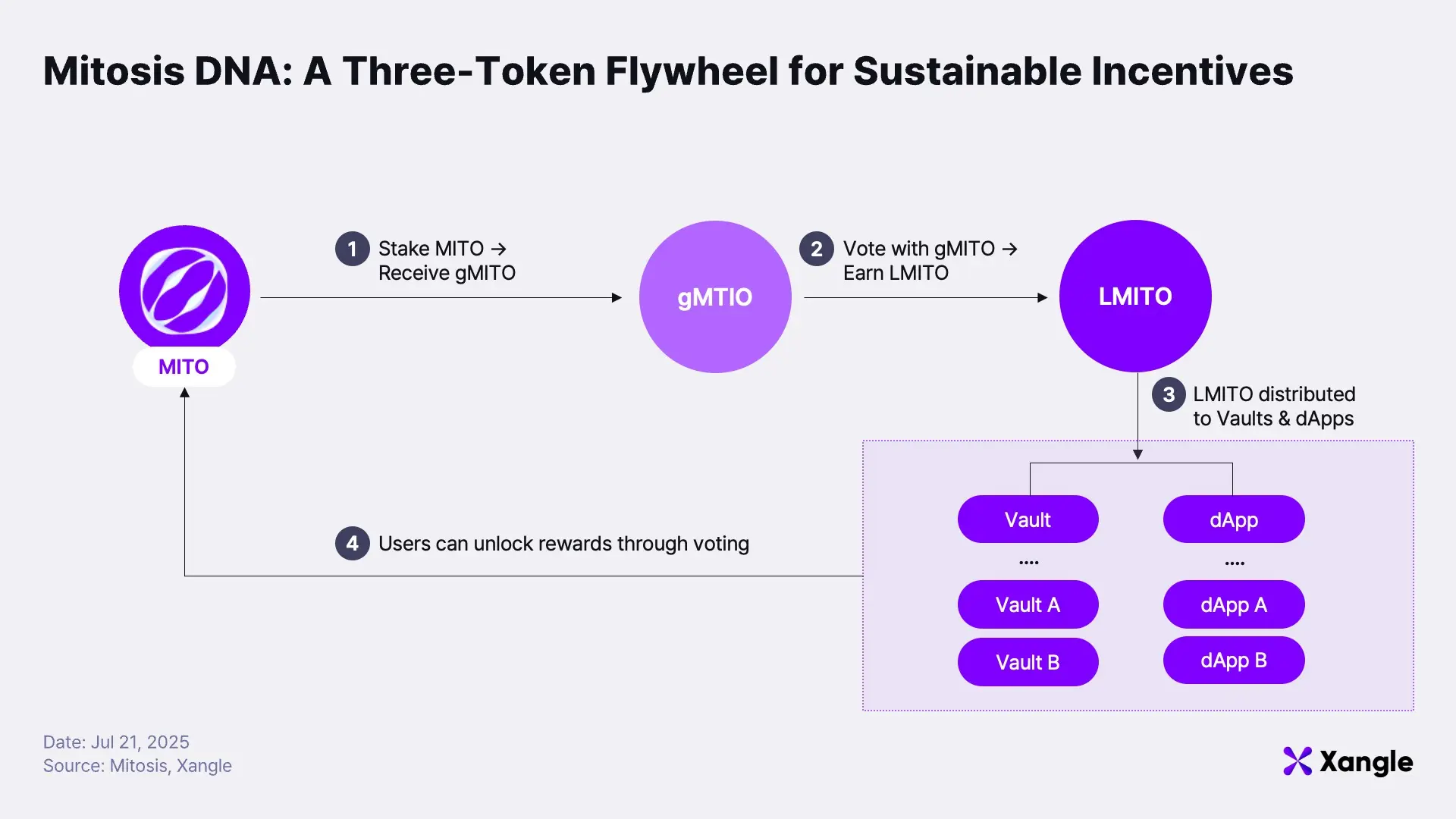
To resolve this fragmentation, Mitosis introduced the DNA Program, a three-token system designed to embed long-term accountability and participatory governance at the core of its ecosystem. The system consists of:
- MITO: The primary utility token, used for staking and paying transaction fees
- gMITO (Governance MITO): A non-transferable governance token earned by staking MITO, granting holders voting rights over critical protocol decisions
- LMITO (Locked MITO): A reward token that unlocks gradually based on governance participation and ecosystem contributions; the more actively users vote with gMITO, the faster their LMITO is released
This design establishes a reinforcing incentive loop—one that ties token unlocks directly to active, long-term participation. gMITO holders can vote on how rewards are distributed across Vaults and dApps, influencing strategic direction and liquidity flows. In doing so, they not only help shape protocol outcomes but also accelerate the unlocking of their own LMITO holdings. This dual incentive structure aligns governance engagement with financial outcomes in a way that strengthens community ownership.
The DNA Program marks a shift away from extractive, short-term behaviors and toward a model grounded in aligned incentives and decentralized execution. By implementing this framework, Mitosis has laid the foundation for a truly decentralized, participation-first ecosystem.
4. Mitosis Is What Comes After
Mitosis is not merely a technical solution addressing isolated inefficiencies in DeFi, it is a structural redesign of how liquidity, access, and participation are organized. By opening up high-yield strategies and exclusive deal flows that were once limited to institutions, and by concentrating liquidity in a unified hub for more efficient deployment, Mitosis establishes a framework where participants of any size can play a meaningful role in the market. In practice, tens of millions of dollars have already flowed into the ecosystem via the Expedition campaign, and the emergence of Matrixand EOL is actively dismantling the legacy of side letter-based privilege.
Where Mitosis is headed suggests a much broader transformation—one that redefines not just how assets are managed, but how liquidity is orchestrated and yields are distributed across chains. As liquid restaking tokens (LRTs) continue to proliferate, a wide range of liquid assets could be layered into the miAsset architecture, enabling the creation of derivative structures that embed both yield potential and underlying utility. This positions Mitosis not just as a yield platform, but as a liquidity infrastructure layer capable of aggregating, optimizing, and redeploying capital across the entire multichain ecosystem.
Expansion is already underway. Beyond existing collaborations with Morph, Theo, Concrete, and Kaito, Mitosis is expected to integrate with a broader array of verticals, spanning restaking protocols, Layer 2 ecosystems, and tokenized real-world assets (RWAs). Notably, Yarm, its social-driven liquidity initiative, offers a new paradigm for decentralized participation where informational value and social capital can operate as functional assets alongside liquidity itself.
Ultimately, Mitosis is not simply enabling broader access to DeFi strategies; it is reclaiming the design authority and negotiation leverage of decentralized finance and returning them to the user. This is not a short-term liquidity capture mechanism, but a long-horizon infrastructure bet on systemic balance and user-led growth. Whether the next wave of dApps, derivative protocols, and social finance experiments will be built atop Mitosis remains to be seen. But if they are, we may be witnessing the foundation of a more equitable and participatory financial architecture.
Appendix: Strategy Guide for Using Mitosis
The Mitosis ecosystem offers more than simple asset deposits—it provides a structure through which users can optimize yields across various dApps. This section outlines a step-by-step walkthrough of real strategies connecting Spindle, Chromo, and Zygo via miAsset. It is designed to help users participating in the Mitosis mainnet campaign (Expedition) find practical and actionable use cases.
1. Acquire miAsset – Participate in Mitosis Expedition
The first step is to participate in the Mitosis Expedition to acquire miAsset.
- Visit https://expedition.mitosis.org
- Deposit supported assets (e.g., weETH, USDT)
- Receive miAsset minted at a 1:1 ratio
- Begin earning MITO points and deploying miAsset across various DeFi strategies
2. Strategy 1 – Leverage Loop Strategy Using Spindle
Spindle is a DeFi protocol forked from Pendle, allowing users to separate principal and yield. Within the Mitosis ecosystem, it enables a leverage loop strategy using miAsset as collateral.
Execution Steps:
- Deposit miAsset as collateral on Spindle
- Borrow stablecoins against the collateral
- Swap the borrowed stablecoins for miAsset or maAsset via Chromo
- Re-deposit into Spindle to expand your position (loop)
- Repeat to compound returns and maximize DNA incentives
3. Strategy 2 – Earn Swap Fees and Incentives by Providing Liquidity on Chromo
Chromo is Mitosis’s native AMM. By providing liquidity in the miAsset-maAsset pair, users can earn:
- Swap fee revenues
- Incentive rewards from the DNA program
Execution Steps:
- Access Chromo and navigate to the Pool section
- Select and deposit into the miAsset-maAsset pool
- Confirm LP token receipt and track rewards via dashboard
- Rewards accrue in real-time and are linked to point systems
4. Strategy 3 – High-Leverage Trading on Zygo, a Native Perp DEX
Zygo is a Mitosis-native perpetual DEX (Perp DEX) that utilizes EOL-based liquidity to enable gasless, high-leverage trading.
Execution Steps:
- Access Zygo DEX (coming soon)
- Select desired trading asset (e.g., ETH, BTC), choose long or short
- Choose your preferred leverage ratio
- Monitor PnL and close positions accordingly
5. Combining Strategies for Optimized Yield
While the three strategies can be used independently, they can also be combined to design a more robust and diversified yield model:
- Use Spindle to apply leverage → redeploy capital via Chromo → simultaneously trade with leverage on Zygo
- Combine Chromo LP income with Zygo hedging strategies for risk mitigation
Disclaimer
I confirm that I have read and understood the following: The information contained in this article is strictly the opinions of the author(s). This article was authored free from any form of coercion or undue influence. The content represents the author's own views and does not represent the official position or opinions of CrossAngle. This article is intended for informational purposes only and should not be construed as investment advice or solicitation. Unless otherwise specified, all users are solely responsible and liable for their own decisions about investments, investment strategies, or the use of products or services. Investment decisions should be made based on the user’s personal investment objectives, circumstances, and financial situation. Please consult a professional financial advisor for more information and guidance. Past returns or projections do not guarantee future results. This article was written at the request of Mitosis. All content in this article was written independently by the author(s), and neither CrossAngle nor Mitosis had any editorial control or influence over the content. The author(s) may hold the cryptocurrencies mentioned in this article at the time of writing.
Xangle or its affiliated partners own all copyrights of the written or otherwise produced materials and content provided on the platform. Any illegal reproduction of such content, including, but not limited to, unauthorized editing, copying, reprinting, or redistribution will result in immediate legal actions without prior notice.
![[CIS Partner Summit Highlights] Ault's Financial Super App Strategy: OnlyBulls](https://resource.xangle.io/files/content/C1A19E1DB41B7FB86076143803C40D8E_1790125531662.webp)

![[Xangle RWA Series] Solana RWA: A Look at the Key Players](https://resource.xangle.io/files/content/F779A005246C0299246537AACB3A39F2_1782287059970.webp)