Shelby Drives New Momentum for the Aptos Ecosystem


Table Of Contents
1. The Missing Piece, A Real-Time Data Layer
2. Shelby Transforms Data into a Real-Time Active Asset
2-1. Clay Code: Delivering Web 2-grade efficiency in Web3 storage
2-2. Solving data bottlenecks with micropayment channels and dedicated high-speed networks
2-3. Enhancing data quality through usage-based incentives
3. Shelby's Role in Driving Aptos Ecosystem Expansion
3-1. Aptos set to power high-performance decentralized applications—Enabled by Shelby
3-2. The $Shelby token could become a catalyst for Aptos ecosystem growth
4. Challenges Ahead – Ensuring On-Chain and Off-Chain Synchronization and Improving the Deposit-Based Payment Model
1. The Missing Piece, A Real-Time Data Layer
We currently live in an era where data is frequently described as “the new oil.” Particularly in the age of artificial intelligence, data significantly enhances algorithms and services, generating substantial added value. However, a major issue remains: the concentration of vast amounts of data within a small handful of dominant Web2 platforms, such as Google and Facebook. Although Web3 and blockchain technology have emerged as promising solutions, current blockchain architectures inherently require the redundant storage of data across dozens or even hundreds of nodes, rendering them unsuitable for efficiently managing large datasets. For example, even a relatively simple NFT profile image is impractical to store directly on the Ethereum blockchain, as it would be highly inefficient and prohibitively costly for thousands of Ethereum nodes to redundantly store identical image files. To circumvent this limitation, images are typically stored on IPFS, with NFTs merely containing links to these IPFS addresses a workaround reflecting blockchain’s current data storage limitations.
Decentralized storage protocols such as Arweave and Filecoin were introduced to address these constraints, and recent attention has again shifted toward this sector following the launch of the Walrus project on the Sui blockchain. Arweave and Filecoin have already achieved meaningful adoption, storing approximately 315TiB and 1,500PiB of data, respectively. Nevertheless, existing decentralized storage protocols continue to struggle significantly when it comes to rapid data retrieval and real time utilization. Applications such as video streaming and AI inference, which require rapid access to large datasets, demand low latency and high bandwidth performance standards that current decentralized storage solutions consistently fail to meet. Consequently, many Web3 applications still rely heavily on centralized cloud infrastructure or RPC services, resulting in the ongoing capture of data generated economic value by established Web2 platforms.
Recognizing these structural limitations, Aptos Labs has developed its own decentralized storage protocol aimed at facilitating more efficient operations for services built on its Aptos blockchain: the Shelby project. Shelby leverages Aptos’s high-performance Layer 1 chain to implement a real time hot data storage system and introduces an innovative incentive mechanism focused explicitly on incentivizing data reading. This approach transforms data from a mere static storage object into a dynamic asset that can be streamed, served, and monetized in real time, effectively activating its inherent economic value. This initiative is led by Aptos’s Head of Infrastructure, Pranav Raval, who previously spearheaded large scale data processing at Meta. It can be inferred that the Aptos infrastructure team, under Raval’s leadership, designed this decentralized storage protocol leveraging their extensive prior experience in handling massive datasets at Meta, where scalability and data efficiency were crucial.
This report seeks to elucidate the motivations behind Aptos’s development of Shelby as a decentralized storage protocol, explore how Shelby processes and manages data, and highlight the technological distinctions that set it apart from existing decentralized storage solutions.
2. Shelby Transforms Data into a Real-Time Active Asset
To enable rapid access to large datasets, Shelby integrates Clay Code based erasure coding, an off chain micropayment channel system, a dedicated high speed network, and a read centric incentive model.
2-1. Clay Code: Delivering Web 2 grade efficiency in Web3 storage
Shelby provides the durability and efficiency typically associated with Web2 cloud services, but within a Web3 context, thereby enabling real time data utilization. Achieving Web2 level performance is critical, as it directly addresses the performance bottlenecks that current decentralized storage solutions have struggled to overcome. Shelby achieves this breakthrough by integrating three critical elements: Clay Code based erasure coding, a Merkle Tree commit structure, and seamless interoperability with the Aptos blockchain.
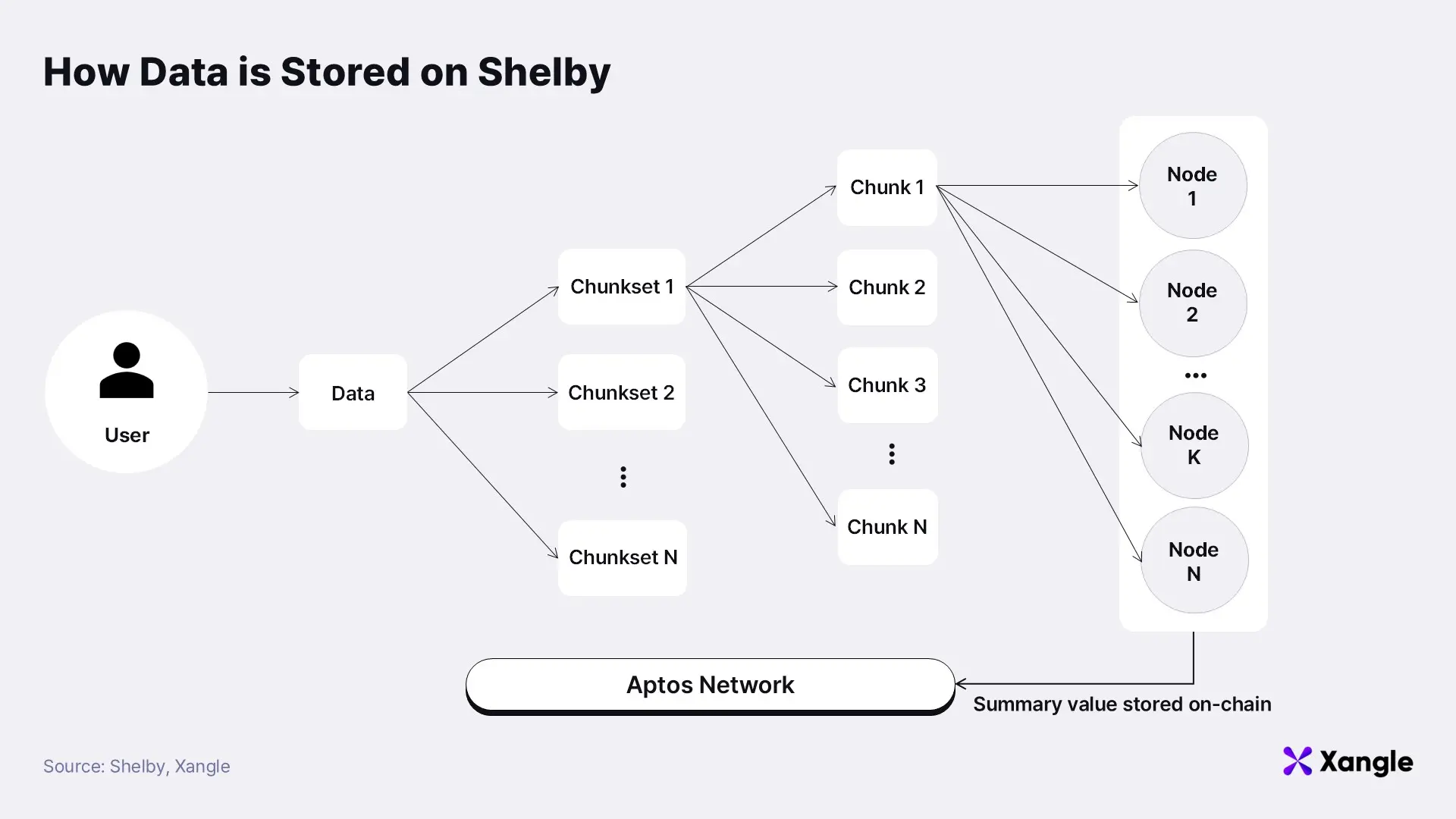
When users upload data such as images, videos, or documents it is initially processed as a complete file unit called a blob. Each blob is then subdivided into smaller groups known as chunksets (approximatelyd 10MiB each), which are further segmented into individual chunks (roughly 1MiB in size). These chunks undergo Clay Code encoding and are subsequently distributed across multiple nodes operated by Storage Providers (SP). Crucially, this distribution ensures that even if certain fragments are lost or unavailable, the original data can still be fully restored without disruption.
Clay Code operates by splitting data into k fragments and then encoding them into a larger set of n fragments (n > k) for distributed storage across nodes. A key advantage of this approach is that any subset of k fragments out of the total nfragments is sufficient to reconstruct the original dataset fully. Moreover, Clay Code incorporates an optimal recovery path, enabling nodes to retrieve only necessary fragments in a precisely optimized sequence, rather than collecting all kfragments at once. Due to the sophisticated design of fragment relationships, Clay Code reduces the bandwidth required for data recovery by up to 60% compared to traditional methods requiring retrieval of all k fragments simultaneously.
Stored chunks are cryptographically summarized using a structure known as a Merkle Tree, providing definitive proof that the entire dataset is securely stored. In simple terms, the Merkle Tree compresses information from all chunks into a single representative value called a root hash. This root hash is permanently recorded on the Aptos blockchain, ensuring immutability. Subsequently, if verification of data existence or integrity is required such as confirming the data remains unaltered or is still accessible a rapid validation process is achievable by referencing only the root hash and a small subset of chunk fragments. In this architecture, Clay Code handles distributed storage and efficient recovery, the Merkle Tree ensures data integrity, and the Aptos blockchain provides an immutable record for verification.
In summary, the integration of Clay Code, Merkle Trees, and the Aptos blockchain forms Shelby’s technological foundation, allowing it to deliver a storage service that is both reliable and economically viable within a Web3 environment. Thanks to this sophisticated combination, Shelby achieves Web2 level durability of 99.999999999% (eleven nines) and an availability of 99.9% while maintaining a storage overhead of less than double the original data size. Consequently, Shelby significantly surpasses competing decentralized storage solutions in terms of storage efficiency and recovery costs.
2-2. Solving data bottlenecks with micropayment channels and dedicated high-speed networks
Shelby is more than just a data storage solution it is specifically engineered with an optimized architecture to facilitate rapid response times and efficient data access in real time. Central to achieving this capability are its micropayment channels, which handle fast, low-value payments, and its dedicated Fiber Network infrastructure, which ensures swift transmission of large scale data with minimal latency.
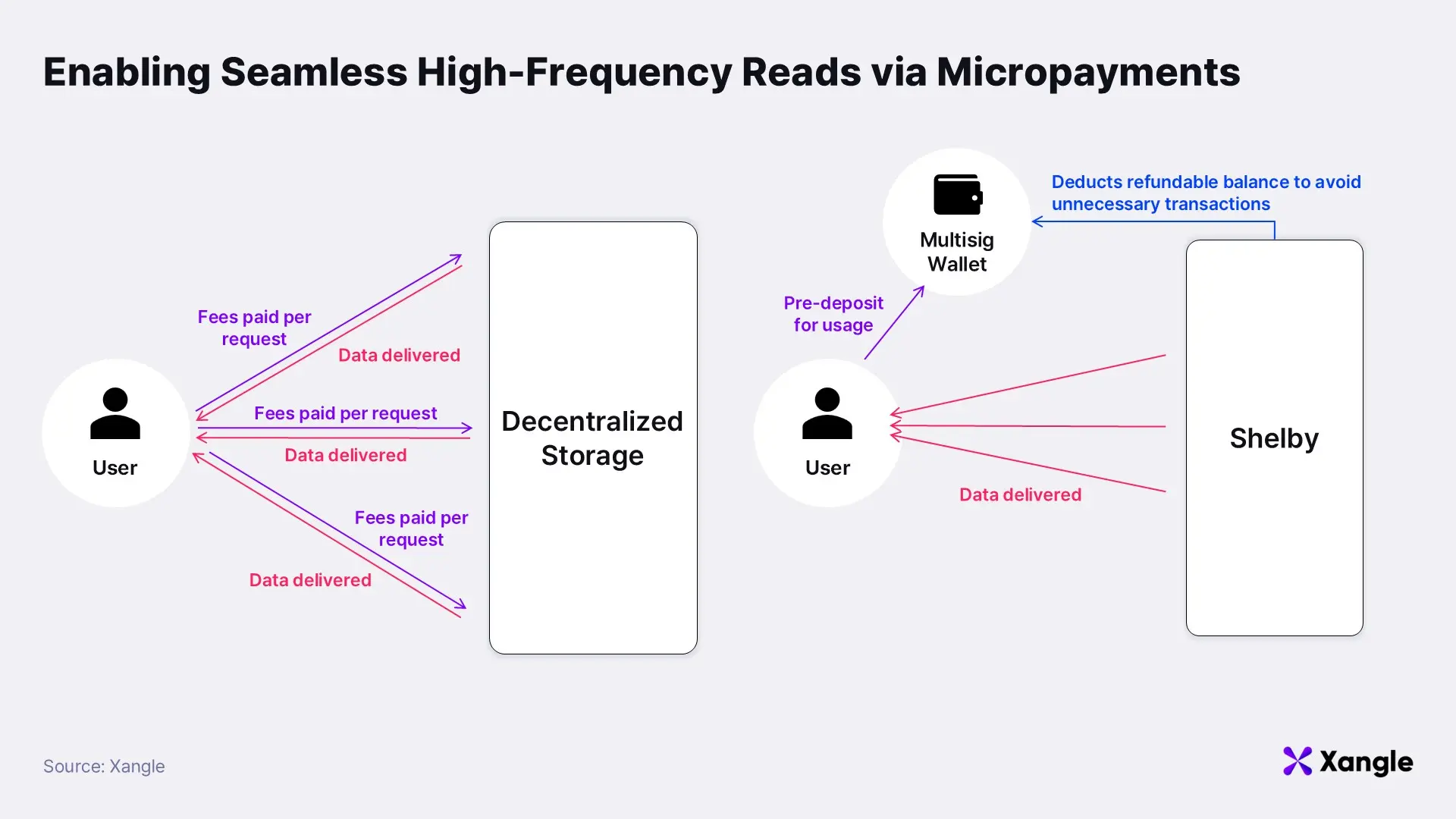
When users wish to access specific datasets, a dedicated micropayment channel is first established between the requesting user and the RPC node responsible for delivering the data. Transactions within this channel are recorded on chain exclusively at two critical points: upon initial channel establishment and at final settlement. All interim payments occur swiftly off chain. Users deposit a certain amount of funds into a multisignature escrow account, gradually decreasing their refundable balance with each data retrieval. Since this method eliminates the need to record each transaction on chain, high frequency data requests can be processed without incurring significant latency or additional gas fees. Settlement upon channel closure utilizes the most recent signed balance, ensuring the process remains secure and trustworthy, even in low-trust environments.
Shelby further distinguishes itself through its dedicated high-speed networking infrastructure. Unlike conventional Web3 services reliant on the public internet, Shelby directly links its Storage Providers (SPs) and RPC nodes via a specialized Fiber Network, effectively mitigating data transmission bottlenecks. This dedicated connectivity enables immediate data transfer upon user requests, delivering an experience comparable to established Web2 cloud services. Such an advanced network design excels in supporting data-intensive use cases such as real-time media streaming, AI inference tasks, and high-frequency database queries, all demanding exceptional reliability and throughput.
Collectively, Shelby’s carefully engineered payment structures and optimized data transmission channels establish an environment for efficient, stable, and high-performance data retrieval. Thus, Shelby transcends a conventional storage system, emerging instead as a purpose-built Web3 data infrastructure capable of supporting real-time services and analytics-focused applications with high-frequency data requirements.
2-3. Enhancing data quality through usage-based incentives
At the core of Shelby’s architecture is its unique "read-based incentive model," which advances beyond traditional models that reward data providers solely for storage. Instead, Shelby generates tangible economic value each time data is actively accessed. This shift redefines the objective of data storage from mere preservation to active utilization, effectively minimizing idle datasets and strategically channeling network resources toward more economically meaningful and practical uses.
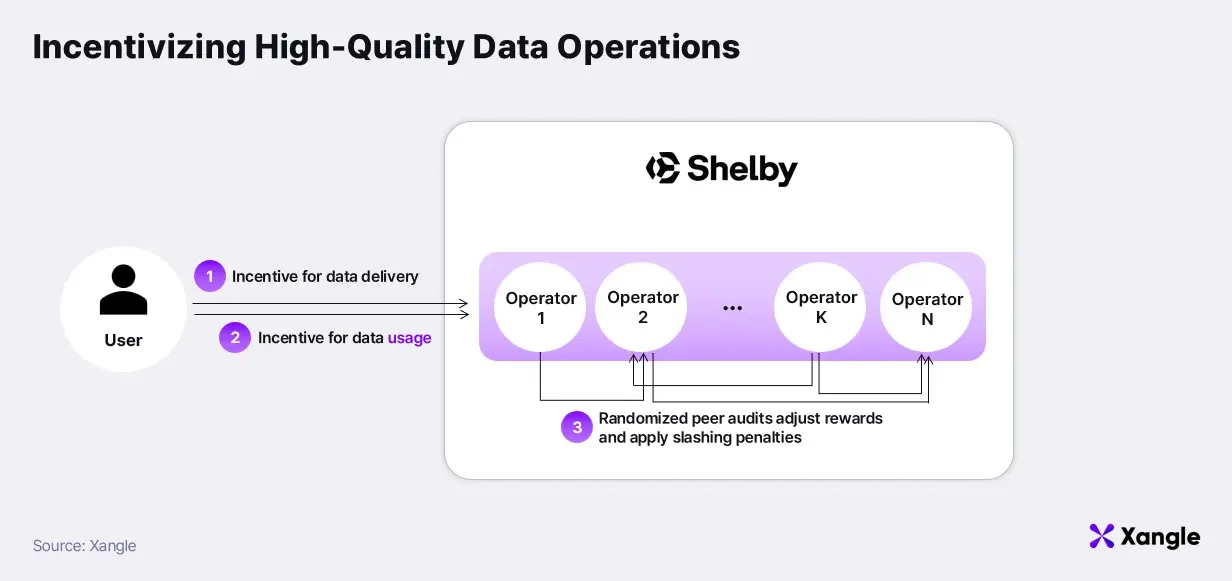
As previously described, users pay incrementally for data retrieval by reducing their refundable channel balance with each data access. Funds collected during this process are then allocated proportionally to the RPC nodes facilitating the data transfers and the Storage Providers responsible for storing that data. The more frequently data is accessed, the greater the reward earned by the respective SP. Conversely, data that remains unused generates no economic returns. This "pay-per-read" incentive structure motivates SPs to store data that is demonstrably useful and frequently requested.
Beyond rewarding useful data storage, Shelby’s incentive structure also prioritizes verifiable and honest data retention. SPs routinely participate in off-chain audits to validate each other’s data integrity by randomly requesting specific data chunks to confirm their availability. Summarized results from these audits are periodically submitted to the blockchain, and a subset of these submissions is randomly selected for further on-chain validation. If discrepancies are discovered during these on chain validations, the offending SP may face penalties, including slashing. Conversely, accurate responses and diligent audit participation are positively reflected in audit scores, influencing future reward distributions.
By harmoniously integrating usage-based incentives with audit-based accountability, Shelby selectively rewards nodes that not only store data reliably but also promptly deliver genuinely useful datasets and transparently demonstrate their integrity. Consequently, SPs have multiple revenue streams: foundational compensation for providing storage capacity, read-driven revenue linked to actual data usage, and rewards for verifiable storage integrity. This multifaceted incentive system positions Shelby as more than just decentralized storage it firmly establishes its identity as a sophisticated, real-time data distribution network. Shelby’s strategic design uniquely blends the security assurances inherent to Web3 with the performance standards typical of Web2, poised especially to thrive in an era where AI driven applications rely heavily on data quality as a critical determinant of service performance.
3. Shelby's Role in Driving Aptos Ecosystem Expansion
3-1. Aptos set to power high-performance decentralized applications Enabled by Shelby
The recent surge in demand for high performance decentralized applications has driven corresponding growth in the need for robust data infrastructure capable of supporting them. Applications such as AI inference systems (e.g., Retrieval Augmented Generation, or RAG), high frequency trading platforms, and media streaming services require much more than basic storage capacity; they demand consistent real time data accessibility and predictable performance. Indeed, the challenge of decentralized handling of massive datasets remains one of the primary obstacles to the emergence of truly decentralized equivalents to platforms like YouTube.
Within this context, Shelby has garnered significant attention as a decentralized storage solution that successfully combines Web2 level read performance with stringent security guarantees. At the foundation of this technological achievement is the Aptos blockchain itself. Aptos is equipped with an ultra high speed block pipeline and a Block STM parallel execution engine, providing transaction finality in under 600 milliseconds, throughput surpassing 30,000 transactions per second, ultra low transaction fees (approximately $0.000005), and the flexibility of logic implementation enabled by the Move programming language. These attributes collectively provide the robust on chain infrastructure necessary for Shelby to efficiently manage real time data streaming and dynamic reward settlements.
Consequently, Shelby moves beyond the scope of a simple decentralized storage provider. Instead, it establishes itself as essential infrastructure enabling the stable operation of high-performance decentralized applications within the Aptos ecosystem. Prominent Aptos dApps such as Noctra AI, Hyperion, and Mereo already handle data intensive workloads across AI, trading, and media verticals. Their requirements for rapid data retrieval and real-time incentive frameworks align exceptionally well with Shelby’s architecture.
Should Shelby succeed in empowering these teams to deploy high-performance Web3 services without dependency on centralized servers, Aptos could evolve from being merely a fast blockchain into a leading hub for performance driven decentralized applications. In doing so, it could become a foundational platform making true decentralization a practical reality. Moreover, the presence of Shelby could organically attract additional external projects with similar infrastructure needs, thereby generating substantial and sustained momentum for both quantitative and qualitative expansion of the Aptos ecosystem.
3-2. The $SHELBY token could become a catalyst for Aptos ecosystem growth
The launch of the Shelby project is expected to generate considerable anticipation around its native token, $Shelby. Decentralized storage protocols represent an area of rapidly increasing technical importance and user demand, and comparable projects tend to command high Fully Diluted Valuations (FDVs). As of June 30, 2025, Filecoin has an FDV of approximately $4.4 billion, while Walrus is valued at roughly $2 billion. Against this backdrop, Shelby’s entry into the market is poised to serve as more than just another storage protocol launch; it could become a pivotal trigger that significantly stimulates activity across the broader Aptos ecosystem. Notably, if Shelby allocates a relatively large airdrop compared to peer protocols, this could strongly influence user acquisition and engagement growth.
To better understand Shelby’s potential impact, consider the recent example of Walrus (WAL) on the Sui blockchain, another Move based platform similar to Aptos. WAL conducted a large scale airdrop aimed primarily at testnet participants and significant contributors to the Sui ecosystem, allocating 4% of its total token supply in an initial distribution. Based on Walrus’s FDV of approximately $2 billion, this amounted to an airdrop worth around $80 million. As a result, numerous participants realized substantial gains. The highest single recipient received 100,000 WAL tokens, valued at approximately $40,000 as of June 30, 2025. Additionally, roughly 1,000 accounts received between 20,000 and 99,000 WAL tokens each, with individual rewards ranging in value from $8,000 to $39,999.
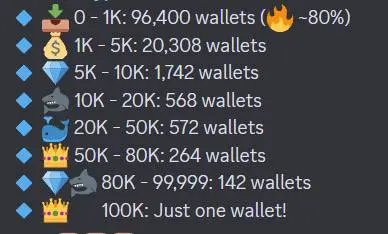 Source: X(@MrBreadSmith)
This airdrop event had a tangible positive impact on the broader Sui ecosystem. Transaction volumes and daily active user counts surged significantly during the WAL airdrop period. Furthermore, within five days surrounding the WAL Token Generation Event (TGE), the price of SUI rose by approximately 20%. Indeed, Sui recorded its highest daily active addresses and transaction counts of the entire year in the immediate aftermath of this event. This case clearly demonstrates how a decentralized storage protocol can extend its influence beyond individual success, driving heightened activity levels and asset valuations throughout the entire blockchain ecosystem.
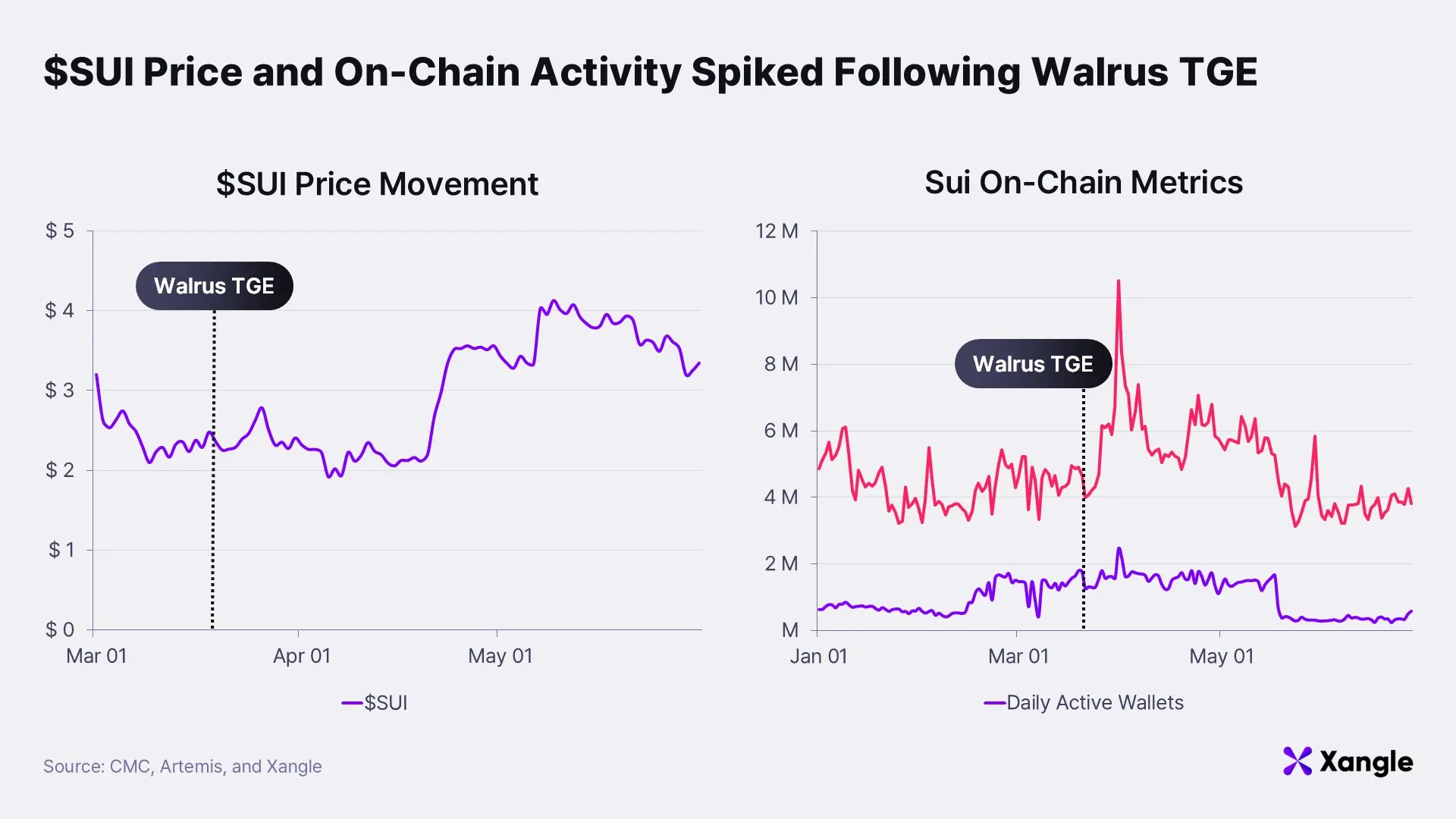
Shelby possesses similar potential to generate comparable momentum within the Aptos ecosystem.
By delivering Web2-grade storage performance and a usage centric incentive model, Shelby aspires to revolutionize decentralized data infrastructure not simply offering decentralized storage capacity but fundamentally redefining usability and economic viability. Importantly, Shelby’s economic model is structured around sustainable revenue derived from actual data utilization rather than short lived hype around airdrop distributions, thereby tightly integrating tokenomics with protocol operations. Consequently, Shelby has the potential to equal or possibly exceed the ecosystem wide impact currently seen in leading storage solutions such as Filecoin and Walrus.
Additionally, the timing of Shelby’s launch aligns well with Aptos’s imminent Token Generation Events for several significant DeFi protocols. In this context, Shelby’s debut could produce meaningful synergistic effects, amplifying overall ecosystem activity. Although Aptos has faced criticism in the past for insufficient incentives aimed at ecosystem participants relative to competing chains, the launch of Shelby may mark a significant turning point. This development has the potential to strengthen Aptos’s user base significantly and foster a more engaged, active community moving forward.
4. Challenges Ahead – Ensuring On-Chain and Off-Chain Synchronization and Improving the Deposit-Based Payment Model
Shelby operates on a distributed architecture, necessitating seamless coordination between on-chain smart contracts (hosted on Aptos) and off-chain nodes, such as RPC nodes and Storage Providers (SP). In systems where multiple components function independently yet interdependently, precise synchronization of activities and outcomes is crucial to maintaining overall system reliability and performance. For instance, when SPs store data or generate audit reports, these outcomes must be accurately and promptly reflected on the Aptos blockchain to ensure correct reward distribution and proper enforcement of penalties (such as slashing).
This synchronization process, however, poses significant challenges. While core actions such as data storage and verification occur off-chain, critical state changes, including reward calculations and audit logs, are recorded on-chain. Data loss or delays occurring during the transmission between off-chain and on-chain layers could result in erroneous reward distributions and negatively affect network reliability. Consequently, ensuring rapid and stable operation of RPC nodes, SPs, and smart contracts, alongside maintaining the high performance Fiber Network infrastructure connecting these components, is of paramount importance.
Therefore, Shelby’s architecture is not merely complex; it requires careful timing and extreme accuracy across the entire operational landscape. Meeting both high performance and reliability standards demands meticulous system-wide coordination and robust operational safeguards.
An additional challenge arises from Shelby’s current payment structure. To initiate data retrieval, users must first deposit a specific amount of funds into an escrow account, from which their refundable balance is gradually deducted with each data request. Although this method efficiently facilitates frequent micropayments, it introduces potential friction, as users are required to complete a deposit process upfront. Such a structure could pose barriers to initial user adoption and negatively impact overall user experience.
Nevertheless, Shelby remains in an early developmental stage, and structural challenges such as these are expected to be progressively addressed through continuous enhancements. Key areas anticipated for ongoing improvement include streamlining the payment flow to enhance user experience, ensuring greater stability in on-chain and off-chain synchronization, and automating operational processes. Consequently, a thorough assessment of Shelby’s practical applicability and broader ecosystem impact will require ongoing observation of its technological advancements and maturation over time.
Disclaimer
I confirm that I have read and understood the following: The information contained in this article is strictly the opinions of the author(s). This article was authored free from any form of coercion or undue influence. The content represents the author's own views and does not represent the official position or opinions of CrossAngle. This article is intended for informational purposes only and should not be construed as investment advice or solicitation. Unless otherwise specified, all users are solely responsible and liable for their own decisions about investments, investment strategies, or the use of products or services. Investment decisions should be made based on the user’s personal investment objectives, circumstances, and financial situation. Please consult a professional financial advisor for more information and guidance. Past returns or projections do not guarantee future results.
Xangle or its affiliated partners own all copyrights of the written or otherwise produced materials and content provided on the platform. Any illegal reproduction of such content, including, but not limited to, unauthorized editing, copying, reprinting, or redistribution will result in immediate legal actions without prior notice.
![[CIS Seoul Partner Summit] Chainlink: Connecting Traditional Finance to the Onchain Economy](https://resource.xangle.io/files/content/8EB9A253149E878D527C131761401276_1791965386210.webp)
![[CIS Partner Summit Highlights] Sumsub: AI-Powered Trust Infrastructure for Digital Asset Businesses](https://resource.xangle.io/files/content/746AECF01E9094566488AD287BDF5977_1789025319904.webp)